Since launching Insider’s Insights in 2013, we have practiced its conviction that practical, experience‑driven knowledge should be accessible to all who work in and care about our industry. What began as a small series of guidance notes for clients, colleagues, and peers has grown into a library shaped by 18 years of hands‑on industry experience, real project learnings, and the collective wisdom of our team. Today, we are delighted to announce that as of now, the entire collection is now freely available on our website—no barriers, no paywalls, just open access for the community we serve.
Over the years, Insider’s Insights have explored a wide range of topics, from the fundamentals of clinical study conceptwriting to the craft of designing professional posters. Each guide distils essential principles from leading scientific publications and regulatory standards, including foundational documents such as the ICH E3 guideline on clinical study report structure and content, which has shaped global expectations for CSR quality since 1995 [1]. We pair this with the lived experience of our writers and consultants, creating resources that are both authoritative and immediately useful. Every edition also includes a brief interview with a seasoned Niche practitioner, offering readers a window into how experts apply these principles in real‑world settings.
To make this knowledge even easier to access, we have brought all past and current editions together in one place, a single, searchable hub where readers can browse, download, and revisit the full library whenever they need it. Visitors can also register to receive new issues as they are released and suggest topics they would like us to cover in future editions. This reflects our long‑standing belief that learning is a shared endeavour, strengthened by dialogue with the community.
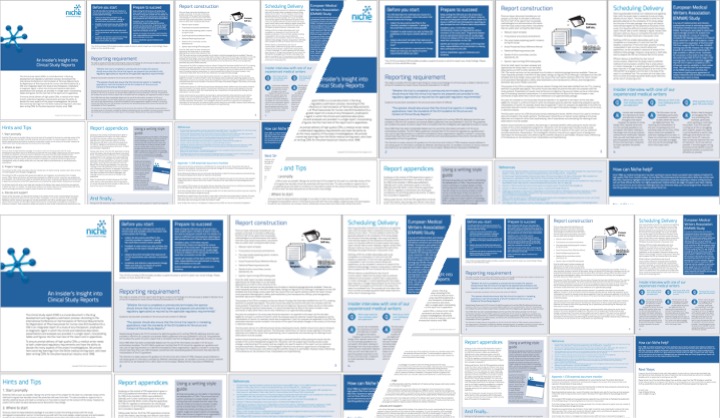
This month, we are re‑releasing one of our most popular resources: the updated Insider’s Insight on Clinical Study Report Writing. The new edition incorporates recent changes in guidelines and draws on insights from respected professional writing bodies, building on the foundations established by long‑standing standards such as ICH E3 [2]. Authored by our Head of Medical Writing, Dr Justin Cook, the guide reflects his 18+ years of medical writing experience and more than a decade spent training teams to produce first‑class CSRs. It is designed not just to inform but to serve as a practical reference document—the kind readers will want to keep close at hand for future projects.
Looking ahead, several new issues are already in development. Upcoming topics include making killer slide presentations, avoiding plagiarism, a subject long recognised as a core element of research integrity [3], and navigating the EU Clinical Trial Application process, an area shaped by evolving regulatory expectations and structured submission pathways [4].
We invite you to explore the full library, revisit old favourites, and discover new guidance that supports your work. We are open to suggestions as to how we can improve our offerings. Register today to ensure you never miss a future release, and please do share your suggestions for topics you’d like us to add to our growing repertoire. Knowledge moves the industry forward, and we’re proud to keep that knowledge open to all.
References
- International Conference on Harmonisation. Structure and Content of Clinical Study Reports E3. 1995.
- European Medicines Agency. ICH E3: Structure and Content of Clinical Study Reports – Scientific Guideline. 1996.
- Zimba O, Gasparyan AY. Plagiarism detection and prevention: a primer for researchers. Reumatologia. 2021;59(3):132–137.
- Central Committee on Research Involving Human Subjects (CCMO). Clinical Trial Application (CTR): From Start to Finish.