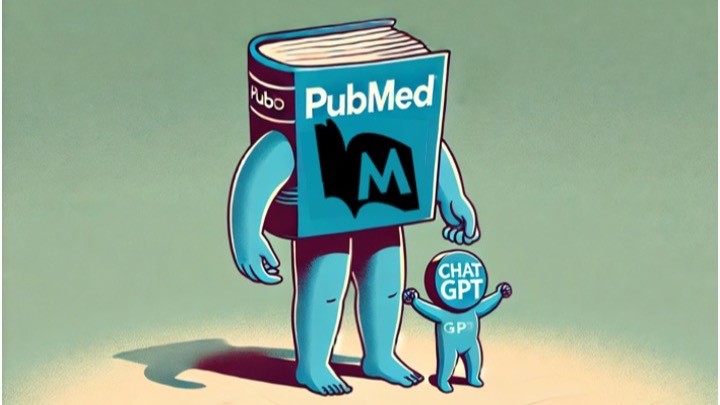
The role of artificial intelligence (AI) in scientific research and public health has been widely debated, with proponents hail it as a revolutionary force [1]. However, despite advances in AI-driven technologies, its contributions to major medical breakthroughs remain somewhat limited compared to the impact of traditional research methodologies. While AI is used for administrative efficiencies (e.g., automating paperwork or streamlining patient triage), as yet there is little evidence that LLMs have directly improved patient survival rates, treatment outcomes, or reduced medical errors. There is no doubt this will come but for now the hype is all about promise.
In contrast, we tend to overlook what has been one of the most significant resources in biomedical research for the last 30 years is the National Library of Medicine’s (NLM) PubMed database. This repository has played an indispensable role in advancing medicine by providing comprehensive access to peer-reviewed literature. Before PubMed, access to medical literature was limited to physical libraries and expensive subscriptions, creating barriers for researchers and clinicians, particularly in low-resource settings [2]. I expect few people miss the days of scouring monthly releases of Index Medicus (I suspect there aren't that many of us left in research from those days).
Since it was established in 1996, it has become the backbone of medical research by aggregating over 35+ million citations and enabling free access to peer-reviewed knowledge. When it was originally set up the MEDLINE service could only support up to twenty-five users simultaneously, and access was available primarily in medical libraries, whereas over 2 million users now access PubMed daily. PubMed usage continues to increase, in 2022 PubMed processed approximately 2.6 billion searches versus 3.7 billion in 2023.
The discourse around AI in medicine often conflates technological novelty with transformative impact but the narrative that AI alone represents a paradigm shift in medicine needs challenging. In the words of Darth Vader:
“Don't be too proud of this technological terror you've constructed. The ability to destroy a planet, or even a whole system, is insignificant next to the power of PubMed.”
AI is beginning to make substantial strides in healthcare, particularly in specific applications such as medical imaging analysis, drug discovery, and electronic health record (EHR) management. Machine learning algorithms have improved the accuracy of disease diagnosis, with AI-powered imaging tools detecting abnormalities in radiology scans with a precision comparable to, or even exceeding, that of human radiologists [3]. AI has also been used in drug discovery, where it accelerates the identification of potential therapeutic compounds by analysing vast datasets [4].
However, while these AI-driven advances show promise, their direct impact on improving patient survival rates or reducing medical errors remains unproven. AI’s current role in healthcare is largely limited to administrative efficiencies, such as streamlining patient triage, automating medical coding, and reducing paperwork. Large language models (LLMs) like ChatGPT offer conversational capabilities, yet there is no evidence that they have directly led to medical breakthroughs or improved patient outcomes in the same way that traditional research has.
AI models, particularly LLMs, rely on existing data, meaning their capacity for generating novel scientific insights is constrained. As yet, AI lacks the ability to conduct original hypothesis-driven research, perform laboratory experiments, or develop new treatment modalities independently. In addition, AI-generated medical insights must be rigorously validated against clinical evidence to avoid the risks of misinformation or bias [5]. Without peer-reviewed validation, AI’s role in medical advancement remains complementary rather than foundational.
Since its inception in 1996, PubMed has revolutionized medical research by providing free and open access to a vast repository of biomedical literature. As of 2023, PubMed contains over 35 million citations, including research articles, clinical trials, and systematic reviews [6]. This access has enabled clinicians, researchers, and policymakers to stay informed of the latest scientific discoveries, accelerating evidence-based medicine and global collaboration.
Unlike AI, which operates within predefined datasets, PubMed serves as a continuously growing knowledge base, integrating new findings through rigorous peer review. It plays a crucial role in evidence-based medicine, ensuring that healthcare decisions are informed by the most reliable and up-to-date research. Its impact on clinical decision-making, continuing education, and patient care is profound. Randomized controlled trials and systematic reviews accessible through PubMed have directly led to changes in clinical practice, influencing treatment guidelines and public health policies [7]. PubMed has also contributed to public health by providing policymakers, public health professionals, and the general public with access to reliable scientific information [8]. PubMed supports global health initiatives by providing access to research on infectious diseases, maternal and child health, and nutrition [9].
While AI-driven tools assist in processing and analysing medical data, they do not replace the necessity of peer-reviewed research. PubMed facilitates the discovery, evaluation, and dissemination of validated medical knowledge, serving as the cornerstone of medical progress. In contrast, AI applications rely on existing literature, reinforcing PubMed’s role as a foundational resource in healthcare.
During the COVID-19 pandemic, AI was employed to analyse patient data, predict disease spread, and assist in vaccine development [10]. However, AI’s contributions were secondary to the essential role played by traditional scientific research. The rapid development of mRNA vaccines by Pfizer-BioNTech and Moderna relied heavily on findings published in biomedical literature rather than AI-driven discoveries. PubMed facilitated the sharing of critical COVID-19 research, enabling swift collaboration among scientists worldwide. Decades of PubMed-indexed research on mRNA stability and lipid nanoparticles enabled Moderna and BioNTech to rapidly develop COVID-19 vaccines [11].
Some tangible contributions from AI lie in automating repetitive tasks:
However, these applications optimize existing workflows rather than enabling novel discoveries. Others have explored using AI to accelerate target identification and compound screening: AlphaFold predicts protein structures, aiding 20% of structural biology projects [15] and startups like Atomwise use AI to identify drug candidates 50% faster than traditional methods [16]. Despite this, no AI-discovered drug has yet reached Phase III trials, and its predictions require validation through traditional methods like X-ray crystallography.
In contrast, innumerable groundbreaking medical advances have been made possible through PubMed’s dissemination of knowledge. For example, the discovery of Helicobacter pylori’s role in peptic ulcers [17], the identification of HIV/AIDS treatments, and the development of statins for cardiovascular disease all stemmed from rigorous research published in peer-reviewed journals. These advances underscore the irreplaceable role of evidence-based medicine over AI-driven data analysis alone. In the immortal words of Joni Mitchell: “you don’t know what you got till it’s gone,” God forbid the funding for PubMed is ever withdrawn. In the current climate the whole world might be grateful that the success of PubMed has been so low key.
AI’s integration into healthcare raises ethical concerns, particularly regarding data privacy, bias in algorithms, and accountability for medical decisions. AI systems trained on biased datasets may produce discriminatory outcomes, leading to disparities in healthcare access and treatment recommendations [18]. The reliance on AI for critical medical decisions also raises questions about liability—should an AI-driven misdiagnosis result in patient harm, determining accountability remains a challenge.
PubMed embodies the principles of open science, ensuring that medical knowledge is accessible to all, whereas many AI-driven tools operate within proprietary systems. The transparency of PubMed’s peer-reviewed literature contrasts with the black-box nature of AI algorithms, reinforcing the importance of verifiable scientific data in clinical decision-making.
The integration of artificial intelligence (AI) into medicine has sparked claims of revolutionary potential, yet its tangible contributions to medical discovery and patient outcomes remain nascent. The idea that LLMs have significantly advanced medicine is largely a misconception fuelled by public enthusiasm for AI. While AI has improved certain aspects of efficiency and accessibility, it has not contributed groundbreaking discoveries or substantially improved patient care and clinical outcomes. Despite their ability to process and generate text, LLMs do not conduct independent research or generate novel hypotheses [19].
In contrast, the National Library of Medicine’s PubMed, a freely accessible repository of biomedical literature, has demonstrably accelerated global research, evidence synthesis, and clinical practice for decades. PubMed’s contribution to medical science is foundational, enabling the dissemination and validation of knowledge that underpins modern medicine. It feels fair therefore to claim that PubMed has been the single largest contributor to the advancement of medicine by democratizing access to scientific knowledge, fostering global collaboration, and supporting research, clinical practice, education, and public health. Its impact is evident in the countless discoveries, innovations, and improvements in healthcare that have been made possible by its vast repository of biomedical literature. As PubMed continues to evolve, it will remain a cornerstone of the medical community, driving progress and improving health outcomes worldwide.
Perhaps we could take a break from the Emperor's new clothes. The future of medical progress will likely depend on the synergy between AI-driven analytical tools and the foundational knowledge base provided by PubMed, ensuring that scientific advancements continue to be guided by rigorous research and validated evidence. For example, LLMs like BioBERT improve PubMed’s search accuracy, linking related concepts [20] (Lee et al., 2020) and AI tools like Rayyan screen abstracts 10x faster, aiding evidence synthesis [21]. But PubMed remains irreplaceable.
References

Get our latest news and publications
Sign up to our news letterResources
Social


Contact us
Address
Niche Science & Technology
Unit 26 Falstaff House
Bardolph Road
Richmond TW9 2LH
United Kingdom