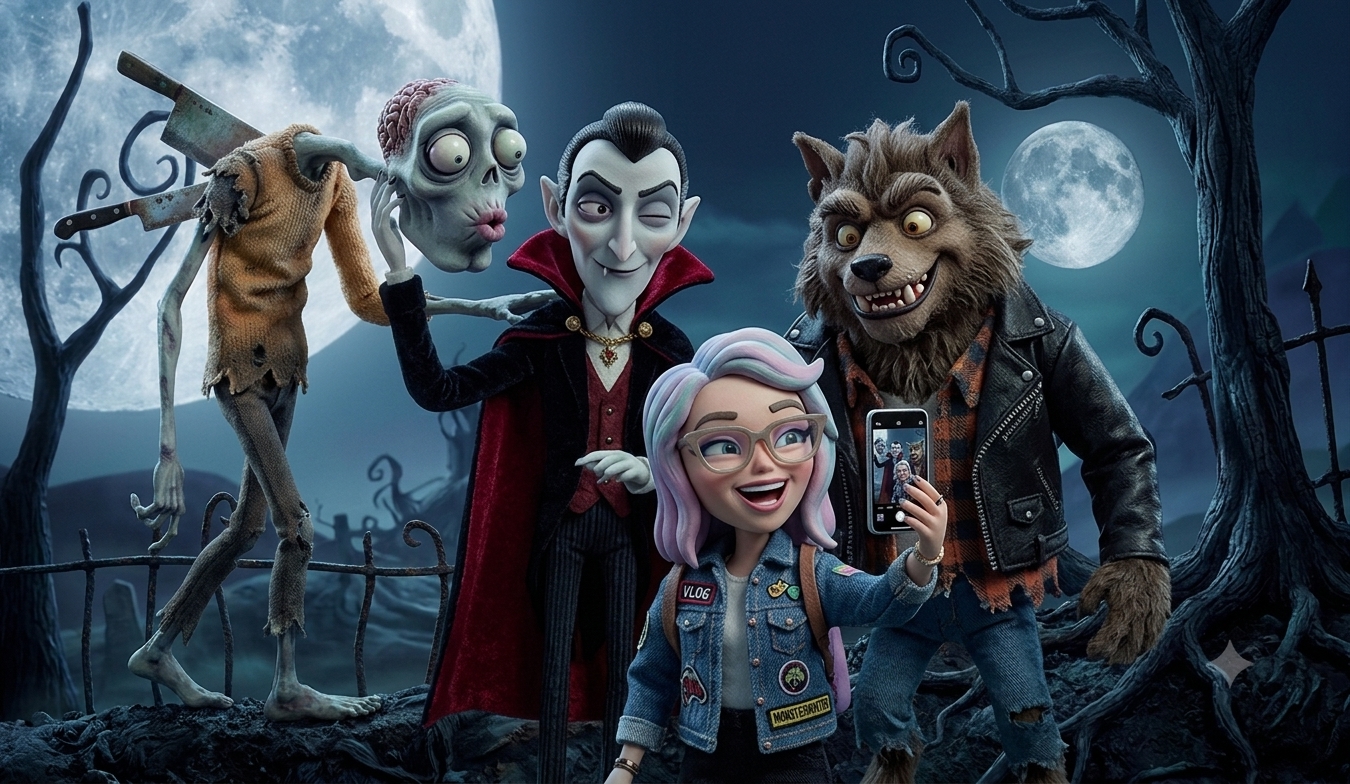
At Halloween, thoughts turn naturally to horror. Ghosts, vampires, zombies and assorted creatures of the night emerge from their hiding places to give us a delicious shiver of terror. We enjoy being frightened, provided the monster stays on the screen, the lights can be switched back on and we can return to the reassuring familiarity of everyday life.
I have a particular weakness for exploring frights, Halloween and horror, especially as the nights draw in. Previously, I have explored the unsettling relationship between science, technology and human behaviour [1–8]. Horror also provides an opportunity to examine what makes us tick, why we sometimes enjoy being scared, and how the things we fear reveal something about ourselves.
But why do some of us eagerly queue for a horror film, while others would rather spend the evening reviewing a particularly dull clinical study report? And, more importantly, why are some of us thrilled by vampires while werewolves give us the wobbles?
What fear is for
Fear is part of a broader defensive system that helps us detect danger, direct attention, mobilise energy and select appropriate responses. Contemporary models describe a continuum of threat responses: vigilance when danger may be nearby, orientation and assessment when a potential threat is detected, freezing or flight when danger approaches, and fight-or-flight defensive reactions when an attack becomes imminent [9].
Our understanding of the neurobiology of fear is advancing all the time, but much remains unknown. These responses, however, are thought to involve an interconnected network of brain regions, including cortical areas involved in interpretation and prediction, the hippocampus, the amygdala, the striatum and midbrain defensive circuits. The popular shorthand that the amygdala is “the fear centre” is clearly too simple. The amygdala contributes importantly to detecting and learning about threat, but the conscious experience of fear depends on wider cognitive, bodily and contextual processes [10][11].
Fear also differs from anxiety. Fear is typically tied to a specific, present or imminent threat; anxiety is more often a state of heightened vigilance about uncertain or possible future danger. Horror exploits both. A slow-building sense that something is wrong produces anxiety-like tension, whereas a sudden jump-scare triggers a rapid defensive response [11].
Finding your perfect fright
Fear is an essential survival mechanism. It helps us recognise potential threats, mobilise our bodies and prepare to respond. Yet horror entertainment allows us to experience some of these reactions without necessarily facing the danger that originally made them useful. Our hearts race, our attention sharpens and we may jump at an unexpected noise, even while knowing that we are sitting safely on the sofa.
Research suggests that our enjoyment of horror depends partly on how we interpret these reactions, alongside the nature of the frightening material itself. The attraction is not simply a desire to feel afraid. It is the opportunity to experience fear within boundaries that make it tolerable, exciting or even pleasurable [11][12].
A 2024 study of responses to horror-film scenes found that perceived fearfulness, realism and morbid curiosity helped predict levels of excitement and enjoyment. These findings appear to confirm what we all suspect: our responses to horror are not uniform. What terrifies one person may thrill another, while something that appears frightening in theory may leave us distinctly underwhelmed in practice [12].
So, what variety of terror best suits your particular psychological wiring?
Monster hunters. These are the people who want their fear to have a face. Vampires, werewolves, zombies (my particular favourite), predatory animals and murderous humans all provide a tangible threat. We can see the danger, understand its intentions and, at least in principle, work out how to escape it.
There is something reassuring about a monster with recognisable limitations. Garlic, silver bullets, a stake through the heart or a well-aimed blow to the head will do the trick. Of course, horror cinema has taught us that apparent death is rarely a reliable reason to relax. Nevertheless, the threat is visible, and the contest between predator and prey gives the story a satisfying structure.
Seekers of the supernatural. Ghosts, unexplained events, strange noises and things that move when nobody is looking offer a different kind of fear. Here, the problem is not necessarily what we see, but what we cannot explain.
A shadow in the corner of a room is unremarkable until we begin to suspect that it has moved. A creaking floorboard becomes sinister when we believe we are alone. Uncertainty gives the imagination room to work, and the mind is often remarkably efficient at filling gaps in the evidence with possibilities far more disturbing than the evidence itself.
Psychological research supports this intuition. People differ in their tolerance of uncertainty, and higher intolerance of uncertainty has been associated with broader generalisation of threat responses, including difficulty distinguishing cues that signal danger from those that signal safety. In other words, ambiguity can make the brain treat an uncertain situation as though it were dangerous. The paranormal enthusiast therefore gets a thrill from the uncertainty itself, waiting for the moment when the unexplained becomes impossible to ignore [13].
The deliberately lost. For these viewers, the most frightening experience is entering a world in which ordinary rules no longer apply. Isolated locations, unfamiliar environments, social collapse and the breakdown of everyday relationships can all provide the necessary fear ingredients.
Zombie apocalypses are a particularly good example. The walking dead may be the obvious threat, but the deeper horror frequently comes from the living. Who can be trusted? Who will sacrifice whom? And why does somebody always decide that splitting up is a sensible survival strategy?
In this case, the terror originates from the collapse of familiar assumptions. People who once relied on social rules, institutions and one another suddenly find themselves operating in a world where those rules no longer provide any protection. The monster becomes a backdrop to a more disturbing question: how would we behave if everything we took for granted disappeared overnight?
Of course, these categories overlap. The most effective horror films often combine a visible monster, an unexplained mystery and an environment in which nobody can be trusted. Our three categories are therefore a useful way of thinking about personal preference, rather than a scientifically validated classification of horror audiences. Individual differences matter too: sensation-seeking, empathy, fearfulness and morbid curiosity all help shape who seeks out horror, who enjoys it and who would rather leave the room before the basement door opens.
Why fear can be fun
One of the strangest features of horror is that fear, normally aversive, can become enjoyable. One explanation is excitation transfer theory. Suspense generates negative affect and physiological arousal; when the threat is resolved, that arousal can be reinterpreted as relief, exhilaration or even euphoria [11].
This helps explain why suspense matters. Early research found that viewers appreciated suspenseful programmes more than non-suspenseful ones, particularly when the narrative eventually resolved the threat [11]. More recent work similarly suggests that fear, arousal and the way we, as viewers, appraise a frightening situation combine to produce excitement rather than distress [12].
Individual differences also matter. Morbid curiosity, the interest in information about danger, death, violence and other threatening phenomena, is a measurable psychological trait. People in whom this trait is pronounced are more likely to seek out threatening or disturbing material, including horror films in which threat is a central theme [14].
So, what kind of fear junkie are you? Do you want to see the monster, suspect the shadow in the corner of your eye, or discover that the people around you are more dangerous than either? Knowing the answer will help you select your next blockbuster shocker, although individual preferences are inevitably more complicated than fitting neatly into one of three convenient labels.
When real life becomes the horror
There is, however, a fundamental difference between fictional fear and the real thing. Fiction provides boundaries. The credits roll, the lights come on and the monster disappears. Real life is not always so considerate.
Our fascination with horror has long reflected anxieties about the world beyond the big screen. Monsters can represent threats we struggle to understand, supernatural stories give form to uncertainty, and tales of social collapse expose our dependence on systems and relationships that we normally take for granted.
Science and technology offer their own versions of these unsettling possibilities. We create increasingly powerful tools, introduce them into complex environments and then discover that their consequences are not always easy to predict. The discomfort comes not necessarily from the technology itself, but from the possibility that our confidence in our creations may exceed our understanding of them. Current concerns over the impact of AI on society are a particularly good example.
Without appropriate scrutiny, the very tools designed to help us can undermine the reliability of the work we entrust to them. The frightening possibility is not that machines will suddenly acquire fangs and start stalking us through deserted corridors. It is that we might become so dependent on systems we do not adequately understand that we stop asking the questions that matter. Perhaps this is a more contemporary form of horror: the realisation that the threat is not always an external creature, but something embedded in the systems we have created and come to rely on.
The horror of missing out
Despite the acute terror associated with Terminator-like scenarios, with apologies to the Terminator film franchise, there remains a more chronic and pervasive everyday fear. For that, we need look no further than the small glowing rectangle in our pockets.
Fear of missing out, better known as FoMO, describes the persistent apprehension that other people are enjoying rewarding experiences from which we are absent. Researchers examining the concept empirically found associations between FoMO, lower satisfaction of psychological needs, poorer mood and greater engagement with social media. Unlike a vampire, FoMO does not need to break into your house. You invite it in, provide it with a permanent connection to your attention and carry it around all day [15].
Social media presents an endless stream of other people’s achievements, holidays, celebrations, opinions and apparently perfect lives. There is always another event you were not invited to, another opportunity you may have missed and another discussion taking place without you. Even when nothing particularly interesting is happening, the possibility that something interesting might be happening elsewhere can be enough to keep us checking.
The evidence requires some caution. Associations between problematic social networking and anxiety do not prove that social media causes anxiety in everyone. Nevertheless, a 2024 systematic review and meta-analysis of 209 studies, involving 252,337 participants across 28 countries, found moderate positive associations between problematic social networking use and several forms of anxiety, including FoMO [16]. Research has also distinguished problematic patterns of use from simple frequency of use, with the former more consistently associated with poorer wellbeing [17].
Social media can connect us, inform us and entertain us. The problem arises when connection becomes compulsion, and the fear of missing something starts preventing us from enjoying what is actually happening. Horror!
There is a certain irony here. We willingly pay to experience fear in a cinema, but may spend the rest of the week trying to escape the much less entertaining anxiety generated by our digital lives. The fictional monster gives us a fright and then leaves us alone. FoMO keeps whispering, suggesting subliminally that we should check our phones just one more time.
As with more traditional horror scenarios, the answer is not to abandon technology, but to recover some control — in this case, over our attention. Put the phone away during a meal. Resist the urge to check every notification. Distinguish between something genuinely important and something merely designed to grab your attention by the amygdala. And occasionally appreciate the experience you are having, rather than comparing it with the experiences everyone else appears to be having. Sometimes the best way to escape a manufactured nightmare is simply to stop feeding it.
So, this Halloween, enjoy the ghosts, the ghouls and the assorted creatures of the night. Choose the horror that suits you, turn down the lights and allow yourself a respectable shiver. And if you find yourself checking social media during a horror film because you are worried about what you might be missing, congratulations. You have discovered a genuinely modern nightmare: being too frightened of missing out to enjoy being frightened.
Happy Halloween!
References
- Hardman TC (2025). Fright here, fright now.
- Hardman TC (2024). Are Science Publishers Monster Predators?
- Hardman TC (2023). Metathesiophobia: from preclinical to clinical development.
- Hardman TC (2022). Top 10 horrifying Halloween healthcares.
- Hardman TC (2021). How frights create a happy Halloween.
- Hardman TC (2020). Understanding your fears.
- Hardman TC (2019). A Halloween Reflection: Life, Death, and the Uncanny.
- Hardman TC (2017). The Zombie Apocalypse Inside You.
- Mobbs D, et al. The ecology of human fear: survival optimization and the nervous system. Front Neurosci. 2015;9:55.
- LeDoux JE. Coming to terms with fear. Proc Natl Acad Sci U S A. 2014;111(8):2871–8.
- Martin GN. (Why) do you like scary movies? A review of the empirical research on psychological responses to horror films. Front Psychol. 2019;10:2298.
- Kiss BL, et al. The role of excitement and enjoyment through subjective evaluation of horror film scenes. Sci Rep. 2024;14:2987.
- Morriss J, Macdonald B, van Reekum CM (2016) What Is Going On Around Here? Intolerance of Uncertainty Predicts Threat Generalization. PLoS ONE 11(5): e0154494.
- Scrivner C. The psychology of morbid curiosity: development and initial validation of the Morbid Curiosity Scale. Pers Individ Dif. 2021;183:111139.
- Przybylski AK, et al. Motivational, emotional, and behavioral correlates of fear of missing out. Comput Hum Behav. 2013;29(4):1841–8.
- Du M, et al. Association between problematic social networking use and anxiety symptoms: a systematic review and meta-analysis. BMC Psychol. 2024;12:263.
- Boer M, et al. Social media use intensity, social media use problems, and mental health among adolescents: investigating directionality. Child Dev. 2021;92(4):e621–38.