What’s the scariest things about Halloween – it might be real life rather than horror stories. As autumn settles once again across the landscape, leaves turn to amber and brown, and nightfall steadily encroaches upon the day’s domain. The seasonal shift is more than aesthetic; it is psychological. Halloween occupies a unique cultural and cognitive space in which narratives of death, decay, and the supernatural are not only tolerated but celebrated. Folklore would have us believe that spectral guests are afoot, monsters fill the air, and hobgoblins linger in the periphery of perception. For enthusiasts of horror, Halloween functions as a symbolic “Christmas” of the macabre, a ritualised convergence of fear, curiosity, and storytelling.
Within this context, we revisit several scientifically grounded narratives that echo the themes of mortality, liminality, and the boundaries of life itself. Readers may recall earlier discussions from Niche and its broader engagements; this article serves as both a reflection and a consolidation of those ideas, offering light reading for the day after the night before.
One of the most striking intersections between environmental science and cultural tradition lies in the vulnerability of burial sites to climate change. Cemeteries, often regarded as permanent fixtures of human memory, are increasingly threatened by flooding, coastal erosion, and permafrost thaw. Studies have shown that rising sea levels and soil destabilisation can lead to the exposure and displacement of human remains, challenging both public health frameworks and ethical norms surrounding death care [1][2]. The persistence of organic material in permafrost, once considered stable over centuries, is now subject to accelerated decomposition due to warming temperatures [3]. Thus, even in death, the human body remains embedded within, and vulnerable to, dynamic ecological systems.
Equally provocative are developments in neuroscience that interrogate the boundary between life and death. Experimental work involving ex vivo perfusion of porcine brains has demonstrated the partial restoration of cellular activity hours after death [4]. While these findings do not indicate the recovery of consciousness, they complicate traditional definitions of irreversible brain death. The implications extend into bioethics, organ transplantation, and philosophical debates regarding the precise endpoint of life. Such research evokes age-old fears of reanimation, yet remains firmly rooted in mechanistic biology.
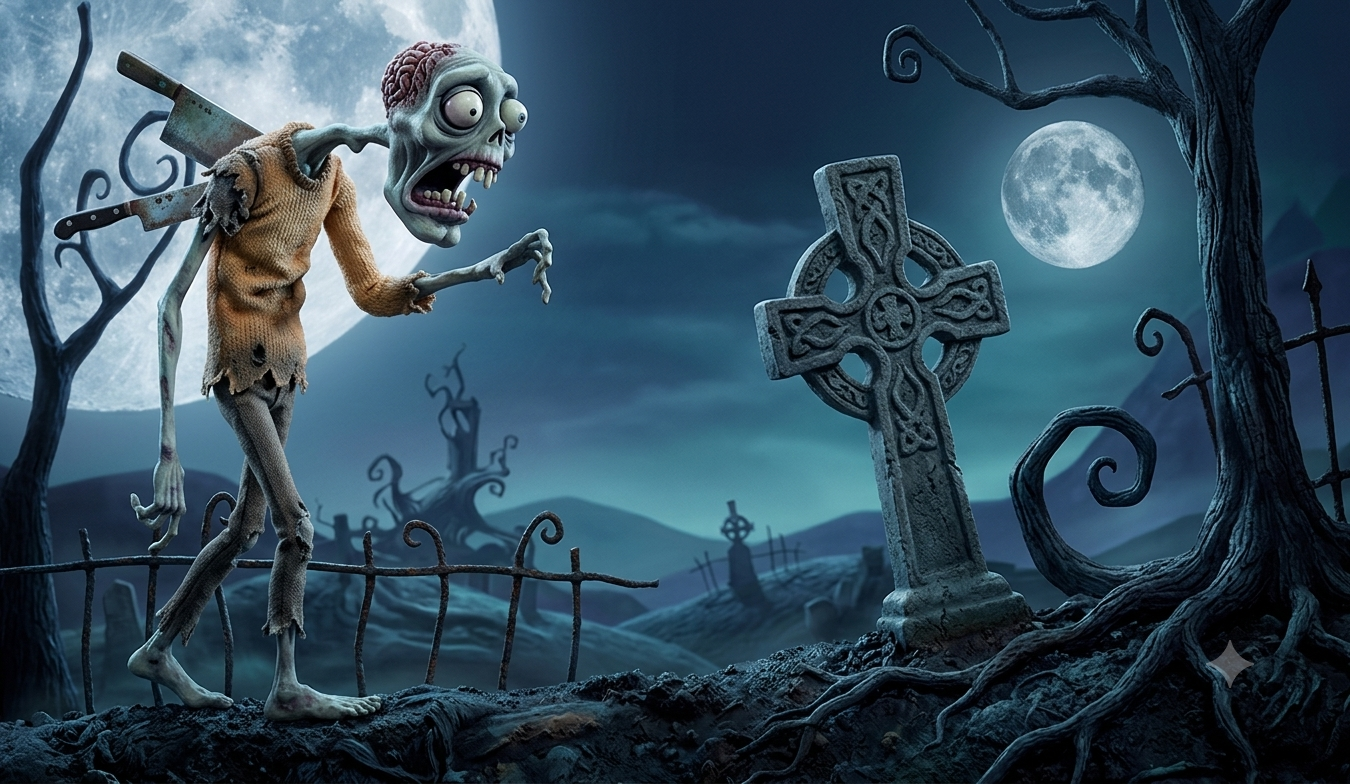
The concept of the “zombie,” often relegated to fiction, also finds resonance in clinical and neuropsychiatric phenomena. Case studies have documented conditions such as Cotard’s syndrome, in which individuals hold the delusional belief that they are dead or decaying [5]. Additionally, infections such as rabies have historically contributed to behaviours, aggression, hydrophobia, altered cognition, that may have inspired early zombie myths [6]. These examples illustrate how cultural archetypes often emerge from misunderstood or poorly characterised biological realities.
Beyond the laboratory and clinic, the language of horror has also permeated organisational and behavioural discourse. Metaphorical classifications: ghosts, zombies, vampires, and werewolves, have been employed to describe distinct patterns of engagement and leadership within professional environments. For instance, “zombie” organisations may be characterised by low innovation and high inertia, persisting without vitality in competitive ecosystems. While these frameworks are largely heuristic, they reflect underlying principles of organisational psychology, including motivation, adaptability, and social dynamics [7].
Finally, speculative scenarios such as a “zombie apocalypse” have been used as pedagogical tools in fields ranging from epidemiology to disaster preparedness. Mathematical modelling of infectious disease spread, often framed through fictional outbreaks, provides accessible insights into transmission dynamics, containment strategies, and systemic resilience [8]. These exercises, though imaginative, underscore the importance of preparedness in the face of real-world biological threats.
In conclusion, Halloween’s enduring appeal lies not merely in its theatrics but in its capacity to surface fundamental questions about life, মৃত্যু, and the unknown. The stories we tell, of reanimated tissue, vanishing graves, and mind-altering diseases, are grounded in scientific inquiry, even as they evoke primal unease. As the nights grow longer and shadows deepen, we are reminded that the boundary between the natural and the supernatural is often narrower than it appears.
References
- Nicholls RJ, Cazenave A. Sea-level rise and its impact on coastal zones. Science. 2010;328(5985):1517–20.
- Keenan JM. Climate change and the built environment: Impacts and adaptation. J Urban Affairs. 2018;40(4):487–502.
- Schuur EAG, McGuire AD, Schädel C, et al. Climate change and the permafrost carbon feedback. Nature. 2015;520:171–9.
- Vrselja Z, Daniele SG, Silbereis J, et al. Restoration of brain circulation and cellular functions hours post-mortem. Nature. 2019;568:336–43.
- Berrios GE, Luque R. Cotard's syndrome: Analysis of 100 cases. Acta Psychiatr Scand. 1995;91(3):185–8.
- Jackson AC. Rabies: Scientific basis of the disease and its management. Lancet Neurol. 2013;12(6):504–14.
- Deci EL, Ryan RM. Intrinsic motivation and self-determination in human behavior. Springer. 1985.
- Munz P, Hudea I, Imad J, Smith RJ. When zombies attack!: Mathematical modelling of an outbreak of zombie infection. Infect Dis Model. 2009.