In home offices, playlists have become as common as laptops. Many professionals report that music makes them “more productive,” yet others find it distracting or even stressful. Neuroscience helps explain this tension: music is a powerful modulator of reward, attention, and emotion, and those same systems underpin focus, learning, and decision‑making at work. I have previously written about how music can be used to engineer a flow state but what exactly is happening?
Functional imaging shows that music recruits auditory, motor, and reward networks, including the nucleus accumbens, a key hub in the dopaminergic system associated with motivation and pleasure [1][2]. When we bring that neural orchestra into the workplace, we are effectively redesigning the cognitive environment. Sometimes that redesign accelerates routine work; sometimes it clogs the mental “traffic” needed for complex reasoning. The challenge for leaders and employees is not whether music is good or bad, but when to play, and when to stop.
The dopamine advantage: music, mood, and repetitive tasks
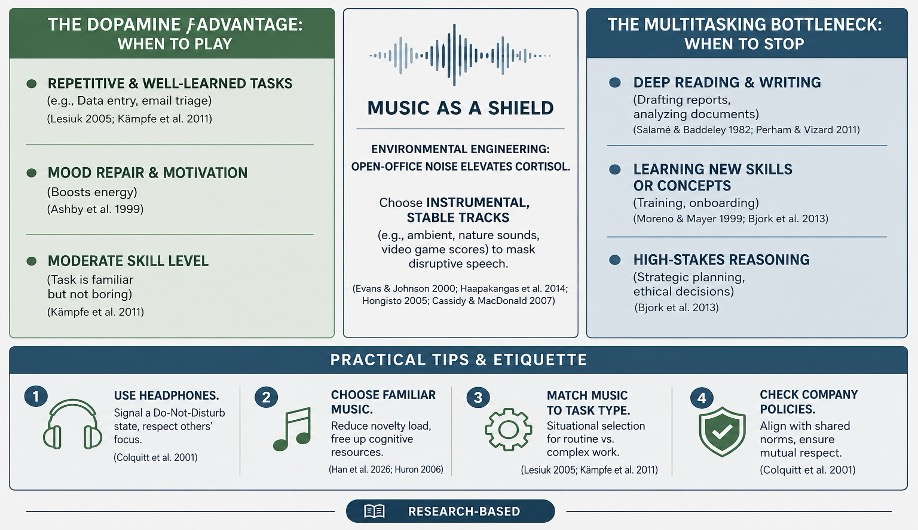
Music’s most celebrated workplace benefit is its ability to make routine work feel less tedious. Neuroimaging and molecular studies show that pleasurable music increases activity in dopaminergic pathways, including the nucleus accumbens and dorsal striatum, supporting reward prediction and motivation [2][3]. In one PET–fMRI study, emotionally engaging music was found to activate D1‑receptor–rich regions, consistent with phasic dopamine release during peak emotional responses [3]. This dopaminergic “boost” translates into subjective enjoyment and a mild elevation in mood, conditions known to facilitate persistence on repetitive tasks and reduce perceived effort [4].
From an organisational‑psychology perspective, this matters because many knowledge workers oscillate between deep, complex work and lower‑stakes, routine activities such as data entry, email triage, or document formatting. Field studies with software developers and office workers suggest that self‑selected background music can improve perceived productivity, positive affect, and time‑on‑task during such routine work, particularly when tasks are well‑learned and low in cognitive complexity [5][6]. Meta‑analytic evidence indicates that music’s positive effects on performance are most reliable for simple or monotonous tasks, where mood and arousal play a larger role than working‑memory capacity [7].
Skill level moderates this effect. When individuals are already highly expert, their performance on familiar tasks tends to be robust to moderate background stimulation, including music [7]. In contrast, novices learning a new skill often show performance decrements when music is present, because they require more attentional resources to build accurate mental models and procedural knowledge [8]. In other words, music can be a dopamine‑rich lubricant for routine work, but only once the cognitive “machinery” is already well‑oiled.
When to play (dopamine advantage)
The cost of lyrics and complexity: the multitasking bottleneck
The same neural systems that make music rewarding can also create a bottleneck when the brain must juggle multiple streams of information. Cognitive‑load theory and dual‑task research show that background music effectively adds a second task: the brain must parse auditory input while simultaneously encoding, manipulating, or retrieving work‑related information [8][9]. When tasks demand high levels of working memory, such as reading complex reports, writing, or learning new material, this multitasking can impair performance.
Lyrical music is particularly problematic for language‑based work. Studies on the “irrelevant sound effect” demonstrate that background speech or lyrics disrupt serial recall and verbal working memory, especially when the material being processed is itself linguistic [9][10]. In one experiment, participants performing a reading‑comprehension and memory task showed significantly poorer performance when exposed to music with intelligible lyrics compared with instrumental music or silence [10]. The interference arises because both the lyrics and the text compete for phonological and semantic processing resources in the brain’s language networks.
Novel or complex music adds another layer of distraction. Neurocognitive research indicates that unfamiliar or structurally complex music triggers orienting responses and prediction‑error signals, drawing attention toward the sound in order to update internal models of rhythm, harmony, and melody [1][11]. This ‘novelty response’ is adaptive in leisure contexts but counterproductive when the goal is to maintain sustained attention on abstract concepts or intricate problem‑solving.
From a research‑integrity and learning‑science perspective, this matters: subtle distractions can lead to shallow encoding, misinterpretation of key information, and overconfidence in one’s understanding [12]. For tasks that involve critical reasoning, ethical decision‑making, or complex writing, the safest cognitive environment is often quiet or near‑quiet.
When to stop (multi-tasking bottleneck)
Environmental engineering: music as a shield against open‑office stress
Even when music itself is neutral, the surrounding soundscape may not be. Open‑plan offices expose employees to intermittent speech, phone calls, and unpredictable noise bursts—conditions associated with elevated cortisol, reduced task performance, and increased fatigue [13][14]. Experimental and field studies show that chronic exposure to such noise impairs the prefrontal cortex’s capacity for planning and self‑regulation, leading to more errors and lower job satisfaction [13].
Here, carefully chosen music can function as sound masking rather than entertainment. Ambient instrumental tracks, nature sounds, and certain classical styles (including Baroque music with stable tempo and moderate dynamics) can reduce the salience of disruptive speech by providing a continuous, low‑complexity auditory background [15]. This masking effect decreases the number of attention‑capturing ‘peaks’ in the environment, thereby lowering stress responses and improving perceived concentration [15][16].
Video‑game soundtracks are an intriguing example of applied cognitive design. Composers intentionally craft these scores to be engaging yet unobtrusive, supporting sustained focus on complex visual and motor tasks without overwhelming working memory [17]. Preliminary studies suggest that such music can maintain arousal and motivation while preserving performance on attention‑demanding tasks, particularly when the music is instrumental and familiar [17].
From an organisational‑behaviour standpoint, this is a form of environmental engineering: employees use music to reclaim a sense of control over their sensory context, which is linked to higher perceived autonomy and lower burnout [18]. However, the benefits depend on volume, predictability, and alignment with task demands.
When to play (environmental shield)
Professional etiquette and practical tips
Music in shared workplaces is not just a cognitive issue; it is also a social and leadership question. Organisational‑culture research shows that perceived fairness and respect strongly influence engagement and trust [18]. Imposing one person’s musical preferences on others can erode that sense of respect, especially when colleagues differ in personality and sensory sensitivity.
Personality studies indicate that extroverts, who typically have lower baseline cortical arousal, often prefer higher levels of external stimulation and may report improved mood and performance with upbeat music [19]. Introverts, with higher baseline arousal, are more likely to experience the same stimulation as distracting or fatiguing, particularly during demanding cognitive tasks [19]. Good etiquette acknowledges this variability.
Practical guidelines
Conclusion: music as a situational productivity tool
Music is neither a universal productivity hack nor a cognitive villain. It is a situational tool that can enhance motivation, mask stress‑inducing noise, and support employee satisfaction—especially for repetitive tasks and in distracting environments [4][5][6][7][13][14][15][16]. Yet the same neural mechanisms that make music rewarding can interfere with learning, language‑based work, and complex reasoning when lyrics, novelty, or high cognitive load are involved [8][9][10][11][12].
For professionals and leaders, the most productive stance is nuanced: play music when the goal is mood, routine, or environmental control; stop when the goal is deep learning, critical thinking, or shared focus. Used with this awareness, music becomes not just background noise, but a deliberately tuned part of the cognitive architecture of work.
References (Vancouver style)

Get our latest news and publications
Sign up to our news letterResources
Social


Contact us
Address
Niche Science & Technology
Unit 26 Falstaff House
Bardolph Road
Richmond TW9 2LH
United Kingdom