I find travel exhausting. It’s not my 'thing.' Travel for work and you are often expected to 'perform' as soon as you arrive in a new country. Equally, there is little respite when you return from your travels. I returned from Berlin on Thursday and was met by a host of unanswered emails and encroaching deadlines.
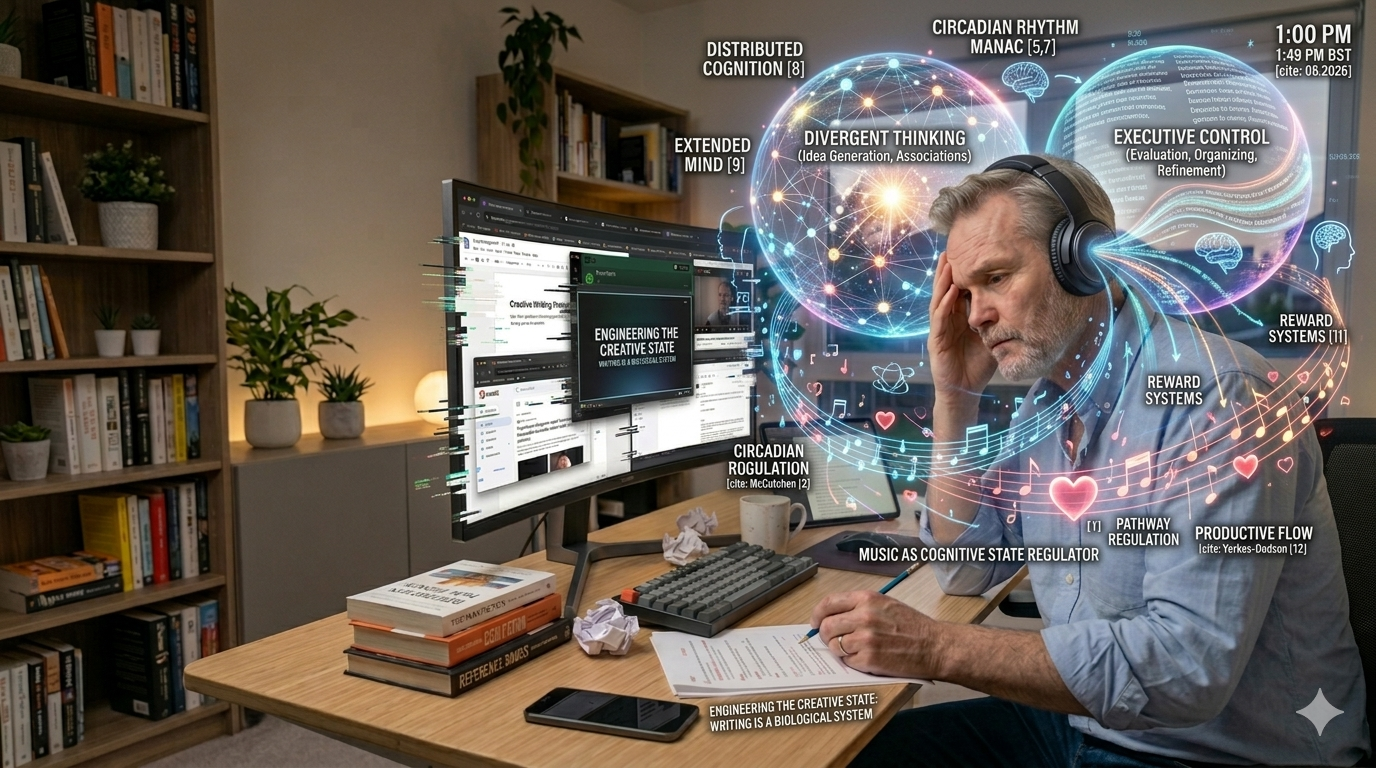
This contrasts with the traditional image of the writer, often portrayed as a solitary individual applying skill and imagination to a blank page. Contemporary cognitive science (and my own experience) suggests a more complex picture: writing is an activity produced by a dynamic biological system embedded within an equally dynamic environment. The way writers approach the page throughout the day differs in attention, memory capacity, emotional state, motivation or physiological readiness at every moment of the day. When faced with deadlines like those I had this week I may be at my desk at 7am in the morning and not stop until it gets dark that evening.
Writing requires the coordination of multiple cognitive processes, including idea generation, semantic association, working memory, attentional control, emotional regulation, research and self-evaluation. These processes compete for limited space in our brains and fluctuate according to sleep, circadian rhythms, stress, motivation and environmental conditions [1][2]. Consequently, productive writing is unlikely to emerge from maintaining identical conditions throughout the day.
Experienced writers find strategies to modify their surroundings and internal state to support different phases of creative work. This perspective suggests that writing is not simply a cognitive skill; it is an exercise in creative state management.
Writing is one of the most cognitively demanding human activities. It requires both divergent and convergent thinking. During early drafting, writers must generate possibilities, associations and novel combinations of ideas. Later, they must evaluate, organise and refine these ideas. These processes rely on partially competing cognitive systems.
Creativity research has shown that producing novel ideas requires a balance between spontaneous associative processes and executive control mechanisms that evaluate usefulness and coherence [3]. Excessive control can suppress originality, while insufficient control can produce disorganised output. The optimal creative state therefore requires dynamic regulation rather than a constant level of activation.
Neuroscientific studies of creativity suggest that different brain networks contribute at different stages of creative production. The default mode network is associated with internally generated thought and spontaneous idea production, whereas executive control networks contribute to deliberate evaluation and refinement [4]. Effective creativity involves interaction between these systems rather than dominance of one over the other.
The implication for writers is significant: the mental state required to generate a first draft is not necessarily the same state required to edit it.
Human cognition changes systematically across the day. Circadian biology regulates sleep–wake cycles, hormone release, body temperature and alertness, producing predictable fluctuations in cognitive performance [5]. Individuals also differ considerably in chronotype, meaning their preferred timing of cognitive and physical activity [6].
Research examining time-of-day effects demonstrates that cognitive abilities are not equally available at all hours. Tasks requiring sustained attention, working memory and executive control may vary according to circadian phase and sleep pressure [7]. A writer attempting complex structural editing late in the day may therefore experience a different cognitive environment from the same writer working earlier.
This does not mean there is a universally optimal writing time. Instead, it suggests that writers should recognise that their internal conditions are variable. A period of low analytical energy may still support imaginative association, while a period of high executive functioning may be better suited to revision and argument construction.
Creative productivity may therefore depend less on maximising hours spent writing and more on matching cognitive states to appropriate writing tasks.
Cognitive science increasingly challenges the idea that thinking occurs entirely inside the brain. The theory of distributed cognition proposes that cognitive activity emerges through interactions between individuals, tools and environments [8]. Similarly, the extended mind hypothesis argues that external structures can become functionally integrated into human thinking processes [9].
For writers, this means that notebooks, software, physical spaces, routines, lighting and sound are not merely background features. They can become components of the cognitive system supporting creativity.
Environmental consistency may help establish reliable cognitive cues. Repeated associations between a particular setting and creative work can reduce the effort required to initiate writing. This principle resembles research on context-dependent learning, where information retrieval improves when environmental conditions resemble those present during encoding [10].
Many writers intuitively create such conditions through rituals: a specific location, a particular beverage, a routine before writing, or a consistent auditory environment. These practices may function as cognitive preparation mechanisms, signalling the transition into a focused creative state.
Among environmental variables, music is particularly interesting because it can directly influence emotional state, physiological arousal and attention.
Music affects brain systems involved in reward, emotion and motivation. Neuroimaging studies suggest that pleasurable music activates neural pathways associated with reward processing, including dopaminergic mechanisms [11]. This provides a plausible explanation for why music can alter mood and motivation before or during demanding cognitive activity.
For writers, music may serve several possible functions.
The relationship between arousal and performance is often described by the Yerkes–Dodson principle: moderate levels of activation can optimise performance, whereas excessive or insufficient arousal can impair it [12]. As with muscles, our brains can benefit from a proper warm-up! I tend to start the day with a selection of classical music as I scane the literature for developments.
A writer experiencing fatigue may use stimulating music to increase activation. Conversely, a writer experiencing anxiety may use slower, predictable music to reduce physiological tension. I am sure you can think of plenty of music tracks that would work for you in these situations. The aim is not simply to increase energy but to achieve an appropriate cognitive state for the task.
Repeated pairing of music with writing may create a learned association between a sound environment and a creative activity. Research on associative learning demonstrates that contextual cues can influence behaviour by signalling expected cognitive states or actions [13]. A particular playlist may therefore function as a psychological 'entry condition' for writing, like my morning warm-up routine. This resembles the use of pre-performance routines in sport psychology, where consistent preparation sequences help athletes achieve optimal performance states [14]. What works for you when your mind is flying?
Background music has complex effects on cognition. Evidence suggests that music can improve mood and motivation but may interfere with tasks requiring substantial verbal processing, particularly when lyrics compete with language production [15].
For writing, instrumental music may therefore be preferable during demanding linguistic tasks because it provides emotional and attentional regulation without introducing competing semantic information. For example, when my flow is disturbed during the day by a phone call or meeting I might bump-start the creative process by listening to AI generated instrumental tracks (https://www.youtube.com/watch?v=6qbhP6SNhfc).
However, individual differences are substantial. Some writers may perform better with silence, while others benefit from carefully selected sound environments.
The scientific literature suggests a shift in how creative work should be understood. The writer is not simply someone who applies effort to produce words. The writer is a biological system operating within changing internal and external conditions. Perhaps think of yourself as tissue bath experiment where you determine the fluid you bathe in and the stressors you are exposed to.
This creates a practical framework for you to act on:
This approach reframes creativity from a mysterious personal quality into a process that can be supported through deliberate cognitive and environmental design. Another example might be how I try to accelerate my ‘flow’ by listening to high-energy tacks like Queen’s Don’t stop me now. As I approach a milestone, I might reward myself with We are the champions.
Creativity is cultivated, not merely summoned. Writing requires the coordination of multiple cognitive systems that fluctuate across time. The expectation that writers should maintain a constant level of creativity under identical conditions ignores the biological reality of cognition.
The most productive writers may not be those who force themselves to write in every state, but those who understand how to adapt their environment to the cognitive demands of the moment.
Music, workspace design, routines and sensory cues are not superficial productivity tricks. They represent attempts to regulate the interaction between brain, body and environment.
Creative achievement may therefore depend not only on having ideas, but on engineering the conditions in which ideas can emerge.
References

Get our latest news and publications
Sign up to our news letterResources
Social


Contact us
Address
Niche Science & Technology
Unit 26 Falstaff House
Bardolph Road
Richmond TW9 2LH
United Kingdom