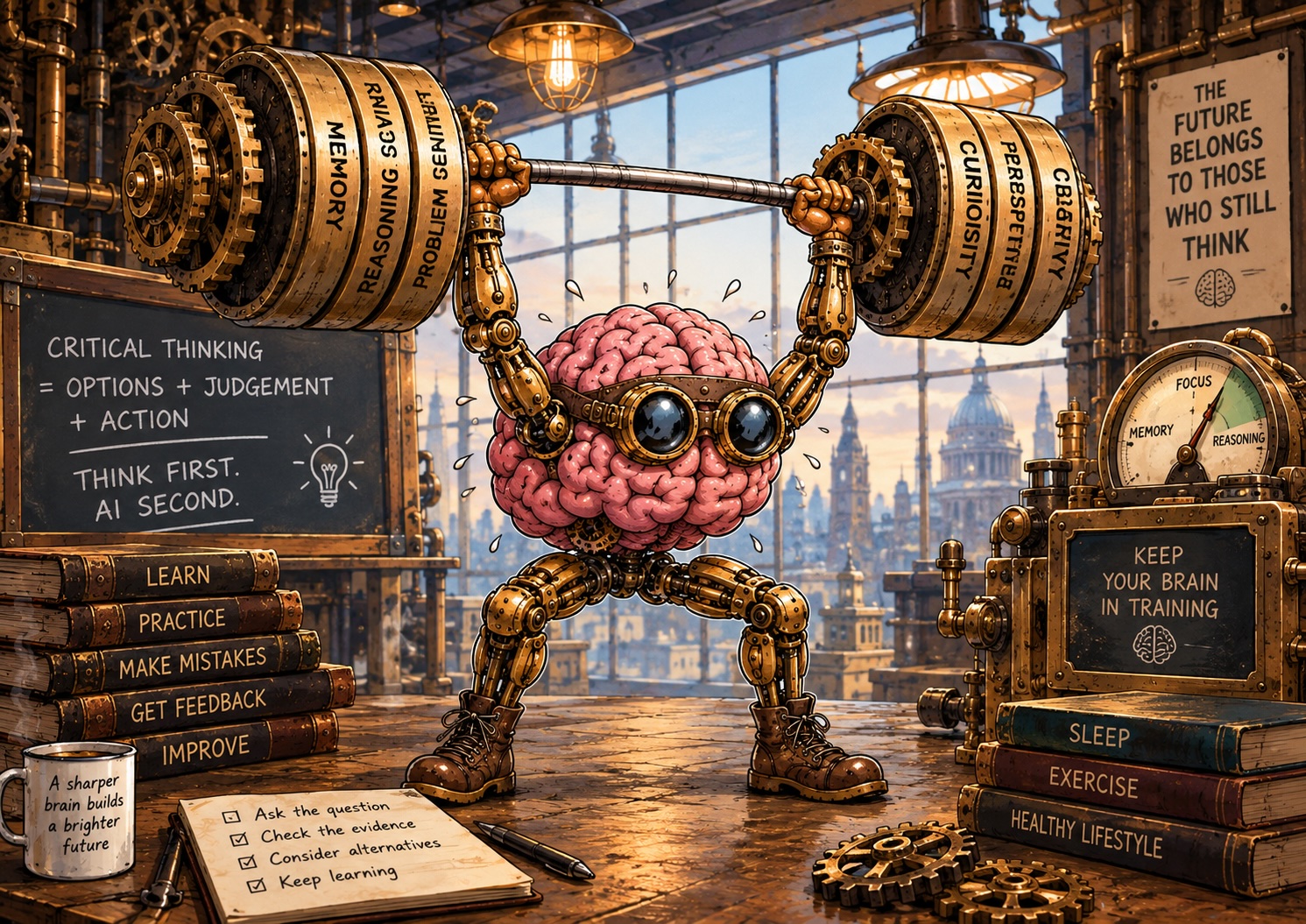
We’ve all heard how artificial intelligence (AI) signals the end of humanity. But what will the more immediate effects be?
There is a strange paradox at the heart of the AI revolution. It is becoming extraordinarily good at doing things for us. It can search, summarise, write, analyse, code, generate ideas and increasingly carry out whole tasks with remarkably little direction. Like any tool, it should make us more capable, or at least more productive. But there is another possibility. If we routinely hand over the activities through which we develop memory, reasoning, judgement and problem-solving, we may become very efficient at producing answers while being no better at understanding them.
That distinction matters. The most valuable human capability in an AI-rich world is not knowing how to produce answers. It is knowing which question to ask, what evidence to trust, what alternatives to consider, when an answer is wrong and what to do next. In other words, critical thinking and agency become more valuable precisely because AI’s abilities seem so capable.
There is an even subtler issue. We tend to think of our ability to think as something we possess, rather like a bank balance. It is not. Thinking is a skill built and maintained through use. Our most valuable intellectual asset is a kind of thinking currency. If we continually spend it, but stop replenishing it through effort, practice, mistakes and learning, we become cognitively poorer.
What do we actually mean by critical thinking?
Critical thinking means different things to different people. It can mean scepticism, logic, evaluating evidence, recognising bias, solving problems or simply not accepting the first answer that appears on your screen [1]. Researchers tend to regard it as a collection of overlapping processes rather than a single mental skill. Memory, reasoning, decision-making, problem-solving and metacognition all contribute [2].
One particularly important aspect is the ability to consider alternatives. That is what scientists do. We don’t simply ask, “How can I prove my hypothesis?” We ask whether another explanation could account for the same observation. We consider what evidence would distinguish between competing explanations. We actively look for findings that do not fit our preferred model [3].
But here’s the catch: critical thinking also depends on knowledge. Being an excellent critical thinker in clinical pharmacology does not automatically empower you to comment on economics, history or engineering. We need sufficient subject knowledge to recognise plausible alternatives and understand which evidence actually matters [2][4]. This is one reason teaching critical thinking as a generic skill is so difficult.
This matters even more in an AI world. An LLM can give you a fluent answer about almost anything. Fluency is not the same as understanding. If you do not know enough about a subject to recognise a plausible alternative, challenge an assumption or spot some missing evidence, then the machine’s expressed confidence replaces your judgement. This brings us to something fundamental about learning. It is not simply absorbing information. It is what we do with it.
Learning is not passive
Both depth and nature of processing influence subsequent memory [5]. Students who repeatedly retrieved information from memory learned more than those who spent the same amount of time studying the material using concept mapping [6]. A meta-analysis has also shown that actively generating information generally produces better subsequent memory than simply receiving it [7].
This is what some researchers describe the benefit of including ‘desirable difficulties’ in learning. Making learning harder in the short term makes it more effective in the longer term [8]. The inconvenience is part of the mechanism.
That is an uncomfortable thought in an age in which technology is increasingly designed to remove inconvenience. We can ask AI to explain a research paper before we have struggled with it. We can ask it to produce the outline before we have decided what we think. We can ask it to solve our underlying problem before we have worked out where we are stuck. All of these things are wonderfully efficient. But efficiency is not the same as learning. Sometimes the difficult bit is the bit that changes you.
Mistakes are not necessarily failures of learning
To me, it seems that we have developed an unfortunate habit of removing mistakes from learning. We no longer teach people how to fail.
During my undergraduate learning, attempting to retrieve an answer, getting it wrong, receiving corrective feedback and then trying again, was a powerful learning technique [9]. In the words of Yoda, “The greatest teacher, failure is.” The important point is not that every mistake is educational. It is that the opportunity to attempt, fail, understand why and try again is enormously valuable [10].
This is not isolated to academic study. Nobody learns to ride a bicycle by having it described to you. You get on, wobble, fall off, adjust and try again. Intellectual skills develop in much the same way. Deliberate-practice research suggests that expertise depends not simply on accumulating years of experience, but on focused effort, feedback and repeated attempts to improve performance [11][12].
There is a lesson here for AI. If the machine always supplies the answer before we have had an opportunity to struggle with the problem, we are not just saving time, we are simultaneously removing part of the learning process. The mistake that never happens may be the lesson that never gets learned. This doesn’t mean we should be making everything difficult. It means recognising that some forms of effort are productive. (no pain, no gain). The art is knowing how to remove pointless friction while protecting the friction that builds capability.
The problem is not that AI is intelligent
AI makes it extraordinarily easy not to think.
Cognitive offloading is nothing new. We have embraced calculators, calendars, sat-navs and shopping lists because external tools allow us to reduce cognitive demands [13]. That is often sensible. The difficulty comes when we offload the very cognitive activity needed to learn. There is a huge difference between using a calculator to check your calculation and using one because you never learned how numbers work. AI takes this to a new level. It can formulate the hypothesis, search the literature, analyse the data, write the argument and construct the presentation. Increasingly, it can even decide what should happen next. The cognitive work disappears without us even noticing.
That is why the hidden threat of AI is somewhat different from The Terminator movies. It’s not a machine taking away our freedom or intelligence; more it is our gradual surrender of them because doing so is convenient.
The concern is not entirely new. In the 2010s, the ‘Google effect’ described the belief that people would remember less information when they knew it would be readily available online [14]. Subsequent research has similarly shown that cognitive offloading can actually improve immediate performance though simultaneously reducing memory for information that has been offloaded [15]. In the end. Google did not destroy our memory. Nor does this evidence show that AI will destroy reasoning. The point is subtler. When the environment changes the amount of cognitive work we need to perform changes with it. The important question in the AI age may therefore not be “Will AI make us stupid?” but “Which capabilities are we maintaining through practice, and which are we gradually outsourcing?”
For now, we simply don’t know whether our abilities are shrinking.
Concerns about intellectual decline are not new. What is new is the scale and speed at which AI can now perform activities that previously required us to think for ourselves.
The emerging evidence about generative AI and critical thinking is mixed. Some studies and reviews suggest potential benefits for higher-order thinking, while others raise concerns about over-reliance, mental inertia and reduced independent cognitive engagement [16][17][18]. So far, the studies differ in models, tasks, populations and definitions of critical thinking, so it would be premature to claim that AI is making people cognitively weaker. But uncertainty is not a reason to ignore the possibility. It is a reason to pay attention to how we use the technology, especially around those who need to build their abilities.
This is particularly important for young people. Science is not simply a collection of facts. Scientific thinking requires people to formulate hypotheses, interpret evidence, consider competing explanations, recognise uncertainty and change their minds when evidence demands it [19]. These activities are not merely outputs of scientific education. They are the process through which scientific thinking develops.
There is also a broader question for all of us. If we increasingly use AI at the point where thinking becomes difficult, what happens to our ability to tolerate difficulty? What happens to our memory of things we have learned? What happens to the confidence that comes from solving something ourselves? We should not assume the worst. But we should not assume that cognition is immune to disuse either.
Critical thinking needs exercise
The brain is not a static filing cabinet. Learning changes the neural representations and networks involved in memory, attention and executive control [20]. There is no magic switch that keeps the brain sharp. There is, however, a substantial body of evidence pointing towards something rather more ordinary: use it, challenge it, recover it and use it again.
That means critical thinking needs exercise. Try to remember the telephone number before looking it up. Write before asking AI to write for you. Make the prediction before seeing the result. Do the calculation before checking it. Read something difficult. Discuss it. Teach it to somebody else. Try to solve the problem before asking for the solution. These are small acts, but they matter because they force the brain to retrieve, generate, compare, predict and explain rather than simply receive.
Learning is biological, human and specific to that one individual. You cannot put what you know on a floppy disk (anyone remember what they are?). We do not need to become cognitive athletes. But like physical fitness, cognitive capability benefits from being used.
High agency: the other half of the equation
Critical thinking asks, “What do I think?” Agency asks, “What am I going to do?”
Human agency has been described in terms of intentionality, forethought, self-regulation and self-reflection [21]. However, the concept has acquired another meaning in the AI age because an ‘agent’ can also be something that acts on our behalf. That creates an interesting tension.
AI is incredibly empowering. It has never been easier to send a cold email, build an application, analyse data or test an idea. Two recently published books even share the title You Can Just Do Things, capturing this emerging high-agency philosophy [22]. You could say that we are approaching a point only previously envisioned in science-fiction novels such as Arthur C Clarke’s The City and the Stars.
As AI becomes increasingly agentic, we need to distinguish between AI doing things for us and AI deciding what things we should do.
There is a marked difference between “challenge my thinking” and “tell me what to think”. There is a difference between “help me write this” and “write it for me”. One preserves agency. The other risks transferring it. High agency does not mean doing everything yourself. It means retaining ownership of intention, judgement and action [23][24]. AI can make us extraordinarily capable without becoming the source of our goals.
Keep ownership of the important decisions
This introduces what may be the most important rule. Use AI aggressively. Use it to generate possibilities, challenge your assumptions, find weaknesses in your argument, explain difficult concepts, test your ideas and remove tedious work. But keep ownership of important decisions.
Ask yourself:
- What do I believe?
- Why do I believe it?
- What evidence would change my mind?
- What alternatives have I missed?
- What assumptions am I making?
- What should I do next?
Those questions belong to you.
There is a useful mental habit here: think first, AI second. Form your initial hypothesis before asking the machine. Write your rough argument before asking it to improve the prose. Decide the type of evidence you need before asking it to search. Work through the calculation before asking it to check your arithmetic. Then use AI as a sparring partner.
This approach turns AI into a cognitive amplifier rather than a cognitive replacement. It also gives you something important: a point of comparison. If you never formulate your own answer, you have nothing against which to judge the machine’s answer.
In a world where AI can produce polished output almost instantly, genuine understanding may become more valuable precisely because it is harder to fake. Anyone can generate something that looks impressive. Far fewer people understand why it is correct. Fewer still can recognise when it is wrong. As Erasmus put it, “In the country of the blind the one-eyed man is king”. Your insight may be the little bit of imperfection that moves polished prose to poetry. The objective should not be to eliminate cognitive effort. It should be to spend cognitive effort where it coverts technical correctness to art.
For students, that means remembering that education is not the production of essays, reports and answers. It is the development of a mind capable of producing, testing and challenging those things.
For scientists, it means remembering that the uncomfortable process of formulating hypotheses, analysing evidence and discovering that we were wrong is not an inconvenient part of science. It is science.
And for all of us, it may mean protecting something we rarely think about until it starts to disappear: the ability to think without assistance.
The future belongs to people who can still think
I do not think the answer is to use AI less. Quite the opposite. The opportunity is enormous. We should use these extraordinary tools to increase what humans can do. But we should be careful about what we give away.
The future will not belong to those who use AI least, or even necessarily to those who use it most. It will belong to people who can use enormous amounts of artificial intelligence while retaining something much older: their own judgement.
That means continuing to learn difficult things. Remembering rather than always looking up. Making predictions before seeking answers. Writing sometimes without assistance. Doing the calculation before checking it. Making mistakes. Getting feedback. Changing your mind. Having difficult conversations. Reading things that do not fit neatly into a summary.
AI may become an extraordinary extension of human capability. But an extension is only useful if there is something human at the centre of it. Our thinking is a kind of currency. We should spend it generously, but we also need to keep earning it.
The future will belong to those who work hardest to retain the ability to think.
References
- Hardman TC (2018). Critically thinking.
- Halpern DF. Teaching critical thinking for transfer across domains. Dispositions, skills, structure training, and metacognitive monitoring. Am Psychol. 1998;53(4):449-455.
- Dunbar KN, Fugelsang JA. Scientific thinking and reasoning. In: Holyoak KJ, Morrison RG, editors. The Cambridge Handbook of Thinking and Reasoning. Cambridge: Cambridge University Press; 2005. p. 705-725.
- Patel VL, Groen GJ. Knowledge based solution strategies in medical reasoning. Cogn Sci. 1986;10(1):91-116.
- Craik FIM. Levels of processing: past, present, and future? Memory. 2002;10(5-6):305-318.
- Karpicke JD, Blunt JR. Retrieval practice produces more learning than elaborative studying with concept mapping. Science. 2011;331(6018):772-775.
- Bertsch S, et al. The generation effect: a meta-analytic review. Mem Cognit. 2007;35(2):201-210.
- Bjork EL, Soderstrom NC, Little JL. Can multiple-choice testing induce desirable difficulties? Evidence from the laboratory and the classroom. Am J Psychol. 2015;128(2):229-239.
- Metcalfe J. Learning from errors. Annu Rev Psychol. 2017;68:465-489.
- Hays SJ, Kornell N, Bjork RA. When and why a failed test is more effective than a successful study episode. Mem Cognit. 2010;38(7):905-914.
- Ericsson KA. Deliberate practice and acquisition of expert performance: a general overview. Acad Emerg Med. 2008;15(11):988-994.
- Ericsson KA, Harwell KW. Deliberate practice and proposed limits on the effects of practice on the acquisition of expert performance: why the original definition matters and recommendations for future research. Front Psychol. 2019;10:2396.
- Risko EF, Gilbert SJ. Cognitive offloading. Trends Cogn Sci. 2016;20(9):676-688.
- Sparrow B, Liu J, Wegner DM. Google effects on memory: cognitive consequences of having information at our fingertips. Science. 2011;333(6043):776-778.
- Grinschgl S, Papenmeier F, Meyerhoff HS. Consequences of cognitive offloading: boosting performance but diminishing memory. Q J Exp Psychol (Hove). 2021;74(9):1477-1496.
- Li J, Ai F, Wang J, Cheng B, Li Y, Chen Z. Application of AI-generated content in medical education: systematic review of the impact on critical thinking abilities of medical students. JMIR Med Educ. 2025.
- Zhao Y, et al. Does generative artificial intelligence improve students’ higher-order thinking? A meta-analysis based on 29 experiments and quasi-experiments. J Intell. 2025;13(12):160.
- Alhur A, et al. Effects of artificial intelligence-supported education on critical thinking, problem-solving, clinical reasoning, and decision-making in health science education: a systematic review of interventional studies. 2026.
- Nosek BA, Errington TM. What is replication? PLoS Biol. 2020;18(3):e3000691.
- Shors TJ, Anderson ML, Curlik DM 2nd, Nokia MS. Use it or lose it: how neurogenesis keeps the brain fit for learning. Behav Brain Res. 2012;227(2):450-458.
- Bandura A. Social cognitive theory: an agentic perspective. Annu Rev Psychol. 2001;52:1-26.
- Hall C. You Can Just Do Things: The High-Agency Method for Getting Everything You Want. London: HarperCollins; 2026.
- Ryan RM, Deci EL. Self-determination theory and the facilitation of intrinsic motivation, social development, and well-being. Am Psychol. 2000;55(1):68-78.
- Di Domenico SI, Ryan RM. The emerging neuroscience of intrinsic motivation: a new frontier in self-determination research. Front Hum Neurosci. 2017;11:145.