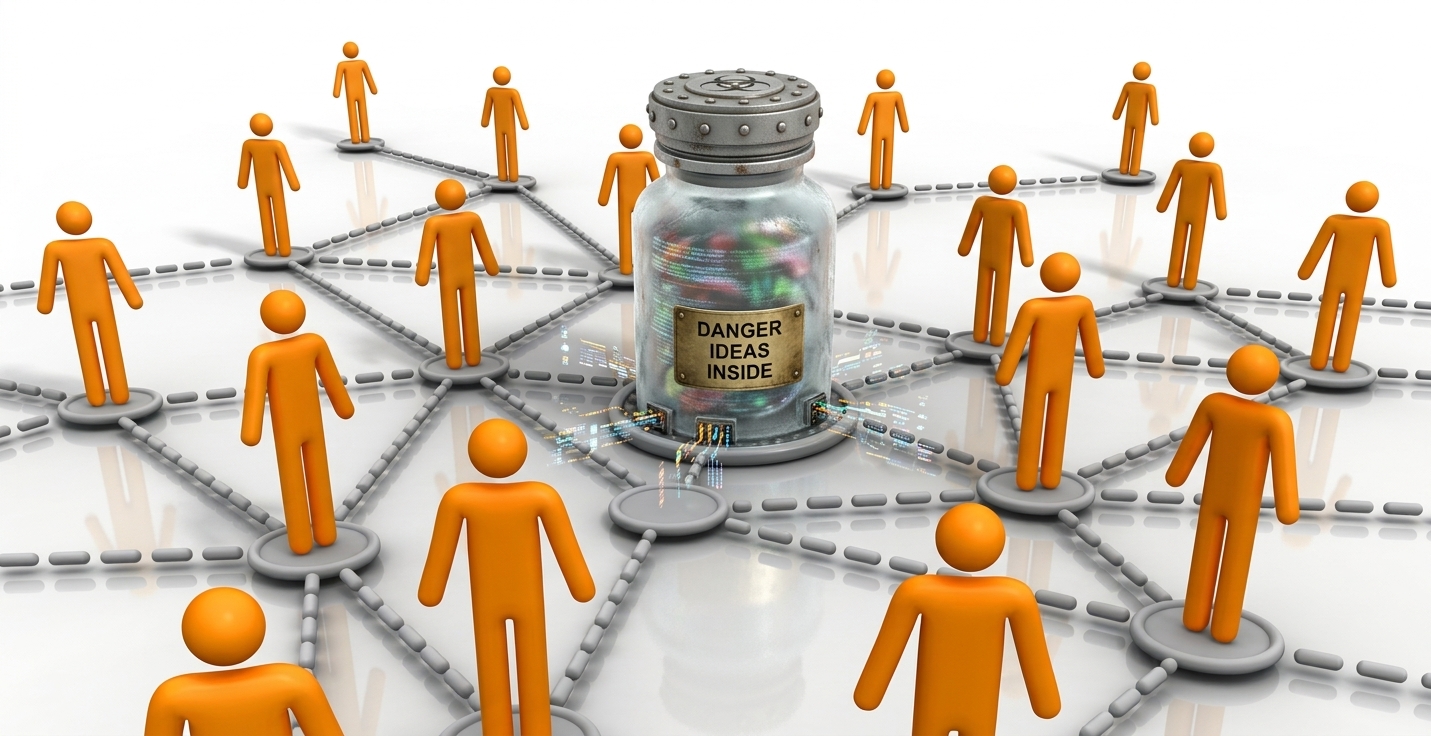
For anyone who regularly creates content, there is a shared ambition: that one of our articles or posts might go viral. It conjures up images of breaking the internet, attracting millions of views and briefly becoming an important global thought leader, at least until the next cat video appears. My definition is a little less ambitious.
For a regular blogger or content creator, going viral does not necessarily mean reaching millions. It means achieving a significant and sudden increase in the size of your audience beyond your normal sphere of influence. Perhaps an article reaches ten, fifty or even one hundred times the audience you might normally expect. The important point is that it escapes the boundaries of your usual network and begins to replicate itself through other people's networks. In that sense, virality can be seen as a form of social contagion. An idea, story, meme or post is adopted, passed on and disseminated, moving from person to person and network to network. And that raises an interesting question for anyone involved in communicating science:
Why does some information travel while other information, despite being scientifically excellent, simply disappears?
Where to start
Posting articles for over 15 years, I can confirm that genuine virality rarely happens. Most of my articles perform OK. Some do rather well. Some disappear without a trace, despite my conviction that they were clearly works of deep insight. For example, I still cannot fathom why my 2010 blog on the best science articles ever published tanked [1].
My first notable encounter with something approaching virality came in November 2025 with an article about the legacy of Professor James D. Watson [2]. The second came in July this year, with an article concerning the changing research landscape for scientists [3]. In both cases, the articles travelled far beyond my normal expectations. People outside my established network were actively commenting on the articles and sharing them with their own communities. It was an interesting experience, but it also raised an obvious question.
Why those articles?
Before getting too carried away with the psychology and neuroscience of blogging performance, there is one rather mundane contributing factor. You need an audience. Over the past 15 years, LinkedIn has been my principal communication platform. In around 2010, my network contained fewer than 500 contacts. Today, it contains over 7,000. That does not mean that since building a larger audience every post I make goes viral. Far from it.
But it does represent a much larger seed audience. As with a viral infection, every piece of content needs an initial group of people to encounter it, react to it and potentially pass it on. Without that primary infection, even the most brilliant article will simply disappear into the vast digital filing cabinet marked interesting but unseen. It should certainly encourage anyone involved in scientific communication to build an audience. But audience size alone isn't enough.
The real question is:
What makes somebody decide that your content is worth engaging with and sharing?
Why do people pass things on?
One of the most useful ways of thinking about what makes content infectious comes from Jonah Berger's work on why ideas spread. Berger summarised several important drivers of sharing in the memorable acronym STEPPS: Social Currency, Triggers, Emotion, Public, Practical Value and Stories [4].
Social currency is reasonably straightforward. People like to share things that make them look good. Sharing a particular article can make us appear knowledgeable, funny, insightful or simply ahead of everyone else. In science, sharing useful information can also signal that we are engaged with an important issue. Sharing someone else's content allows us to contribute to a conversation without having to create the original content ourselves. Then there are triggers: the cues that bring something back into our minds. The classic marketing example is the association between KitKat and ‘taking a break’. A regular experience becomes a reminder of a product or idea. In scientific communication, a major news event, regulatory announcement, scientific breakthrough or controversy can provide a similar trigger. The public element concerns visibility. Things that are visible are easier to imitate. If we can see other people discussing or sharing something, it acquires social legitimacy.
Practical value is also important. People like to share information that may genuinely help somebody else. An article that explains a complicated regulatory change, identifies a useful scientific resource or provides an answer to a common professional problem has a built-in reason to be passed on. I often share content with friends and colleagues via email saying:
"I saw this and thought of you."
That may be one of the most useful tests of scientific communication.
Is your content sufficiently useful, interesting or relevant that someone would actively think of another person who needs to see it?
Then there are stories. Human beings have been communicating through stories for considerably longer than we have been discussing PowerPoint presentations around the Neolithic campfire. A narrative provides structure, context and characters. It gives information somewhere to live in the memory [4].
And this is where the distinction between scientific information and scientific communication becomes important. A clinical trial may generate an enormous amount of technically important information. A regulatory submission may contain thousands of pages of carefully controlled data. A scientific publication may contain years of research. But scientific importance does not automatically make information communicatively effective.
A message still needs to be understood. It needs to be remembered. And, sometimes (almost always), it needs to be passed on.
The emotional engine
But the most powerful of Berger's STEPPS is emotion. Research has found that content provoking high-arousal emotions is more likely to be shared. This includes positive emotions such as awe and negative emotions such as anger and fear. Low-arousal emotions, including sadness, are less effective at driving transmission [5]. In other words, people do not necessarily share something simply because they agree with it. They share it because it makes them feel something strongly enough to do something about it.
The power of anger is particularly interesting — and rather worrying. Anyone who has spent time on social media knows that outrage can travel at remarkable speed. And nothing sparks anger more than misrepresentation. As Jonathan Swift wrote in The Examiner in 1710:
"Falsehood flies, and the Truth comes limping after."
Research examining moral outrage online has shown that positive social feedback for expressions of outrage can increase the likelihood that people will express outrage again in the future [6]. Research also confirms that negative emotional language spreads more widely than positive language in political discussions [7]. That does not mean negativity is a guaranteed route to virality. Nor should it be. The more interesting point is that positive high-arousal emotions can also be powerful. Awe, excitement and surprise can all encourage sharing [5]. That has an important implication for scientific communication.
Science does not have to be sensationalised to be engaging. It has to be made meaningful.
The importance of surprise
Surprise is particularly fascinating from a neuroscience perspective. Novel stimuli engage regions of the midbrain that include the substantia nigra and ventral tegmental area, often abbreviated to the SN/VTA. These areas are closely associated with dopaminergic reward signalling and learning. Research shows that the human SN/VTA responds to absolute stimulus novelty and may contribute to enhanced learning in the context of novelty [8]. There is therefore a plausible neurological explanation for something every communicator already suspects:
We pay attention when something is new.
This is one reason why scientific communication can be so difficult. The scientific community is continually generating genuinely novel information. But the people who need to understand that information may be confronted by an enormous volume of it. A biotech company may have a genuinely important discovery. A clinical development programme may have a fascinating story. A new regulatory development may have major consequences. A publication may contain an important finding. Yet none of those things guarantees attention.
The challenge is not necessarily creating more information. It is making important information visible and meaningful without compromising its scientific integrity.
The algorithm in the room
Of course, modern virality is not simply a matter of one person sharing a link with another. Not everybody sees the same internet. We are not all watching the same channel. In simplistic terms, people may be spending their time on LinkedIn, X, TikTok, Instagram or the wider internet. Each has its own content ecosystem.
The concept of the filter bubble, popularised by Eli Pariser, describes the increasingly personalised information environment created by our previous online behaviour [94]. What we search for, like, click on and share influences what we are subsequently shown. This has advantages. Algorithms can help put highly relevant content in front of people who are genuinely interested in it and most likely to share our interests.
But there is a downside. Content can become trapped within a highly specific audience. It may perform extremely well inside one professional, political or social community without ever reaching beyond it. This is related to, but distinct from, the concept of echo chambers. A filter bubble is primarily associated with algorithmic personalisation. An echo chamber is more socio-psychological, arising when groups of like-minded people preferentially interact with one another and reinforce shared beliefs.
Research across major social-media platforms has shown how homophily and information diffusion among like-minded users promotes echo chambers [10]. The crucial point is that content does not travel across a neutral population. It moves through networks shaped by relationships, beliefs, algorithms and social identities. You could say that these populations have inherent infectability.
And understanding that is becoming increasingly important for scientific communicators.
Can we manufacture virality?
Don't believe what anyone tells you. There is no reliable recipe. If there were, everyone would already be using it, and things would be considerably worse than they already are. Virality results from a confluence of factors. A sufficiently large seed audience helps. Social currency matters. Practical value helps. Stories make ideas memorable. Visibility encourages imitation. Novelty attracts attention. And emotion is the accelerant.
But perhaps there is a more useful way of thinking about all this. The objective of scientific communication should not be to make something go viral. It should be to make something matter.
For a pharmaceutical or biotech company, the question isn't whether a clinical document will generate a million views. It is whether the right investigator understands the study. Whether the right KOL engages with the data. Whether a publication communicates its findings clearly. Whether a regulatory argument is understood. Whether an investor understands the significance of a development programme. Whether a patient can understand information that affects them. Whether an important scientific idea reaches the people who can do something with it. In other words:
The objective isn't maximum reach. It is meaningful reach.
From scientific information to scientific impact
This is where scientific writing and communication become much more than an exercise in putting words on a page. A good scientific communicator has to understand the science. But they also have to understand the audience. They need to know what matters to that audience, what will confuse them, what will engage them and what they are likely to remember. They need to understand context.
They need to recognise when a technical issue needs explanation, when a complex story needs simplifying and when simplification would actually distort the science. And they need to understand that a document can be scientifically impeccable and still fail to communicate effectively. This applies across the pharmaceutical development process. The writing therefore needs to do more than transmit information. It needs to connect information with people.
That is something we have spent a long time thinking about at Niche. Our work sits at the intersection between scientific expertise and communication: helping biotech and pharmaceutical companies turn complex clinical, regulatory and scientific data into documents and content that are clear, credible and fit for purpose. That might mean supporting a regulatory submission. It might mean publication planning and scientific dissemination. It will always mean taking a complicated scientific story and asking a deceptively difficult question:
What does the person reading this actually need to understand?
The title matters too
First impressions matter. Beyond the image that accompanies an article, titles remain critical [11]. A 2023 corpus-based study of 8,658 articles published in Science found that characteristics including title length, lexical sophistication and sentiment had modest but statistically significant associations with Altmetric Attention Scores [12].
Another study of healthcare articles found that papers with simple, declarative titles were more likely to appear in the Altmetric Top 100 [13]. More intriguingly, research examining social-media metrics of scholarly papers has noted that papers with funny titles, curious topics and what the authors described as the "usual trilogy of sex, drugs, and rock and roll" can be particularly popular on social platforms [14]. A much larger 2025 study analysing more than 130,000 papers found that promotional language in abstracts predicted greater online media mentions and higher Altmetric scores [15].
There is therefore a plausible hypothesis that words associated with novelty, controversy, danger or curiosity can increase the likelihood that scientific content gets noticed. But there is an important distinction. Attention is not the same as impact. A provocative title may earn a click. It does not necessarily earn trust. And in science, trust is rather more important than clicks. The communicator therefore has to balance two competing requirements:
Earn attention without sacrificing credibility. That is arguably one of the central challenges of modern scientific communication.
The real lesson from going viral
The articles that travelled furthest from my own network did more than simply present information. I believe they touched something that people were already thinking — or feeling — about. They connected with concerns about scientific legacy, professional identity and a changing research landscape. That, perhaps, is the real lesson.
Good communication does not necessarily tell people something they have never thought about. Sometimes it gives them a better way of thinking about something they already care about. And that is why the best scientific communication is not simply about what you know. It is about what your audience needs to know, why they need to know it and what they might do with it afterwards.
Your objective should not be to produce content designed simply to accumulate clicks. It should be to create something that generates a response. Something that makes people pause and think:
"Other people should read this."
When that happens, your message begins its journey into the great e-beyond. It may jump from one network to another, cross professional and geographical boundaries and occasionally break through the invisible walls created by algorithms and personal preferences. And when it does, the experience can feel almost mysterious. But it isn't magic. It is psychology, sociology, neuroscience, network effects and, inevitably, a little bit of luck.
Before you go
One last word of warning. There is a fairly strong body of research that supports a psychological impact that accompanies success. A 2023 CHI study examined creative labour among TikTok creators. Participants described experiencing considerable pressure after a video unexpectedly went viral. The sudden increase in views, followers and engagement created an expectation that they should reproduce the performance. Some creators found themselves repeatedly making variations of the successful content, even when they wanted to do something different. The researchers describe this as a disruption of creative routines and, importantly, report feelings associated with burnout and alienation from creativity[16].
Unexpected success → expectation of repeatability → deliberate replication → failure to reproduce → negative self-evaluation → increased effort → further failure.
A recent qualitative study involving 24 high-profile influencers specifically examined virality, social comparison and psychological wellbeing. Participants described viral success as highly rewarding and reported becoming emotionally dependent on engagement metrics. When subsequent performance declined, they reported anxiety, panic and a compulsive desire to recover the lost attention. The study also identified burnout and identity strain – what you might term ‘viral addiction’ [17].
It always best to remember that your content went viral because what you made happened to intersect with a particular audience, emotional state, cultural moment, algorithmic environment, network structure and sequence of sharing events, a.k.a. luck.
Oh — and one last thing before you go. Please like and share this article widely.
References

Get our latest news and publications
Sign up to our news letterResources
Social


Contact us
Address
Niche Science & Technology
Unit 26 Falstaff House
Bardolph Road
Richmond TW9 2LH
United Kingdom