I couldn’t think of anything to write about this week. After more than 300 blogs and 40 scientific manuscripts, I was unexpectedly defeated by a blank page. None of the usual creative tricks I recommend to others seemed to work [1][2][3]. It felt as if my brain had reached an information bottleneck.
Not being a neuroscientist, I have always been happy to envisage (incorrectly) that the brain works a little like a computer. The development of the PC occurred somewhat in parallel with my own career. During my PhD and post-doctoral studies, laboratory computers moved from the 8088 processor era through the arrival of Pentium architectures, and from 16-bit systems towards 32-bit and beyond. Machines that once seemed extraordinarily powerful quickly became obsolete. Memory expanded from kilobytes to megabytes, then gigabytes and terabytes. Processing speeds accelerated and data storage grew beyond anything we could have imagined.
I used to make a small amount of extra cash helping my academic colleagues install upgrades to their PCs. My sales pitch was simple: compare your computer’s architecture with the human brain.
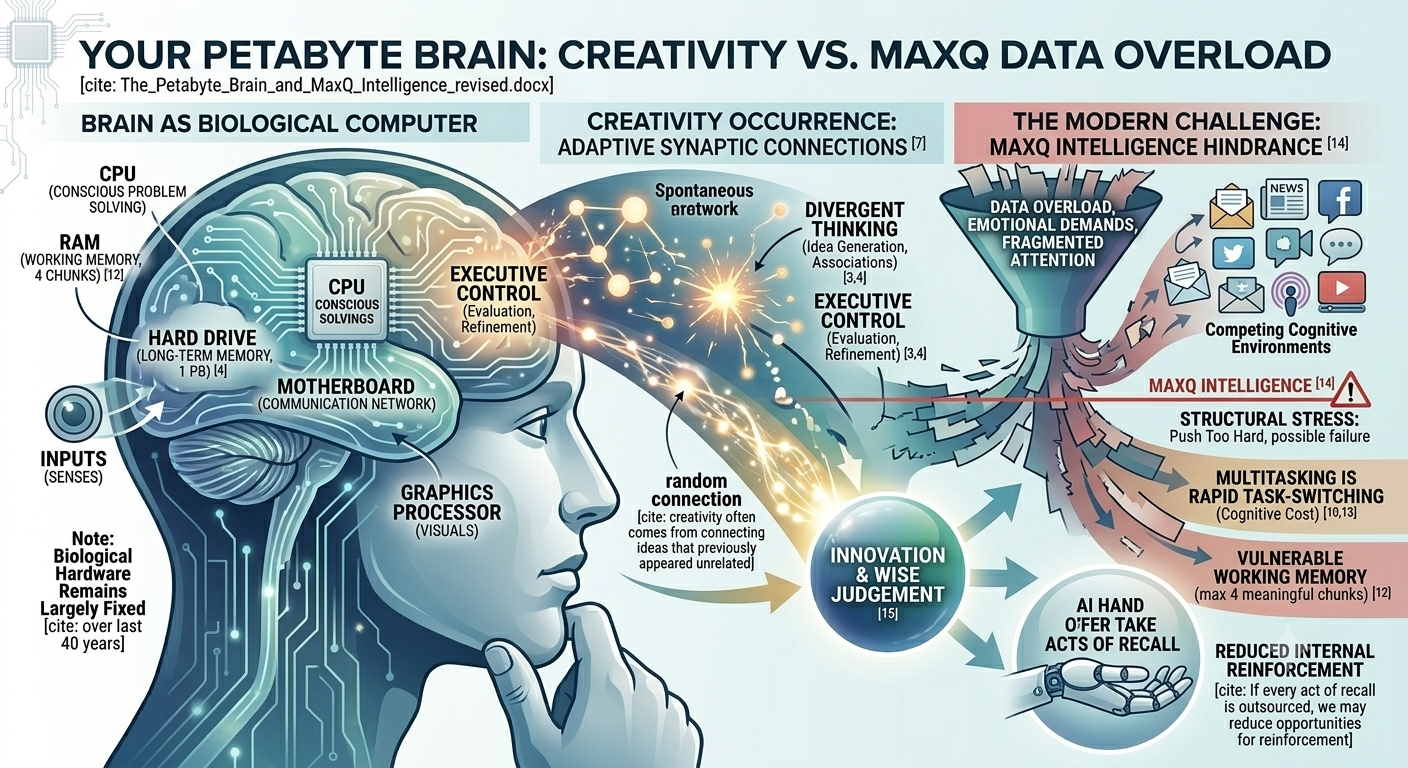
The analogy was attractive. The CPU could be compared loosely with conscious problem solving. RAM resembled working memory, temporarily holding information that we are actively processing. The hard drive represented long-term memory. The motherboard acted like a communication network, connecting components together. Input devices resembled the senses, gathering information from the environment. A graphics processor had similarities with specialised visual processing systems, while the power supply provided the energy needed to keep everything functioning.
Of course, the comparison only goes so far. The brain is not a biological computer with files, folders and a central processor. It is a living, adaptive system that changes itself continuously. Unlike computers, we cannot simply install more memory or replace an ageing processor. Over the last 40 years, I hope I have accumulated knowledge, experience and wisdom, but my biological hardware has remained largely fixed.
The challenge is that the world around us has not stood still. Human knowledge has expanded at a rate that makes individual mastery of any single subject increasingly difficult. This raises a fascinating question: does the brain have a maximum information capacity, or is the real challenge is keeping up with an ever-more complex world?
Popular culture has explored the idea of the limits and augmentation of memory capacity for decades. In the 1995 science fiction film Johnny Mnemonic, a Keanu Reeves’character's memory capacity becomes dangerously overloaded. The scenario was fictional, but the underlying concern feels increasingly relevant.
Just what are our limits? One notable estimate from 2015 suggested that the storage capacity of the human brain may be around a petabyte, approximately one million gigabytes. The number is based on analysis of synaptic information storage in the hippocampus [4]. The idea captured public imagination because it suggested that the brain could theoretically hold vast quantities of information.
However, the comparison is easily misunderstood. The brain is not a hard drive slowly filling with digital files. Memory is dynamic. Information is continuously reorganised, integrated, strengthened, weakened and sometimes discarded. Memories are not stored as perfect copies but reconstructed through distributed networks of neurons and synapses [5]. This distinction is critical. Digital storage preserves exact information. Biological memory is influenced by emotion, context, repetition, sleep, stress and meaning. Each act of remembering is a unique reconstruction of the original experience [6].
The human brain contains approximately 86 billion neurons connected through trillions of synapses, but these connections do not function like simple computer switches. Synapses change strength over time, allowing the brain to adapt according to experience and need [7]. The petabyte analogy is therefore useful as a metaphor, but it should not be interpreted as a literal measurement of human memory.
The real limitation is probably not storage capacity. It is access, organisation and relevance.
Forgetting is often viewed as a failure, but neuroscience suggests it is an essential feature of an efficient brain. Neural systems prioritise information that remains useful. Experiences that are repeatedly reactivated through conversation, writing, teaching or practical use become easier to retrieve, while unused information becomes less accessible [8]. This means the brain is not designed to preserve everything. It is designed to preserve what matters for future decisions.
A childhood memory may remain vivid decades later, while an important conversation from last week may vanish into thin air. Emotional significance alone does not guarantee permanence. Any student knows that reinforcement and integration determine whether information remains accessible. This process best reflects the nature of neuroplasticity, the brain's ability to reorganise itself in response to experience. Networks that are repeatedly activated become more efficient, while those that are neglected may weaken [9]. Forgetting is therefore not simply a limitation. It is part of the brain's optimisation strategy.
Perhaps this is where creativity emerges. The brain is not a perfect archive. It is a system that continually combines fragments of knowledge, experiences and perspectives. Creativity often comes from connecting ideas that previously appeared unrelated, and just maybe this is where ideas come from, random connections.
Sadly, modern life increasingly challenges this adaptive system. For most of human history, information arrived relatively slowly, leaving time for those connections to work their magic. Today we manage continuous streams of email, messages, social media, online meetings, news alerts, podcasts, video content and AI-generated material. We are no longer simply consuming information. We are attempting to manage multiple competing cognitive environments. We are no longer interpreting data, at best we are simply remembering where we left it.
The problem is that the brain does not truly multitask. What we describe as multitasking is usually rapid switching between tasks, and each switch creates a measurable cognitive cost [10]. Frequent switching reduces efficiency and impairs working memory performance [11].
Working memory is particularly vulnerable to such task interruptions. Although early research suggested a capacity of around seven items, modern estimates suggest that effective working memory is closer to four meaningful chunks of information [12]. We therefore possess extraordinary long-term memory potential while having a surprisingly limited cognitive workspace [13].
This may be one of the defining challenges of modern life. We have access to almost unlimited information but limited ability to transform that information into understanding.
This leads to the concept of cognitive MaxQ. In aerospace engineering, MaxQ describes the point during launch when aerodynamic stress on a spacecraft reaches its maximum. Push too hard at the wrong stage and structural failure becomes possible. Could human cognition have a similar threshold? It seems fair to observe that information density, emotional demands, attentional fragmentation and decision complexity at some point exceeds our optimal adaptive range. Beyond this point, adding more information fails to improve performance. Instead it seems to create instability: distraction, decision fatigue, stress, impaired sleep and reduced capacity for deep thinking [14].
The recent advent of artificial intelligence adds another fascinating dimension. Tools such as large language models increasingly perform tasks once dependent on biological memory, including retrieval, translation, scheduling and aspects of reasoning. These technologies extend cognition beyond the boundaries of the individual brain. They can amplify human capability, but they also require thoughtful use. If every act of recall is outsourced, we may reduce opportunities for the reinforcement that maintains internal knowledge networks.
The question is therefore not simply how much information the brain can store. The more important question is how much information we can meaningfully integrate while preserving curiosity, creativity, judgement and wisdom.
It appears to me that modern challenge is not defeating technology. It is ensuring that technology remains a tool rather than becoming the environment in which our thinking becomes trapped. Creativity requires cognitive space. It requires time for reflection, periods of reduced external stimulation, opportunities for ideas to combine and permission for the mind to wander. The brain's default mode network, involved in internally focused thought and memory integration, appears to play an important role in creative cognition [15].
A civilisation focused only on information throughput risks confusing data with intelligence. Knowledge requires organisation. Wisdom requires interpretation, experience and values. The brain evolved not as an infinite archive but as a predictive system intended to navigate complexity. Its greatest strength is not the amount it stores, but the way it transforms experience into meaning. Perhaps the challenge of the future is not building a bigger mental hard drive. It is creating a data-rich environment ready and able to foster connections.
Fortunately, my own synapses eventually made an unexpected connection. My recall of MaxQ linked not to aerospace engineering but to an old sales pitch from my early days in the lab. The blank page was not empty after all. It was simply waiting for the right connection.
References

Get our latest news and publications
Sign up to our news letterResources
Social


Contact us
Address
Niche Science & Technology
Unit 26 Falstaff House
Bardolph Road
Richmond TW9 2LH
United Kingdom