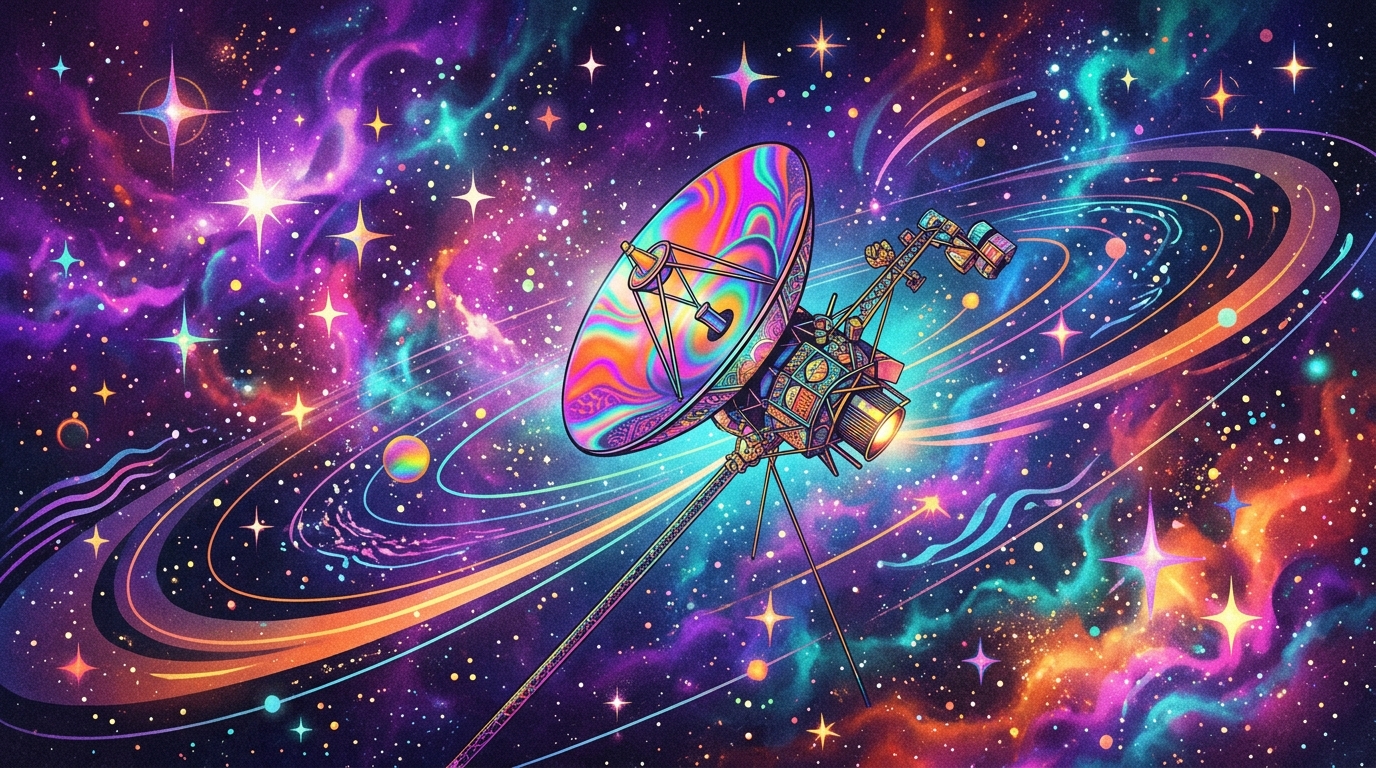
There is something rather extraordinary about a spacecraft travelling through the darkness of interstellar space, carrying technology designed in the 1970s, still communicating with Earth almost half a century after it left. Today, 18 November 2026, NASA's Voyager 1 has reached a distance of one light-day from our planet. That is approximately 25.9 billion kilometres, or the distance light itself travels in 24 hours. A radio signal sent from Earth now takes a full day to reach it, and another day for a response to return [1].
When Voyager 1 was launched in September 1977, I was already beginning my own journey into science. The world was rather different. There was no internet as we know it, computers occupied considerable amounts of office space, mobile phones were barely a concept, and artificial intelligence belonged more to science fiction than scientific practice.
Nearly 50 years later, Voyager is still travelling. It is an extraordinary achievement of engineering, scientific ambition and human persistence. But I think there is a rather more interesting lesson here, particularly for those of us working in science, medicine and the pharmaceutical industry. It is a lesson about the value of thinking beyond the immediate future.
A journey that outlasts its creators
The Voyager programme was conceived to explore the outer planets of our Solar System. Its two spacecraft transformed our understanding of Jupiter, Saturn, Uranus and Neptune, revealing extraordinary planetary environments, active moons and phenomena that had previously existed only as scientific speculation.
Voyager 1 subsequently crossed the heliopause in 2012, becoming the first human-made spacecraft to enter interstellar space. Its twin, Voyager 2, followed in 2018. Both continue to provide unique observations of the environment beyond the Sun's protective bubble [2].
The original engineers could not have anticipated everything that would follow. Nor could they have known that successive generations of scientists and engineers would still be managing the mission almost five decades later.
They were not simply designing a spacecraft to complete a particular task. They were creating something with the potential to deliver scientific value long after the people responsible for its construction had moved on. One day the Voyager missions may be viewed as mankind’s greatest scientific experiment.
That is a rather different approach to planning than we often see today, where short-termism is the name of the game. I too am guilty. Since COVID I have found that I stagger from one project to the next, unsure just. What value I am adding to the collective scientific endeavour.
Determined to address this, I set myself a challenge at the beginning of this year. I made a resolution to write 100 blogs. It was a fairly straightforward ambition, although perhaps slightly optimistic given everything else that competes for one's time when running a business. The intention was to keep writing about science, medicine, the pharmaceutical industry, technology and the wider issues that influence how we live and work. This is blog number 100.
Looking back, the interesting thing was not necessarily achieving my goal. It has been the motivation to follow ideas, explore connections between apparently unrelated subjects, revisit familiar scientific questions (all stored in my ideas graveyard [3]) from different perspectives and, occasionally, challenge some of the assumptions that underpin our industry. Like Voyager, although on a less grand scale, the value of the exercise has been in the journey rather than simply reaching the destination.
The problem with thinking in quarters
One of the defining characteristics of modern business is the expectation of immediate results. Investors want returns, companies want growth, research programmes need funding and projects are judged against milestones that are often measured in months rather than years. The pharmaceutical industry is particularly exposed to this pressure.
Drug development is a long, expensive and uncertain process. A discovery in the laboratory must survive preclinical investigation, clinical development, regulatory assessment and ultimately demonstrate that it makes a meaningful difference to patients. Yet the commercial environment in which this takes place is increasingly impatient.
Biotechnology companies must continually justify their expenditure, investors expect progress and promising research programmes can disappear when the financial conditions change. Sometimes the science has not failed; the funding or commercial appetite has simply run out. We saw this after COVID when VC funding of biotech appeared to dry up.
There is, of course, nothing inherently wrong with commercial discipline. Medicines cannot be developed without investment, and resources must be directed towards programmes with a reasonable prospect of success. But there is a danger that we become so focused on the next milestone that we lose sight of the bigger scientific questions.
Some of the most important discoveries in medicine have emerged from research that took decades to mature. Our understanding of immunology, genetics, molecular biology and the mechanisms of disease has been built on accumulated observations, experiments and ideas, often contributed by researchers who never knew how important their work would eventually become. Scientific progress rarely follows a straight line. It involves dead ends, unexpected observations, failed hypotheses and the occasional discovery that changes the direction of an entire discipline. Perhaps we should be rather more comfortable with the idea that not everything of scientific value can be measured within the next reporting period.
Keeping the mission alive
One of the most remarkable aspects of Voyager is not simply how far it has travelled, but how engineers have managed to keep it operating.
Its electricity comes from radioisotope thermoelectric generators, which convert heat from the radioactive decay of plutonium-238 into electrical power. That supply has gradually diminished, forcing engineers to switch off instruments and non-essential systems to conserve energy. The spacecraft is effectively being managed through a carefully planned process of technological retirement. Each decision is intended to extend the life of the remaining equipment and preserve the ability to collect scientific information. [2,4]
There is an important lesson here about institutional memory. Voyager has survived because successive generations of engineers have inherited the knowledge required to understand, maintain and adapt a system they did not necessarily design. They have had to understand decisions made decades earlier, work with technology that could never be updated or replaced and find solutions to problems that were never anticipated.
In the pharmaceutical industry, we are not always quite so good at this. Experienced scientists leave, companies are acquired, development programmes change ownership and project teams are reorganised. Sometimes the people who understand why particular scientific or regulatory decisions were made are no longer available when those decisions need to be revisited. We spend considerable effort documenting what we do, but documentation alone does not necessarily preserve understanding. A clinical study report can describe what happened during a trial, but it cannot always capture the experience, judgement and reasoning that informed the decisions along the way. This is particularly clear when Finance Directors and procurement departments push for lower prices completely unaware of the true value of a well-written clinical study report [5].
As artificial intelligence increasingly enters medical writing and clinical development, this becomes even more important. We may become exceptionally good at retrieving and processing information, but we should not confuse access to information with an understanding of its scientific significance. Perhaps one of the most important investments we can make is in preserving the knowledge and experience that allow science to build upon its past rather than repeatedly starting again.
What are we leaving behind?
There is another rather beautiful aspect of the Voyager mission. Both spacecraft carry a Golden Record, containing greetings in 55 languages, music, sounds from Earth and images intended to communicate something about humanity to any civilisation that might eventually encounter them. It is an extraordinary concept. The scientists involved were not simply sending a machine into space. They were sending a message about who we are, what we have achieved and what we consider worth preserving [6]. It makes me wonder what equivalent message we are leaving for future generations of scientists. It was one of the reason as I decided to share my own view of the scientific landscape.
Every year, millions of scientific papers are published. Clinical trials generate enormous quantities of data, and pharmaceutical companies invest billions in developing new treatments. Yet how much of this knowledge will remain accessible, understandable and useful to researchers 50 or 100 years from now? We are beginning to explore how AI might interrogate the accumulated scientific literature, identify relationships that individual researchers have overlooked and generate new hypotheses from discoveries scattered across decades of publications.
This is an exciting prospect, but it also reinforces the importance of preserving the scientific record and understanding the context in which knowledge was generated. Science is cumulative. Today's discoveries are built upon yesterday's observations, including those that initially appeared unimportant or inconclusive.
The real value of scientific research is therefore not always what it delivers immediately, but what it makes possible for someone else in the future.
One hundred blogs and a rather longer journey
So, here I am, at the end of my own little challenge: 100 blogs in a year.
When I started, I didn't have a particularly elaborate strategy. I simply wanted to keep writing, explore interesting subjects and perhaps encourage a few people to look at familiar things from a different perspective. The subjects have ranged across pharmaceutical development, clinical science, medical writing, artificial intelligence, research integrity, technology, human behaviour and some of the more unsettling consequences of scientific progress. Occasionally, the pharmaceutical industry has been the central character; sometimes it has simply provided the backdrop for a wider discussion about life.
Writing regularly has also reinforced something I have come to appreciate during more than four decades in science and the pharmaceutical industry: curiosity is one of the most valuable professional attributes we possess. It has also focused the microscope on myself, but that perhaps should be discussed in another blog. One thing I have observed though is that it is easy to become absorbed in the immediate demands of business, deadlines, budgets, regulatory requirements and the endless succession of things that need doing. But occasionally stepping away from those demands and exploring an idea simply because it is interesting can be surprisingly rewarding. I suspect that is why Voyager appeals to me so much.
Its creators could not have known what the spacecraft would ultimately achieve. They could not have imagined the world in which it would still be operating, or the generations of engineers who would continue its work. They simply had the ambition to build something that would go further than anything humanity had attempted before. Perhaps that is a useful philosophy for the rest of us. We should certainly embrace new technologies, accelerate scientific discovery and make better use of the knowledge we already possess. But we should also remember that progress is not always about speed. Sometimes it is about persistence, continuity, patience and the willingness to invest in something whose ultimate value we may never personally see.
Voyager 1 has now travelled for almost 50 years to reach one light-day from Earth. It will continue its journey long after its instruments finally fall silent, carrying its Golden Record into a future we can scarcely imagine. My own 100 blogs are a rather more modest contribution to the scientific record, and I suspect they are unlikely to be discovered by an alien civilisation in the next few thousand years.
But perhaps that is not the point. The important thing is to keep asking questions, keep exploring ideas and keep contributing to the journey. After all, we never really know which of the things we do today might prove valuable to someone tomorrow.
And if Voyager can keep going for nearly 50 years, I suppose there is no excuse for stopping at 100.
References
- NASA. Voyager One Light-Day Downloads. 18 November 2026.
- NASA. Voyager Mission and scientific achievements.
- Hardman TC. (2026). Your graveyard of ideas.
- Witze A. Voyager 1 is about to achieve a cosmic first: one 'light day' from Earth. Nature. 17 November 2026.
- Niche Science & Technology Ltd (2025). An Insider’s Insight into Clinical Study Reports.
- NASA. The Golden Record.