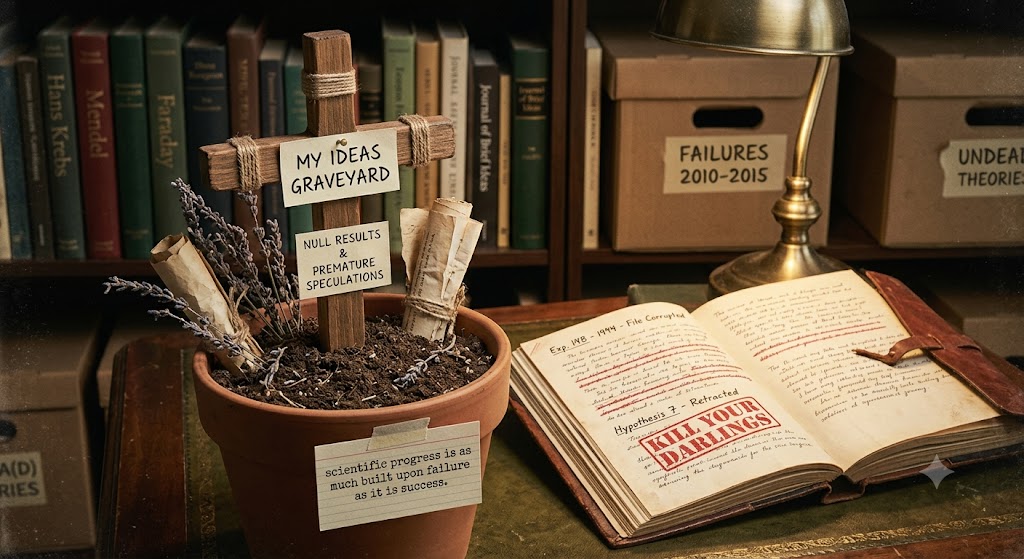
We all know that feeling. A great idea or hypothesis that promised to revolutionise the field collapses under the weight of contradictory arguments. A theoretical framework that seemed elegant on paper proves unworkable in practice. A blog post that was going to explain everything ends up explaining nothing.
You have two options, spend the next 12 months ‘flogging a dead horse’ or delete the files, close the folder, and move on. Both choices, however, represent a betrayal of the scientific process and of your future self.
Let me introduce you to the concept of an Ideas Graveyard, a systematic repository for your ideas that didn't make it to completion. Think about it for a moment, scientific progress is as much built upon failure as it is success. Your dead ends are not distractions but data. That grand hypothesis buried in your graveyard may hold the seed of an idea whose time has not yet come. One day it may reshape our understanding of the world or simply tell us how to make stronger coffee, who knows.
The Productivity of Failure
The history of science is not a winning narrative of steady progress towards a greater truth. It is a history of getting lost, of reaching dead ends, encountering impediments, and failing to answer research questions with the material and conceptual tools available at the time [1]. Yet these failures are not merely obstacles to be overcome; they are integral to the process of scientific advance.
Consider this story told to me by my PhD supervisor. His PhD supervisor was Professor Hans Krebs's. In the course of his research into the chemical process of urea formation, Krebs reached a dead end. His experiments had worked fine, but he was unable to answer his research question with the resources at his disposal [2]. This was not error in the technical sense, he had not made a mistake. He had simply exhausted the conceptual tools available to him. Only through reconceptualising the experimental situation could he move his hypothesis forward. The dead end was not a waste of time; it was a precondition for insight. Note, he went on to re-use the approach in his derivation of the citric acid and the glyoxylate cycles [3].
This pattern recurs throughout the history of science. When Faraday exhausted the conceptual tools in his study of magnetic curves, he was forced to retreat and reassess [4]. When β-decay researchers could not agree on whether the spectrum was continuous or discrete, controversy motivated Ellis and Wooster to abandon the disputed hypotheses entirely and develop an altogether different experimental approach [5]. In each case, what originally looked like failure resulted in radical advance as a result of a forced re-think.
Getting ‘stumped’ eliminates options and motivates you to reconsider the direction of your thinking; you must pivot! The dead end narrows the search space; the anomaly redirects attention to novel conceptual questions [6]. A ‘failed’ experiment is often the one that teaches us the most. As they say, “The Muses love alternatives” (Virgil, Eclogues, Book III circa 43 BC). The question is, are you going to be the one to benefit from all the work you have put in?
The Graveyard of Undead Theories
The scientific community has a troubled relationship with failure. As Ferguson and Heene documented in their influential analysis of publication bias, psychological science has developed a ‘vast graveyard of undead theories’, theories that are ideologically popular but have little basis in fact, sustained not by evidence but by the systematic suppression of null results [7].
The problem is structural. Journals prefer novel, positive findings. Authors assume that null results are unpublishable. Reviewers often react negatively to conclusions that fail to support hypotheses [8]. This creates a vicious cycle: researchers design studies to elicit positive results, engage in questionable research practices to achieve them, and the published literature becomes systematically distorted. It reinforces a ‘kill your darlings’ way of thinking. This refers to a famous piece of advice to prospective authors that they must ruthlessly cut sentences, scenes, characters and subplots if they don’t serve to advance your story. The saying was first expressed by Arthur Quiller-Couch circa 1916 (murder one's darlings) and was popularised more recently by Stephen King.
A 2024 survey found that 98% of researchers believe negative results are valuable—yet they remain difficult to publish [9]. The benefits are widely acknowledged: negative results help identify methodological issues, prevent duplication of unnecessary research, and inspire new hypotheses [10]. But the incentive structure works against these epistemic values. As one editorial board member noted, "it is genuinely disappointing when experimental results disprove a working theory," and this disappointment translates into a reluctance to share findings that contradict expectations [11].
The consequences are profound: When experiments with negative results cannot be published in high-impact journals, the wider research community aren’t able to learn from them and will often repeat failed experiments. This wastes research funds and time, delaying the progress of research [12]. The failure to publish failures is itself a failure of the scientific enterprise.
Premature Discovery and the Time of Ideas
It has long been recognised that the adoption of new scientific ideas is often resisted by scientists on account of it being against the science in vogue, professional specialisation and standing of the discoverers in the science hierarchy [13][14]. This was best conceptualised in the 1980s as delayed recognition, which highlighted how important scientific discoveries often go unappreciated for years (or even decades) because they could not "be connected by a series of simple logical steps to canonical, or generally accepted, knowledge" [15][16]. It seems that even in these more enlightened times delayed recognition remains alive and well [14][17].
We all learn at school how Mendel's work on plant hybridisation from 1866 remained unappreciated for 34 years, not because it was wrong, but because it couldn't conceptually be connected to prevailing scientific opinion. Biologists of the time believed hereditary units were blended together; Mendel's statistical approach seemed illegitimate in biological science. When Mendel's work was ‘rediscovered’ in 1900, a series of advances had provided the missing logical steps. Staining techniques had shown chromosomes to be a regular feature of the nucleus, giving Mendel's abstract units physical reality. The idea didn’t change; the world simply caught up. There are a host of other examples. Karl Jansky's 1933 discovery that radio static came from the Milky Way was ignored because scientists believed the galaxy was too weak a radio source to detect. Peyton Rous discovered the cancer virus that bears his name in 1910, but only received the Nobel Prize in 1966, once a leukaemia virus was isolated allowing his discovery to be appreciated. Back to Krebs, his short manuscript account of the citric acid cycle was rejected by Nature in 1937 [3].
The phenomenon of delayed recognition suggests something crucial about the nature of scientific ideas: they have a time. An idea that cannot be assimilated into the existing conceptual framework will be ignored, irrespective of its merit. But the framework changes. What is premature today may be foundational tomorrow – and this equally holds true for your ideas.
Building Your Ideas Graveyard
The scientific community has begun to recognise the need for institutional mechanisms to preserve the unpublishable. The Journal of Brief Ideas, for instance, provides a venue for short ideas of 200 words or less, archived, searchable, and citable, allowing researchers to get credit for ideas they cannot pursue at length. The journal explicitly welcomes small, negative, partial results, the very material that more mainstream journals reject.
Initiatives like the Journal of Negative Results in Biomedicine (sadly cancelled in 2017) and the Berkeley Initiative for Transparency in the Social Sciences represent similar efforts to address publication bias. It has been noted how replication studies that contradict original work are even scarcer than replication studies that confirm findings, and such studies are frequently referred to as ‘failed’ or ‘unsuccessful’, a framing that itself reveals the bias [18].
My Ideas Graveyard concept applies the thinking behind the Journal of Brief Ideas to your own work and takes it one step further. The suggestion is that once you have killed your idea you should give it a proper burial and perhaps revisit the graveyard from time to time. It is not merely a repository for unpublished negative results or citable brief ideas. It is built through the personal and professional practice of preserving the intellectual labour that goes into your dead ends, anomalies, and premature speculations.
In these days of (almost) limitless online storage there is no reason not to maintain your own repository. For example, for every one of the 300+ blogs I have written over the last decade I have two ‘failed’ projects. The oldest of these dates back to 1994. Things to consider when you inter your project:
It is worth taking a leaf from the book I Claudius, written by Robert Graves (published in 1934). In the book, our protagonist prepares his records for posterity. You should do the same. Plan for the future. For example, I just revisited my records from 1994 and found that the Microsoft Word documents would not open – what brilliant ideas have I lost?
Conclusion
The Ideas Graveyard is not a place of mourning. It is a place of hope. It is the recognition that the work you do today, even the work that seems to go nowhere, may be something you can build upon in 10 year’s time. It is the acknowledgment that science progresses not despite its failures, but through them.
Hans Krebs reached a dead end, retreated, reconceptualised, and advanced. Faraday exhausted his conceptual tools and had to find new ones. Mendel's work sat unread for decades before transforming biology. These were not detours from the path of science; they were the path.
The question is not whether to fail, failure is inevitable, but how to preserve the failure for future use. It is a commitment to the scientific value of the unfinished, the null, and the premature.
References

Get our latest news and publications
Sign up to our news letterResources
Social


Contact us
Address
Niche Science & Technology
Unit 26 Falstaff House
Bardolph Road
Richmond TW9 2LH
United Kingdom