Succeeding With Clinical Study Reports

The clinical study report (CSR) is a crucial document in the drug development and regulatory submission process. We provide key learnings to ensure prompt delivery of high-quality CSRs.

Learn how to:
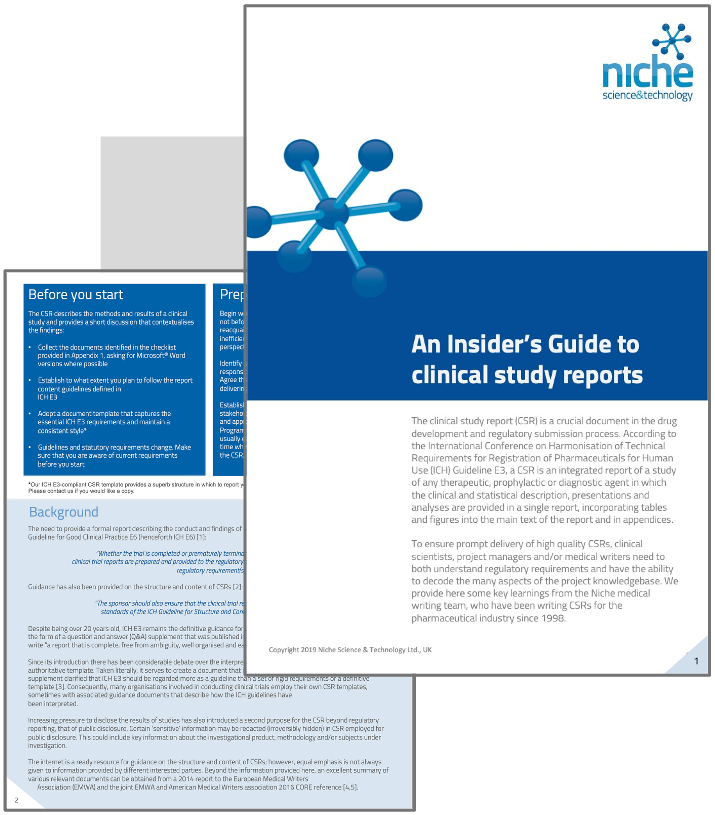
Schedule prompt delivery
Follow regulatory guidelines
Navigate report formats
Address challenging sections
Adopt the right style
Join the other 20,000+ pharma colleagues who have downloaded our Insider’s Insights.

Get your Insider's Insight

* indicates required

Frequently Asked Questions about the Insider’s Insight: Clinical Study Reports

To help you get the most out of our resource library, we have compiled answers to the most common questions regarding the development, application, and distribution of our specialist guides.

At Niche Science & Technology, we believe that sharing expertise is the first step toward industry-wide excellence.
A CSR, also referred to as a Clinical Trial Report (CTR), is a comprehensive, integrated document describing the design, conduct, results, and interpretation of a clinical trial, following the guidance provided in ICH E3. It includes clinical and statistical descriptions, tables, figures, and appendices.
CSR development should begin as soon as clinical data are available, or even earlier, to avoid inefficiencies caused by team members moving on and to prevent retrospective misinterpretation of trial details. Don’t forget you can populate the methodology sections of the CSR template with information from the protocol, statistical analysis plan and other sources before data become available to save time.
Essential items include the protocol and amendments, the trial procedures manual, the Statistical Analysis Plan (SAP), clinical data tables/figures/listings (TFLs), ethics documentation, and an ICH-compliant CSR template.
There are four main types:
- Full CSR – required for regulatory submissions and product approval.
- Supplemental CSR – for additional or delayed analyses.
- Abbreviated CSR – for trials not supporting primary efficacy claims.
- Synoptic CSR – acceptable for early safety, discontinued, or limited-scope trials.
Yes—but only for limited, non-interpretive tasks such as formatting, consistency checks, or draft text based strictly on structured sources. AI cannot interpret data, assess safety or efficacy, or replace human authors; full scientific accountability remains with qualified experts.

Get our latest news and publications

Sign up to our news letter

© 2025 Niche.org.uk     All rights reserved

HomePrivacy policy Corporate Social Responsibility
chevron-down