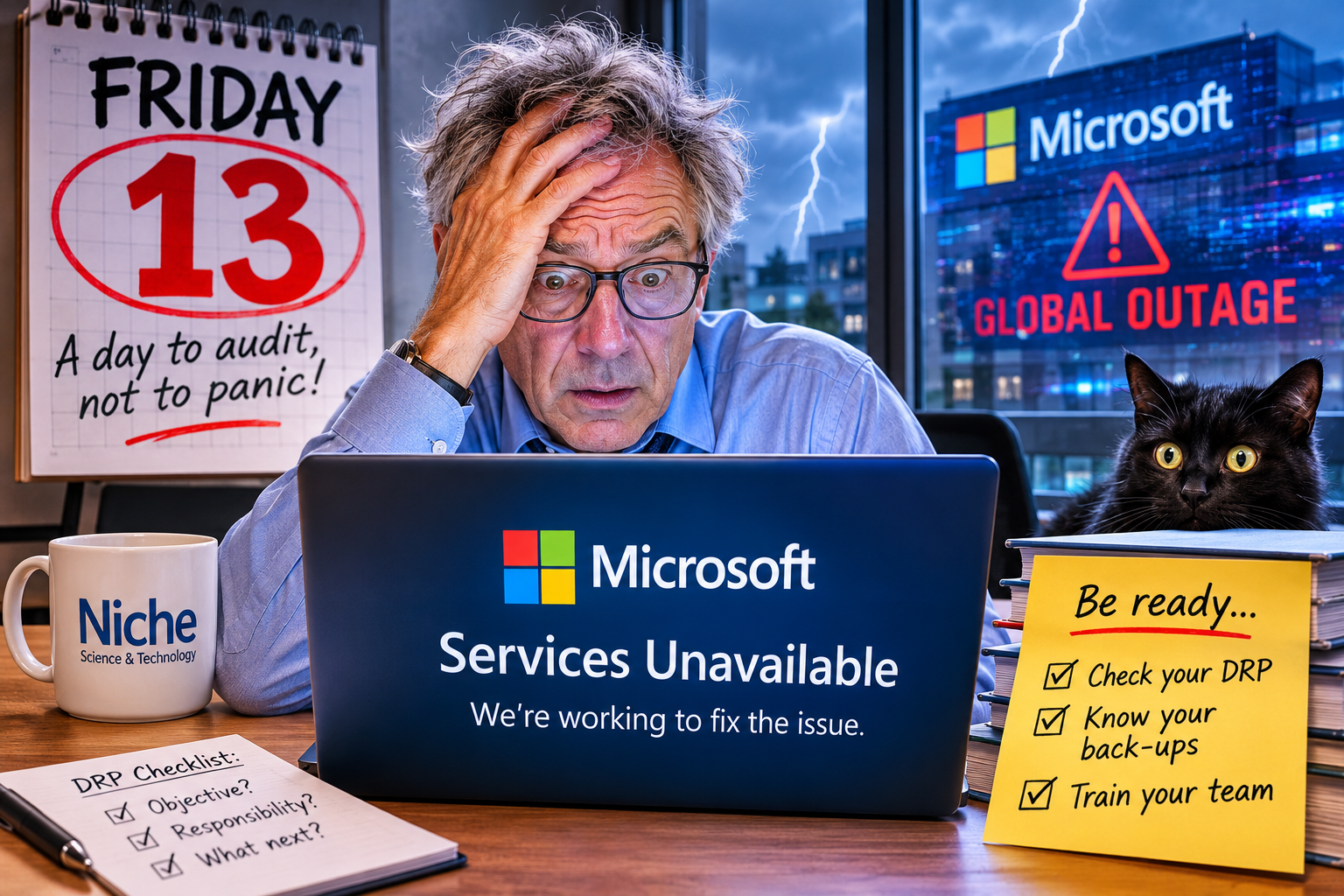
Here's a thought experiment: what if Friday the 13th is SIMPLY precisely because we've decided it is, and that decision is, in itself, the most interesting thing about the day? Perhaps today, the day when the world’s access to Microsoft has failed, is not the day to try to be ironic.
In an article I wrote in 2023 I made the case that there's no scientific evidence that bad things happen more often on Friday the 13th than any other day [1]. Studies of traffic accidents, stock market returns, and surgical outcomes find no pattern, or find the opposite of what superstition predicts. So far, so rational. But that's where most articles stop.
The superstition paradox
I previously observed that US businesses lose an estimated $800–900 million on Friday the 13th because people won't fly or do business. It also notes that a 2008 Dutch study found fewer traffic accidents on Friday the 13th (than on other Fridays). Contrastingly, there's the BMJ study that suggests a 55% higher chance of a hospital visit from a car accident, that was published in their Christmas issue (the journal's famously tongue-in-cheek edition).
What if we read these findings not as contradictions that rubbish the myth but rather as a single story? Fear changes behaviour. People stay home, drive more carefully, postpone flights. In the end, perhaps the day becomes safer because we treat it as dangerous. The superstition, in other words, is self-defeating, one of those rare cases where collective irrationality produces a rational outcome. That's not a debunking of Friday the 13th. That's the twist: the superstition works, just not in the direction anyone expected.
The number 13 is a victim of cognitive efficiency
The most underrated observation about the number 13 is that it simply feels ‘off.’ Twelve is everywhere, months, hours, inches, the times table we drilled in school. Thirteen is the first number that falls outside our comfortable zone. It's not evil; it's unfamiliar. And unfamiliar things require more cognitive effort, which we often misread as unease.
This reframes triskaidekaphobia (fear of the number 13) as a kind of mental shortcut gone slightly wrong, the brain's pattern-recognition system flagging an anomaly and the emotional system over-interpreting the flag. It's the same machinery that makes us suspicious of an odd-numbered queue or an irregular heartbeat. Thirteen isn't cursed. It's just the number that didn't get invited to our mental familiarity.
The real lesson isn't about luck
My previous article's final turn is its most practical: the antidote to superstition isn't rational argument, it's preparation. A disaster recovery plan (DRP) doesn't care whether the disaster is natural, supernatural, or man-made. It cares whether you've written down what to do when the biowaste meets the rotating blade assembly, the article's memorable phrase for things going wrong. On this of all days, how is your DRP working in response to the current crisis?
This is where the twist lands. Friday the 13th isn't a day to fear; it's a day to audit. The Quality Team at Niche repeatedly finds DRPs missing during reviews and vendor assessments, along with the SOP on writing SOPs. That's the real unlucky number: the undocumented procedure, the single point of failure, the business that depends on one person knowing what to do. On days like these you are left relying on your IT department’s ingenuity.
A new ritual for an old date
So, here's the reframe: instead of avoiding Friday the 13th, use it. Make it an annual checklist day. Ask three questions the article says every good DRP answers: What's the objective? Who's responsible? What do we do when it hits? Train someone else to run the business in your absence. Find the missing SOP before it finds you. And develop a response to a global Microsoft failure!
My 2023 observation ended with a quiet confession: planning for the worst and hoping for the best leaves me feeling like I have some control over my circumstances. That's not superstition. That's the most rational thing you can do on a day the calendar has arbitrarily marked.
I am certain that Microsoft will eventually overcome their woes. Thirteen will come around again. The question isn't whether it's unlucky. It's whether you'll be ready, and whether ‘ready’ is a document someone else can actually find and implement. In the meantime, I hope that you are using your time efficiently by reading pointless blogs.
References
- Hardman TC (2023). Paraskevidekatriaphobia or triskaidekaphobia.