You may have noticed that I have yet to cover England in my World Cup musings. That is because I am hoping to write about them when they are crowned champions on Sunday 19 July. OK, OK, a man can dream…
I thought England’s World Cup journey was coming to an abrupt end yesterday against the Democratic Republic of Congo, the subject of my previous post [1]. Harry Kane came to the rescue with a brace of goals that broke Congolese hearts. DR Congo were magnificent, but now they are gone. Having moved into the knockout stage of the competition, one defeat consigns the loser to a long flight home, thinking what might have been.
England’s future opponents could be Brazil, if both teams win their next matches. Brazil triumphed over Japan 2-1 after falling behind to a goal by Kaishu Sano. A delight to watch, Japan played with verve and dynamism, but alas they head home.
Football aside, Japan has made an exceptionally deep and practical contribution to science, combining fundamental scientific insights with masterful engineering capabilities. Japan has won 12 Nobel Prizes in physics and six in physiology and medicine, making it the most successful scientific nation in Asia.
Many consider Japan’s most influential scientist to be Hideki Yakawa, winner of their first Nobel Prize in 1949 for predicting the existence and approximate mass of the meson, which carries the force that binds protons and neutrons in the atomic nucleus.
However, my interest lies in the life sciences; specifically, Shinya Yamanaka, who was responsible for one of the most important conceptual advances in modern biology. He overturned the prevailing paradigm that fully differentiated adult cells are permanently locked into their developmental fate and that cell differentiation is largely a one-way process.
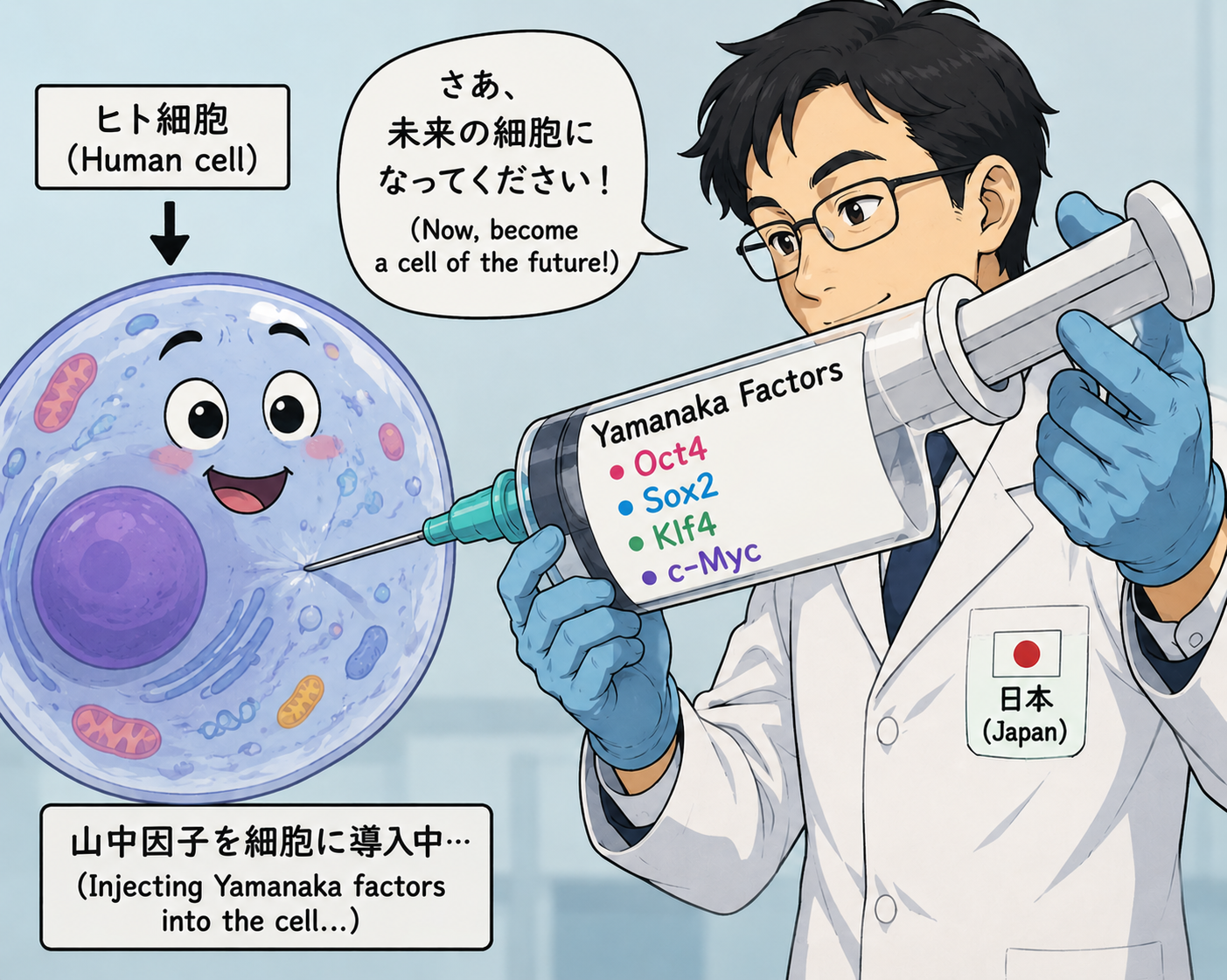
Before Yamanaka's work, scientists believed that once a cell became a fully mature skin, liver, or nerve cell, its identity was essentially fixed. Yamanaka's team identified a small set of genes coding for transcription factors that, when introduced into adult cells, reset them to an embryonic-like condition. The four key reprogramming factors, termed the Yamanaka factors, are: Oct4, Sox2, Klf4 and c-Myc.
Successful expression of the Yamanaka transcription factors switches off genes associated with the mature cell, switches on genes associated with embryonic stem cells, reorganises the cell's gene expression program and resets the cell to a state that can divide indefinitely and differentiate into almost any cell type in the body. Previously, human embryo tissue was the only source.
Termed induced pluripotent stem cells (iPSCs), these embryonic-like cells are capable of developing into any cell in the body and can be developed from a patient’s own cells. The practical implications have been profound. For example, drug screening can now use human cells in place of animal models. Similarly, they have enabled the creation of patient-specific disease models. Researchers have exposed iPSCs to specific growth factors and culture conditions to direct them into becoming different cell types such as neurons, cardiac, liver and retinal cells, raising the potential for tissue repair with little or no chance of immune rejection.
In March this year, the Japanese regulatory authority gave conditional approval to the world's first two therapies derived from iPSCs.
RiHEART® uses allogeneic cardiomyocyte sheets derived from iPSCs to treat severe heart failure. Sheets of cells approximately 3.5 cm diameter are attached to the heart under general anaesthesia. The location of the cell patch is determined by observing the condition of the cardiac surface and identifying a location where myocardial viability might be expected. A review of data on the first three recipients to undergo treatment suggests an improvement in heart failure symptoms [2].
AMCHEPRY® uses iPSC-derived neural progenitor cells that can replace dopamine-producing cells lost due to Parkinson's disease. In a small trial, six patients received bilateral transplantation of dopaminergic progenitor cells. Patients were followed for 24 months. There were no serious side effects. Most patients reported improvements in scores on the Movement Disorder Society Unified Parkinson’s Disease Rating Scale. The six patients showed a 20.4% reduction in motor symptoms for the OFF score (i.e., when the patients’ medications were not working) and a 35.7% reduction in motor symptoms for the ON score (when medications were working optimally) [3]. Neither treatment has shown any evidence of tumour formation, what has been a concern during development.
We have worked on many cell therapies over the years at Niche, including the isolation of T cells derived from individual patients to counter reactivation of adenovirus after allogeneic haematopoietic stem cell transplant, a personalised cell therapy. We have yet to work on iPSC-based therapies, but trials are ongoing in the US, EU and UK, so hopefully it is only a matter of time.
It has taken decades to translate Yamanaka’s discovery into patient benefit, but we are starting to see the rewards of that work. Shinya Yamanaka has shown us it is possible to break the paradigm. There is a tendency for us to think we sit at the summit of knowledge but there is always more to learn. It’s good to be reminded of that from time to time.
References
Get our latest news and publications
Sign up to our news letterResources
Social


Contact us
Address
Niche Science & Technology
Unit 26 Falstaff House
Bardolph Road
Richmond TW9 2LH
United Kingdom