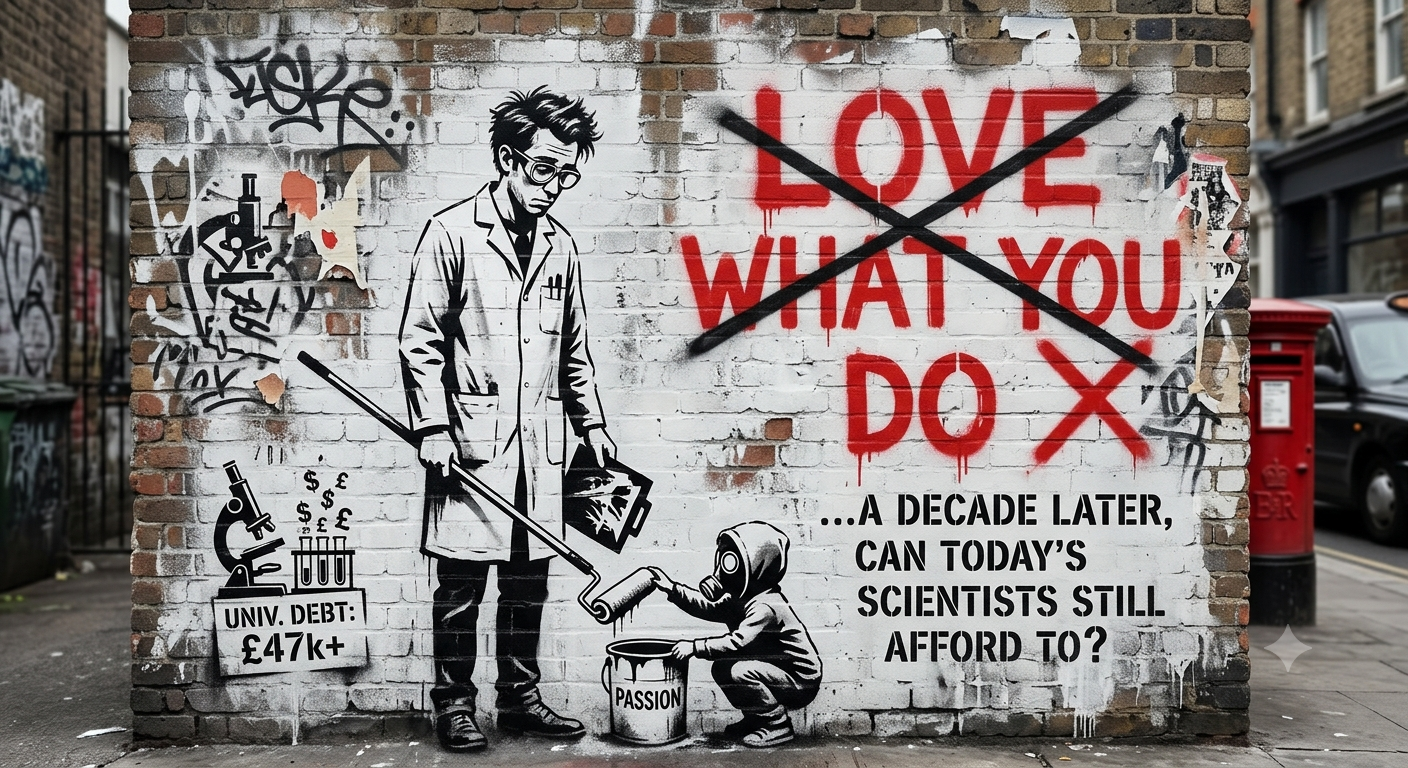
Ten years ago, in July 2016, I reflected on the future for school-leavers [1]. The article, ‘Love What You Do,’ distilled my decades of experience in science and clinical research into a piece of advice for the next generation. Its core message was simple yet, I believed, profound: that meaningful work, grounded in intrinsic motivation, a love of craft, and a commitment to mastery, is one of the most important contributors to a satisfying life. This was not about exam results, but about the durable fulfilment found in purposeful contribution, collaboration, and the simple joy of solving a complex problem [1].
In 2016, the broader context felt, if not entirely optimistic, then at least stable. My own children were progressing through secondary and higher education, and there existed a widely held social contract: that hard work, qualifications, and passion would be rewarded with opportunity. A decade later, as I look at the landscape facing today’s young scientists and graduates, I am compelled to ask a more difficult question. Is that promise still real? Or have the very structures that allowed my generation to “love what we do” been so fundamentally perverted that the advice itself now rings hollow?
The Changing Economics of Opportunity
The most immediate and jarring difference between the world of a decade ago and today is the sheer economic weight placed on the shoulders of young people. The cost of the very credentials that were supposed to unlock opportunity has skyrocketed. At the end of March 2026, the value of outstanding student loans in England reached an eye-watering £295 billion, a figure forecast to approach £500 billion by the late 2040s [2]. The average debt for a borrower who finished their course in 2023 was nearly £47,900 [2]. This is not merely an accounting figure; it is a profound psychological and financial burden that shapes career choices from day one.
While graduates do, on average, still earn more than non-graduates, the graduate premium is far more nuanced than aggregate data suggests [3][4]. For instance, when you control for working hours, the early-career hourly wage advantage for women shrinks dramatically [4], and for men in certain subjects, the return can be negligible [3]. This financial pressure is compounded by an escalating housing crisis. Research from the Institute for Social and Economic Research (ISER) demonstrates that the UK house price boom has significantly increased the intergenerational persistence of housing wealth, making it harder for the children of less wealthy parents to get a foothold [5]. Parental wealth is now a key determinant of a young person’s ability to move to high-earning areas like London, creating a self-reinforcing cycle of privilege [5][6]. This is the reality for today’s graduates: staggering debt, stagnant or insecure real wages, and a housing market that feels increasingly unattainable. We must ask, as a society, whether we have shifted from investing in future generations to extracting value from them.
The Promise of Science and the Decline of Experiential Education
For those of us who entered science in the 1980s, the appeal was clear: discovery, experimentation, and the opportunity to contribute to medicine and society. We learned our craft not just from textbooks, but through hands-on experimentation, independent thinking, and the shared struggle of getting an experiment to work. We were apprentices, learning the tacit knowledge that no protocol can fully capture.
This kind of experiential education is under threat. In my undergraduate studies we had Home Office licences and worked in teams of 2–3 on complex practicals for half of the week. A fellow 1980s graduate, now a professor in our university tells me that now a 100+ students stand around to watch a lab assistant perform those same experiments. A snapshot of UK laboratory practices reveals a marked decline in traditional hands-on demonstrations and lectures, replaced by digital simulations and pre-laboratory exercises [7]. While these tools have their place, they are (in my humble opinion) a pathetic substitute for the real thing. The challenges cited by instructors include a lack of time and resources to design effective practical sessions [7]. Practical science is expensive and time-consuming, and universities, facing funding constraints (despite the toxic salaries of university Vice Chancellors and Presidents), are finding it harder to provide extensive, immersive laboratory training. This erosion of hands-on experience directly impairs the development of critical thinking, troubleshooting skills, and scientific intuition. If we produce graduates who understand theory but lack practical judgment, we are failing to train the next generation of innovators.
Automation and the Disappearance of Scientific Apprenticeships
Alongside changes in education, the very nature of scientific work has evolved. The pharmaceutical research landscape is increasingly dominated by high-throughput screening, robotic automation, and algorithm-driven decision-making. Many entry-level positions, particularly in contract research organisations and manufacturing, are now primarily operational roles, focused on executing protocols and monitoring systems, rather than opportunities for scientific development.
The next generation of scientists will require hybrid expertise combining traditional experimental skills with computational literacy, automation, artificial intelligence, and data-driven approaches to troubleshooting, and validation activities rather than scientific discovery [8]. This is essential work, but it is a far cry from the hypothesis-driven, exploratory roles that previously formed the bedrock of a scientific career. The risk is that junior scientists become operators of technology rather than investigators, learning to maintain a black box rather than understanding the science inside it. The apprenticeship model, where one learns by doing under the watchful eye of a mentor-supervisor, is being systematically dismantled.
The Failure to Invest in People and the Arrival of AI
This is not an accidental outcome but the result of a consistent failure to invest in people. Over the past decade, governments of all stripes have underinvested in education, scientific infrastructure, and long-term capability building. A policy emphasis on short-term economic outputs has overshadowed the need to cultivate scientific talent. The current system often feels designed to channel young people into servicing their debt, rather than creating new knowledge. This calls into serious question the political ambition to establish the UK as a global scientific superpower. That’s a sick joke! You cannot build a superpower on the backs of an indebted, under-trained, and precarious workforce.
Into this already fragile system, we have introduced the most disruptive force yet: artificial intelligence. Generative AI and large language models present enormous opportunities for scientific productivity, knowledge synthesis, and drug discovery. However, the potential consequences for early-career professionals are profound. Recent research on the future of work under AI suggests that its most consequential risk is not immediate job displacement, but the gradual erosion of professional capability [9][10]. As AI automates the entry-level, developmental work that has historically served as the training ground for professional judgment, we risk dismantling the pipeline through which the next generation of experts is produced [9][11]. Henrik Skaug Sætra warns of the “Research Automaton,” where science-like output is produced with minimal meaningful human engagement, eroding the formative experiences crucial for researcher development [12].
If AI writes the first drafts, conducts the initial data analysis, and generates the basic code, what is left for a junior scientist to learn? How will they develop the critical ability to question a result, spot an anomaly, or design a clever experiment? The productivity gains are enticing, but they must be weighed against the capability-building losses. Are we inadvertently creating a generation that is highly educated, heavily indebted, technologically assisted, and scientifically underdeveloped? We generally celebrate how the scientific community ‘stepped up’ during the COVID pandemic. Pandemics by their nature a novel challenges to ‘the system,’ how will that depleted system fare when the next one cones along?
Conclusion: What Happens If We Get This Wrong?
In 2016, I argued that the life of a scientist was a privilege, not a burden, and that finding work you love was the ultimate goal. I still believe in the power of intrinsic motivation. A life organised around purposeful contribution is more likely to yield fulfilment than any external marker of success [1]. However, in the intervening decade, I have come to a sobering conclusion: passion alone is no longer sufficient.
Loving what you do is irrelevant if the economic structures, educational systems, and technological disruptions of our age conspire to remove the very pathways for meaningful participation. The belief that hard work and passion will be rewarded was a promise of my generation. For today’s young scientists, that promise has been broken by a system that saddles them with insurmountable debt, replaces their practical training with digital simulations, and automates their first steps on the career ladder.
If we get this wrong, we risk creating a hollowed-out scientific establishment. We will have a workforce that is expert in operating systems but lacking in deep scientific judgment. We will have plenty of data but very little wisdom. The path to discovery is forged not by efficiency or artificial intelligence alone, but by human curiosity, persistence, and the hard-won lessons of failure. As a veteran of this industry, I see the warning signs. I see a "talent formation fracture" underway [11]. This was a general feeling expressed by the audience at the 2026 ICR and the PCMG conferences. Who will train the next generation of scientists? I see the opportunity for proactive action, but it will not remain open indefinitely [11].
My challenge to policymakers, universities, employers, and industry leaders is this: if Britain genuinely wishes to lead the world in science, it must change its priorities. We must invest in people before technology, capability before productivity, and curiosity before efficiency. We must rebuild the apprenticeship models and experiential learning pathways that have been allowed to decay. We must ensure that a career in science is a viable path for all, not just the economically privileged. If we do not, we will not only betray the hopes of a generation but also undermine the very foundations of our future prosperity and health.
References
- Hardman T. Love or passion? Niche Science & Technology [Internet]. 2016 Jul 12
- Hubble S, Bolton P. Student loan statistics. House of Commons Library [Internet]. 2026 Jun 24 [cited 2026 Jul 13]. (Research Briefing SN01079).
- Grove J. Graduates out-earn peers with same GCSEs but no degree. Times Higher Education [Internet]. 2026 Jun 25.
- Adamecz A, Dickson M, Shure N. Is the graduate premium bigger for women? We need more than earnings data to know. LSE Impact of Social Sciences Blog [Internet]. 2026 Jan 15.
- Sturrock D. How do house prices affect social mobility? ISER Working Paper Series [Internet]. 2026 Jan 12
- Sturrock D. Essays in the economics of wealth inequality and intergenerational mobility [PhD thesis]. London: UCL (University College London); 2026 [
- Sellberg C, Nazari Z, Solberg M. (2024). Virtual Laboratories in STEM Higher Education: A Scoping Review. Nordic Journal of Systematic Reviews in Education 2(1) (2024).
- Musslick S, et al (2024). Automating the Practice of Science -- Opportunities, Challenges, and Implications. arXiv:2409.05890 [cs.CY]
- Rinta-Kahila T, Penttinen E, Salovaara A, Soliman W, Ruissalo J. The Vicious Circles of Skill Erosion: A Case Study of Cognitive Automation. Information and Organization. 2023;33(4):100487
- Steenmans I. Four Futures for Professional Capability Under AI: An exploratory scenario analysis. London: UCL Science, Technology, Engineering and Public Policy (STEaPP); 2026
- Rashidi S. Future of Work in the Age of Automation, Augmentation, and Agentic AI. M-RCBG Working Paper No. 276. Cambridge (MA): Harvard Kennedy School; 2026 Jul
- Sætra HS. The rise of the research automaton: science as process or product in the era of generative AI? AI Soc. 2026;41(3):1865-79.