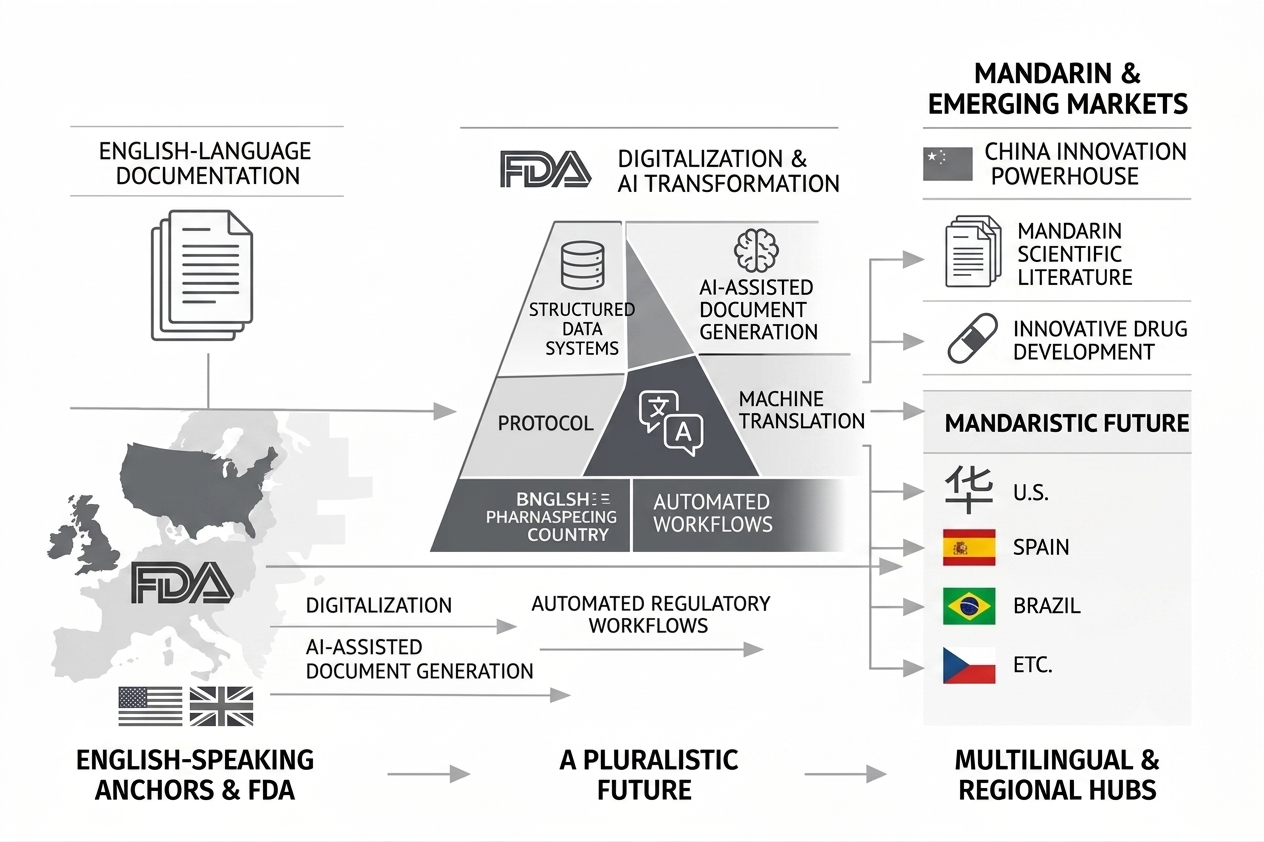
For half a century, English has served as the uncontested linguistic backbone of the global pharmaceutical industry. From the laboratory notebook to FDA submission, from the investigator brochure to the patient information leaflet, English has been the de facto language of drug development. This dominance, however, is no longer a given. Emerging economic pressures, rapid technological transformation, and the rise of China as an innovation powerhouse are collectively challenging the assumption that English will remain the industry’s sole operational language over the next 5–10 years.
The ascendancy of English is neither accidental nor merely cultural; it is a direct consequence of market economics and regulatory power. The US has long represented the world’s largest and most profitable pharmaceutical market, creating a powerful incentive for companies to conduct development programmes in a manner aligned with the expectations of the US Food and Drug Administration (FDA). The concentration of major pharmaceutical companies in English-speaking countries further cemented this dynamic [1]. Simultaneously, the historical predominance of English-language scientific publishing meant that researchers who did not publish in English risked invisibility [2].
This environment generated vast quantities of English-language documentation: protocols, investigator brochures, clinical study reports, regulatory submissions, safety reports, and standard operating procedures. Multinational organisations adopted English not by mandate but by practical necessity, enabling global clinical trials and regulatory interactions. For decades, this self-reinforcing cycle made English the indispensable lingua franca.
The Weakening US Profit Magnet
The most immediate threat to English’s dominance comes not from abroad but from within the US itself. Growing bipartisan political efforts to reduce domestic drug expenditures, through pricing reforms, reimbursement controls, and negotiation mechanisms for government health programmes, are gradually eroding the extraordinary profitability that once made the US market the undisputed centre of gravity. If US profitability becomes less dominant relative to other markets, the economic rationale for maintaining English as the sole operational language weakens substantially.
While the United States will most likely remain highly influential, its relative dominance is already being challenged by rapidly growing markets in Asia and Spanish-speaking regions. Furthermore, Brexit has diminished the regulatory and economic influence of the United Kingdom across Europe, removing one of the key English-speaking anchors on the continent. As capital and clinical trial activity flow toward regions with lower costs and faster patient recruitment, the linguistic centre of gravity is going to shift.
The Decline of the Document-Centric Era
Perhaps the most profound challenge to English’s position is technological. Historically, language served as the primary vehicle for transferring information across the drug development lifecycle. However, digitalisation, structured data capture, electronic health records, integrated clinical platforms, AI-assisted document generation, and automated regulatory workflows are rapidly reducing dependence on traditional narrative documentation [3][4][5].
Large language models and semantic-driven approaches are already being deployed to automate portions of clinical and regulatory writing, diminishing the operational advantage previously enjoyed by native English-speaking organisations [3][4]. As van der Schaar and colleagues have argued, artificial intelligence is poised to revolutionise clinical trials, shifting the focus from narrative documentation to end-to-end structured data systems [5]. In this emerging paradigm, linguistic barriers become far less significant than they were during the document-centric era.
Moreover, digital trial technologies and protocol optimisation tools are reducing the number of protocol amendments and simplifying development processes, thereby decreasing the overall documentation burden [6]. When fewer documents are required, the language in which those documents are written matters less. Machine translation and large language models further erode the residual advantages of English, enabling seamless multilingual workflows that were unimaginable a decade ago [2].
A Changing Linguistic Ecology
The most geopolitically significant challenge to English comes from China. Over 10 years ago, the Head of my son’s school announced that the future was ‘out-East’ and they would be dropping German for Mandarin. As you can see, English is not the only language: English ranks first because it is the dominant global second language, with over a billion people speaking it in addition to their native language. However, Mandarin Chinese has the largest number of native speakers and Hindi is growing due to India’s large and expanding population. Spanish remains one of the most widely spoken native languages across multiple continents.
| Language | Approx # Speakers | Approx # Native Speakers | Major Regions | |
| 1 | English | ~1.49 billion | ~372 million | Global; especially the UK, US, Canada, Australia, India, and many international contexts |
| 2 | Mandarin Chinese | ~1.18 billion | ~988 million | China, Taiwan, Singapore, and Chinese diaspora communities |
| 3 | Hindi | ~611 million | ~347 million | India, Nepal, and South Asian diaspora communities |
| 4 | Spanish | ~561 million | ~487 million | Spain, Latin America, the United States, and elsewhere |
| 5 | Arabic* | ~335 million | Varies by dialect | Middle East and North Africa |
*Arabic is often counted differently because it comprises numerous regional varieties (Egyptian Arabic, Levantine Arabic, Gulf Arabic, etc.), while Modern Standard Arabic is primarily a learned written language.
Historically viewed as a manufacturing hub for generic medicines and active pharmaceutical ingredients, China has undergone a remarkable transformation into a source of innovative drug development [7][8][9][10]. Evidence now shows that China contributes a substantial and growing proportion of global clinical development activity and is increasingly generating novel therapeutic candidates rather than merely producing copies of existing drugs [7][9].
The implications of this shift away from the English language are profound and frequently underestimated. Unlike many countries that largely adapted to English for scientific communication, often out of necessity, China has maintained a strong institutional commitment to Mandarin across government, regulation, education, and business. This is not a minor preference but a deep-seated linguistic ecology. For non-Chinese. Mandarin’s tonal pronunciation and character-based writing system often requires substantially greater investment from adult learners. So, there aren’t going to be that many early adopters.
As Chinese pharmaceutical innovation expands, global organisations will increasingly need to engage with Chinese-language scientific literature, regulatory guidance, digital platforms, and commercial partnerships. The shift towards Asia is already being accelerated by speed advantages and lower regulatory barriers, influencing global drug development timelines and investment decisions. While the existing body of English-language scientific literature serves as a powerful anchor for English, technology could easily overcome this inertia. Machine translation, if sufficiently trusted and validated, could render the historical archive accessible in any language.
A Pluralistic Future
Taken together, these forces suggest that there not be a future lingua franca of the pharmaceutical industry. Rather, it is likely to be a hybrid system combining English, Mandarin, and machine-mediated translation technologies. Future pharmaceutical professionals, particularly medical writers, regulatory affairs specialists, and clinical researchers, may require either direct bilingual capabilities or, more probably, fluency in working with AI-assisted multilingual workflows.
This evolution will have a significant impact on medical writing as a professional skill. Our premium will shift from flawless English prose to the ability to manage information quality, regulatory coherence, and cross-linguistic consistency using digital tools. Medical writers who can operate effectively across English and Chinese scientific ecosystems, augmented by AI, will be those who hold a distinct competitive advantage.
Conclusion
English is not going to disappear as the language of global pharmaceuticals any time soon. The installed base of English-language documentation, regulatory precedent, and scientific literature is too vast to be disregarded. Equally, although English is far from easy, with its inconsistent spelling, vast vocabulary, and reliance on idiom, it can generally be learned to a functional professional level (I am told more quickly than Mandarin). However, its unquestioned dominance is likely to gradually evolve into a more pluralistic system, driven by digital technologies, distributed innovation, and the growing influence of China.
The future competitive advantage in pharmaceutical development is likely to lie less in fluency in a single language and more in the ability to operate effectively across multilingual, AI-enabled scientific ecosystems. For an industry built on global collaboration, that may prove to be not a threat, but an opportunity (particularly if you can manage tonal languages).
References

Get our latest news and publications
Sign up to our news letterResources
Social


Contact us
Address
Niche Science & Technology
Unit 26 Falstaff House
Bardolph Road
Richmond TW9 2LH
United Kingdom