I recently had the good fortune of a long (enforced) hospital stay. Thank you to the NHS for hosting me. Fortunately, I started my working life in hospitals and have worked in more than a few. You could say that I am very comfortable in hospitals and I love hospital people.
During my recent incarceration, I spent my days phasing in and out of consciousness; intermittent alertness would replace opioid-induced stupor in a frustrating cycle on the road to recovery. After the first few days, my wife brought me my laptop, expecting me to relieve the boredom of an extended stay by watching movies and browsing the internet during my more alert and lucid moments.
I have no recollection, but at some point, I must have started using the laptop to write. After a few weeks, it seems I had generated pages and pages of thoughts and anecdotes (some of which I posted on my LinkedIn feed and on Facebook). The enforced break from my day-job, running Niche, allowed me to do what I had forgotten I loved: write. They say that necessity is the mother of invention, and having my jaws wired together meant that the laptop became one of the only ways I could communicate. I wanted to let people know that despite the various tubes, wires and physical disfigurement, I was the same person inside.
Over time I wrote a variety of blogs and articles. I created sketches, lists, Microsoft PowerPoint slides and plans—with little awareness of what I was doing. With limitless time (or so it seemed) I was like a kid in a candy shop. Prior to the accident, I never had time for anything but work. I even started to read again—non-work-related books. The joy! My wife bought me the book Ikigai by Héctor Garcia and Francesc Miralles [1], and I once again felt the profound effects you can get from reading about life in all its forms.
Ikigai is a phrase that the Okinawan community in Japan coined to define ‘purpose’. The term is composed of two Japanese words: iki (life) and gai (the realisation of what one expects and hopes for). There is no standard definition of a single person’s ikigai; it is beautifully unique for all of us. Our personal ikigai embodies our ‘identity’, the deep reason or meaning behind why we do what we do. It is believed that once we have achieved the level of awareness necessary to define our ikigai, we become more capable of triumphing over adversity. Our personal ikigai gives us clear and concise direction in the face of the most harrowing adversities.
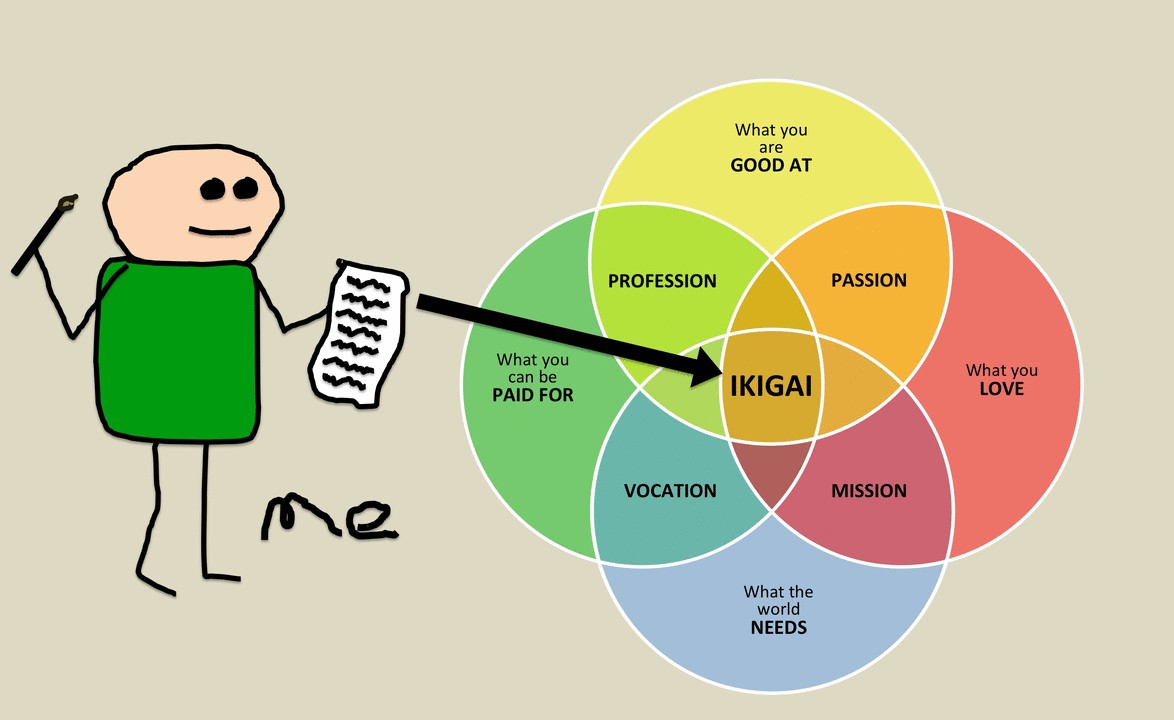
The book that my wife gave me, like many popular Western texts, presents ikigai through a famous four-circle Venn diagram [1]. In this framework, you find your purpose at the convergence of four primary elements: What you love (your passion), what the world needs (your mission), what you are good at (your vocation), and what you can get paid for (your profession) [2]. Where these four elements overlap is seen as the source of value or what makes one’s life truly worthwhile. Interestingly, while it incorporates financial aspects of life, ikigai is more often used to refer to the mental and spiritual state behind our circumstance, as opposed to our current economic status. By necessity, having focused on ensuring everyone in Niche gets their mortgages paid for the last 20 years, I feel that I had lost my sense of ikigai.
However, reflecting on my experience and the literature available at the time, it is important to acknowledge a critical nuance. The popular four-circle Venn diagram is not the traditional Japanese concept of ikigai. Its origin appears to be a Western adaptation. In its original context, particularly as explored by figures like psychologist Meiko Kamiya [3], ikigai is less about a singular, grand, career-focused purpose and more about the appreciation of small joys and the feeling that life is worth living. It exists in the ordinary moments—the first sip of morning coffee, the satisfaction of a job well done, or the warmth of family. While the Western model provides a useful framework for reflection, it can inadvertently narrow the concept into a tool for career optimisation, stripping away its deeper philosophical and emotional roots.
Now, I am not necessarily ‘bought-into’ the concept that when you have found your ikigai, it provides us with a guiding light for overcoming fear and uncertainty. However, 5 months on from my accident and I feel I have escaped any mental scars associated with the trauma—apart, perhaps, from when I had the drains removed from my head (yuck!).
Despite my scepticism, the evidence base for the health benefits of ikigai—or at least its close relative, purpose in life—is compelling. A 2017 study from the Midlife in Japan Study (MIDJA) found that a higher sense of purpose in life was associated with lower levels of glycosylated haemoglobin (HbA1c), suggesting better glucoregulation and a lower risk of type 2 diabetes [4]. Another 2017 study, the Tsurugaya Project, found that elderly Japanese who felt ikigai had a significantly lower risk of developing functional disabilities over an 11-year period [5]. This association between ikigai and positive health outcomes, including better cardiovascular health, lower allostatic load, and reduced mortality, is increasingly supported by research. These studies suggest that having a sense of purpose in life is not just a philosophical ideal but a tangible component of physical and psychological well-being.
Historically, humans have marked points in the lives of individuals that honour the question of purpose through ceremony, vision-quests and rites of passage. We have done this to help us engage with the essential role that we will eventually play in the greater ‘tribe’. For example, in the past we would often serve a period of apprenticeship, where eventual qualification would be recognized by a form of initiation into ‘the craft’. In modern times this has been reflected in ceremonies where we are given certificates recognising matriculation and/or qualification.
In the modern age, our decisions around life-focus unfold in a more reactionary way, propelling us into educational, professional and life-directional paths based less on deep inner calling or soul-inspired vision. We are directed more by societal expectations, so-called ‘practical reality’ and what is required to survive in the systems we have created; just like I had done. How do we peel back the layers of these ‘expectations’ and discover why (as individuals) we are here and what we are really supposed to be doing?
First, don’t ask what the world needs. Ask what makes you come alive. While each of these viewpoints are compelling in their own right, whether we are following our love, our heartache, or some single aspect of life that makes us come alive (or a combination of all three!), all of us (or at least many of us) need to follow a career that pays the bills and covers the basic necessities of life. So how do we balance these factors to create a life which is meaningful, purposeful and aligned with our true calling? Is it possible to tick all the boxes? The essence of ikigai gives us a framework to weave these elements into a cohesive whole.
The world we live in changes at a rate many of us find difficult to keep up with. Today’s graduates cannot expect to work in the same field all their lives and it is frequently cited that the majority of jobs our children will be doing in 10 years’ time have not yet been invented. Will machines and artificial intelligence eventually do away with all jobs? If so, what effect will that have on the human condition? More and more people are feeling the call to align their skills and gifts with a higher cause or sense of contribution. Perhaps you can find a way to channel things you love in directions of positive life changes (but without the intervention of major head trauma). You could start by taking a moment to draw your own version of the overlapping circles of the ikigai symbol and consider the following:
- What do you Love and what allows you to release your inner child’s glee for doing something that thrills you?
- What unique skills do you have that come most naturally to you? What talents have you cultivated and what are you great at, even when you are not trying?
- What cause do you believe in? What breaks your heart or pulls at your gut? What would you give your life for?
- What service, value or offering could you bring to the world that creates real value for others?
Take a few minutes to write down your thoughts for each component of the ikigai blueprint. Look for areas of natural overlap. Reflect on the sum total of these elements and how they may relate to each other. Bring yourself quietly to the centre of the circles and leave space in your mind for whatever impulse or calling may emerge naturally. Remember, the goal is not just to find a perfect, singular mission, but to weave the threads of your daily life into a fabric that feels meaningful, resilient, and truly your own .
References
- Garcia H, Miralles F. (2017). Ikigai: The Japanese Secret to a Long and Happy Life. Hutchinson.
- Robson M. (2018). Managing in and through a crisis – Part 4.
- Mogi, K. (2018). The Little Book of Ikigai: The Essential Japanese Way to Finding Your Purpose in Life. Quercus.
- Boylan, JM, et al. (2017). Psychological resources and glucoregulation in Japanese adults: Findings from MIDJA. Health Psychology, 36(5), 449–457.
- Mori K, et al. (2017). Sense of life worth living (ikigai) and incident functional disability in elderly Japanese: The Tsurugaya Project. Journal of Psychosomatic Research, 95, 62-67.