I remember a time when the regulatory strategy for a first-in-human study in Europe was relatively straightforward. Prepare the dossier, submit it to the relevant authorities, answer the questions and wait. More recently, that simplicity has become rather less straightforward [1].
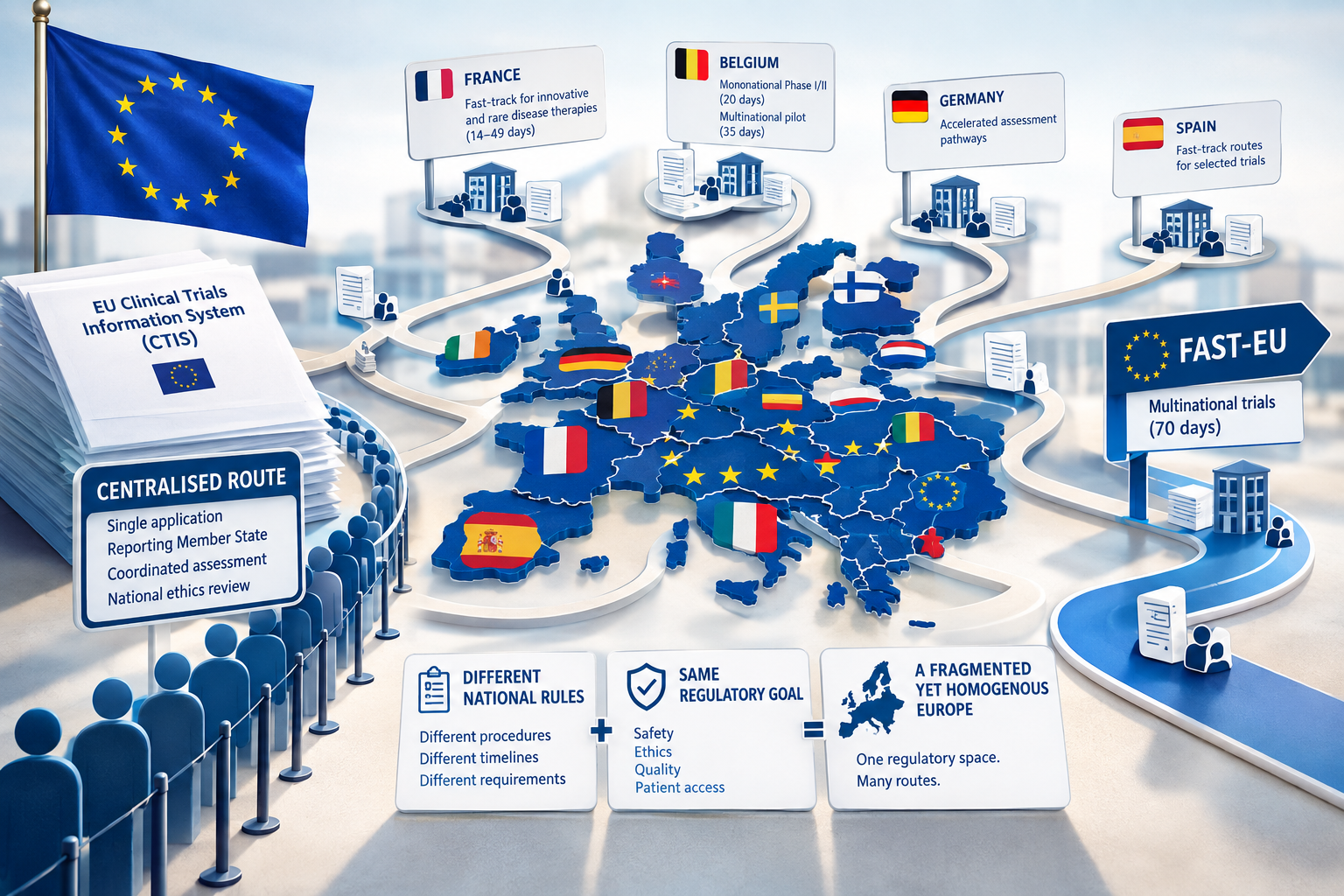
The EU Clinical Trials Regulation (CTR), implemented through the Clinical Trials Information System (CTIS) from January 2022, was designed to harmonise clinical trial authorisation across Europe. A single application, a Reporting Member State and coordinated assessment should, in theory, make multinational trials easier to start. And in several respects it does. But harmonisation has not magically removed complexity [1]. Evidence from early experience with the CTR has identified conflicting requirements, increased document burdens, technical problems and continuing delays, particularly for multinational research [2][3].
Now something rather interesting appears to be happening. Europe is developing ‘fast lanes’ for approval. For a biotech company approaching its first clinical trial, the question may increasingly become not simply How do we get approval? but Which queue do we join?
The centralisation paradox
The CTR replaced much of the previous country-by-country approach with a coordinated system [1]. For multinational trials, the Reporting Member State leads the assessment of Part I of the application, while each Member State remains responsible for national aspects, including ethical considerations [4]. The legal architecture is reasonably elegant. The standard process includes a 10-day validation period and a 45-day assessment of Part I, with defined periods for coordinated review and sponsor responses [4]. The problem is that a regulatory system is not simply a collection of statutory clocks. It is also an organisation. It contains regulators, ethics committees, sponsors, CROs, investigators, information systems and, inevitably, human beings. Those people and organisations (stakeholders) have to coordinate. They have to interpret rules. They have to communicate. They have to resolve questions. And they have to make decisions.
That is where the interesting bit begins. A 2024 analysis of three multinational European studies found that the CTR had brought improvements, but also reported conflicting application requirements, additional document burdens and technical obstacles associated with CTIS [2]. A separate analysis by the European Organisation for Research and Treatment of Cancer found that sponsor responses to regulatory comments averaged 27.5 days, substantially longer than the 12-day period envisaged within the CTR process [3].
In other words, the theoretical clock and the biological clock of drug development do not necessarily run at the same speed. And a biotech's cash runway certainly does not stop while either clock is running.
So why not create a fast lane?
Because, of course, that is precisely what is now happening. Belgium introduced accelerated timelines from January 2026 for mononational Phase I, Phase I/II and Phase II clinical trial applications. The stated maximum assessment time for these applications is 20 days, although requests for additional information can extend the process and certain advanced therapy and biotechnology products can attract an additional 10 days [5].
France has also developed accelerated procedures for early-phase clinical research. Its published framework includes pathways with assessment targets as short as 14 days where no questions are raised [6]. And this is not simply a collection of national experiments. In February 2026, the Heads of Medicines Agencies, through the Clinical Trials Coordination Group, launched FAST-EU (Facilitating and Accelerating Strategic Clinical Trials in the EU/EEA), a voluntary pilot for multinational clinical trials. Its ambition is a maximum overall timeline of 70 calendar days from CTIS submission to final conclusion, including sponsor response time [7].
The early results are intriguing. By May 2026, 15 multinational trials had entered the pilot and the first three procedures had met or closely approached the 70-day target [7]. That matters because FAST-EU is effectively asking a very practical question: Can Europe coordinate rather than merely harmonise?
The answer, at least so far, appears to be yes. But there is another question that is perhaps more interesting…
Does faster mean better?
Not necessarily. Clinical research has spent decades learning that speed is valuable, but speed without appropriate scientific and ethical control is not progress. The history of first-in-human development is littered with examples of why nonclinical evidence, dose selection, pharmacology and careful risk assessment matter. European regulators have consequently developed detailed approaches for minimising risk in first-in-human studies, particularly following historical concerns about unexpected toxicity [8].
The objective of an accelerated pathway should therefore not be to remove scientific scrutiny. It should be to remove unnecessary waiting. That distinction is crucial. There is a substantial difference between shortening a queue and lowering the quality of the assessment. The former may improve drug development. The latter could damage it.
The literature on clinical trial regulation also suggests that the relationship between regulation and efficiency is more complicated than simply adding or removing rules. Research examining European regulatory systems has shown how harmonisation can paradoxically produce new forms of fragmentation when organisations have to adapt existing responsibilities and institutional structures to a new framework [9].
This is perhaps the great irony of regulatory reform. We centralise the system to make it simpler. The system becomes more complicated. So, we create another system to make the complicated system faster. And then we need experts to explain which system we should have used in the first place.
The geography of Phase I
For an early biotech, this creates an unusual strategic opportunity the echoes somewhat the earlier pre-CTIS days. The location of a first-in-human study may be less constrained than the location of a later patient trial. In a conventional Phase I study outside oncology, healthy volunteers are often used. The specialist disease network and patient population that become critically important in Phase II may therefore be less decisive.
Speed, investigator experience, specialist facilities, quality and regulatory predictability can be extremely important. The potential benefits are not merely theoretical. Research examining European trial-site selection found that professionals considered speed of approval and the availability of appropriate investigators and clinical infrastructure important determinants of site selection [10].
But there is an important caveat. The fastest regulator is not automatically the fastest route to first patient in. Regulatory approval is only one component of trial activation. Contracts, budgets, ethics review, pharmacy, IMP release, site initiation and investigator availability can all become the next bottleneck. A regulatory fast lane followed by a 6-month contracting queue is not particularly fast [11].
This is where the old-fashioned concept of looking at the whole development pathway becomes rather useful.
The new regulatory strategy
For an early-stage biotech, regulatory strategy should therefore begin before the CTA is assembled. What is the product? What is the indication? Is the trial genuinely multinational at Phase I? Which countries offer appropriate investigators and facilities? Does the product qualify for an accelerated national pathway? Would a mononational Phase I provide a sensible bridge to a multinational Phase II? Could the study qualify for FAST-EU? Has scientific advice already been obtained? And perhaps most importantly, is the dossier genuinely ready?
Because the faster the pathway, the less room there may be for avoidable mistakes. A weak IMPD for example, a poorly justified starting dose, inconsistent nonclinical package or ambiguous protocol do not become a good dossier because somebody has put the word ‘fast-track’ on the cover. Indeed, there is a danger that accelerated pathways could make preparation more important, not less. The paradox is rather enticing, particularly for US biotechs prepared to navigate the new landscape. If Europe succeeds in making the regulatory process faster, sponsors will have less time to recover from poor preparation.
Europe has not solved the queue. It has multiplied it.
It could be argued that the European clinical trials landscape is therefore entering an interesting phase. There is the conventional CTR route. There are national accelerated pathways. There is FAST-EU. There are emerging proposals for further reform. And there are the inevitable differences between what the legislation says should happen and what happens when real organisations have to make the system work. We should also not forget the UK. The MHRA remains closely aligned and represents an additional option for the savvy regulatory expert.
All this is not necessarily bad news. Competition between regulatory systems can create useful innovation. The evidence from FAST-EU suggests that coordinated accelerated assessment is operationally achievable without abandoning scientific, safety or ethical standards [7]. But the new landscape creates a different challenge for biotech leaders. As suggested above, regulatory strategy is becoming a key development decision rather than simply a compliance exercise. The question is no longer just whether Europe can authorise your trial. It is whether you have chosen the right route through Europe.
For a company with limited funding, a novel molecule and investors waiting for the first patient to be dosed, that distinction could be worth considerably more than a few days on a regulatory spreadsheet. The race to the clinic has always involved science. Increasingly, it also involves knowing which queue to join.
References

Get our latest news and publications
Sign up to our news letterResources
Social


Contact us
Address
Niche Science & Technology
Unit 26 Falstaff House
Bardolph Road
Richmond TW9 2LH
United Kingdom