In the 1980s and 90s, scientific dissemination seemed, at least from today’s perspective, relatively straightforward. You did the research. You analysed the data. You wrote a manuscript and submitted it to a scientific journal. If the work was accepted, you might also present it at a learned conference as a poster or oral presentation. Your institution might write a press release for the news agencies. The scientific community would read it, discuss it and, if it was important, build upon it. It was the carefree age of publish-and-forget.
The implicit assumption was simple: do good science and, eventually, people would find it. Probably 2 years later while leafing through Index Medicus. Of course, it was never quite that egalitarian. Prominent researchers, prestigious institutions and well-established scientific networks have always attracted disproportionate attention. Scientific merit has never operated in a complete vacuum [1]. But there were fewer journals, fewer communication channels and fewer demands on scientists to become writers, communicators, public intellectuals and personal brands simultaneously.
In those heady days, publish or perish meant that simply getting your article accepted by a journal was often regarded as the principal act of dissemination. No longer. Today, scientific communication is not simply about making science available, visible and engaging. Increasingly, it is about making trustworthy science understandable and distinguishable from everything else [1]. And getting it to the people for who it matters [2].
When visibility became part of the game
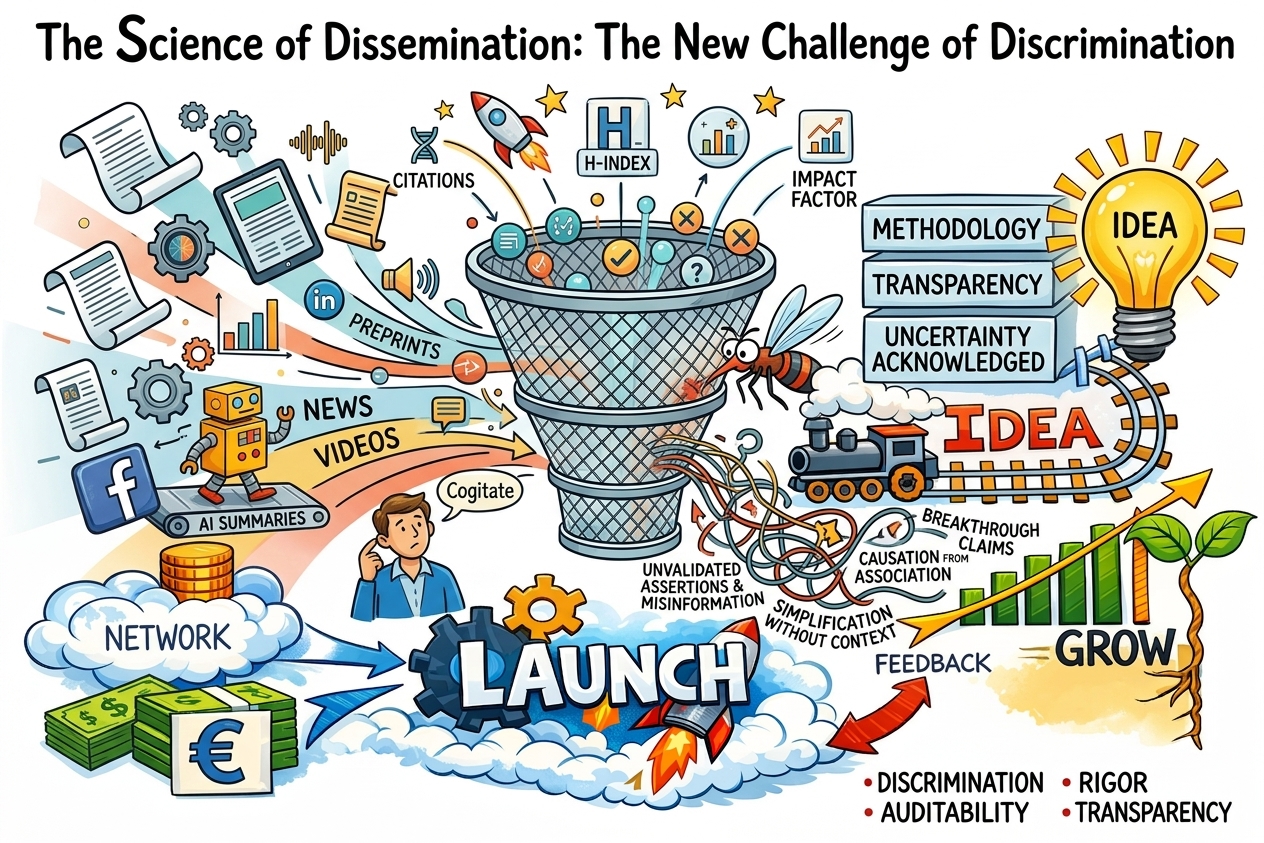
Over the decades, I have seen dissemination become increasingly entangled with metrics. Citation counts, journal impact factors, h-indices, altmetrics and other bibliometric indicators have provided ways of quantifying aspects of scientific activity and influence [3]. They can be useful tools. The problem is not measurement itself. The problem begins when the measurement becomes the objective.
Our earlier Insider’s Insight on bibliometrics made much the same point [3]. Publication metrics can provide useful information, but they cannot provide a simple measure of the quality or scientific value of an individual piece of research. A highly cited article may be influential because it is excellent, controversial, methodologically important or simply widely discussed. Equally, valuable work in a specialised field may attract relatively few citations. This is one reason why initiatives such as the San Francisco Declaration on Research Assessment have argued against using journal-based metrics as proxies for the quality of individual articles or researchers [4].
The question increasingly becomes not simply, Was the science good? but Was it visible? Was it cited? Who published it? Who is talking about it?
There is a danger that scientific communication begins to resemble a football championship in which researchers compete to accumulate points. Publications become championship games. Citations become points. Followers become points. Attention becomes points. Yet visibility and scientific value are not the same thing. Unfortunately, the volume of information has expanded so dramatically that visibility has become almost a prerequisite for influence. Good science that nobody encounters has little immediate impact. But science that is highly visible is not necessarily good.
That distinction is becoming harder to maintain.
The problem is no longer getting science out
For much of the twentieth century, one of the principal problems was ensuring that scientific knowledge escaped the laboratory, the institution or the specialist journal. Today we have almost the opposite problem. There is simply too much to engage with.
Those of us wanting to keep up with science face an extraordinary and growing volume of journal articles, preprints, reviews, conference presentations, press releases, blogs, podcasts, videos and social media posts. Nobody, however diligent, can keep up with everything even within a narrow speciality, let alone across science as a whole.
It is no longer really possible simply to stumble across an interesting paper and learn something entirely new, perhaps outside one’s immediate field. You had a better chance with Index Medicus than some of today’s electronic tools. At least you occasionally had to leaf through the pages and might accidentally discover something interesting. Never have the words of Alexander Pope seemed more appropriate [ref]:
“One science only will one genius fit;
So vast is art, so narrow human wit.”
Information has become abundant. Attention has not.
This changes the nature of dissemination. The question is no longer simply whether information can be made available. It is whether the right people can find it, assess it and understand why it matters. And that creates several problems simultaneously. How quickly should information be disseminated? Who is communicating it? Has it been properly validated? Can different audiences understand it? Will the science be distorted when simplified? How might the misinformation monkeys exploit scientific uncertainty? And can the public participate in the conversation rather than merely be spoon-fed information? Clearly, none of these questions existed entirely independently in previous decades. However, today they are inseparable.
Simplification without distortion
Scientific communication has always required translation. The language appropriate for a specialist manuscript is rarely appropriate for a patient, policymaker or member of the public. But translation is not simply a matter of replacing complicated words with simpler ones. Every audience requires a different vehicle. A clinician may need methodological detail. A policymaker may need to understand the implications of the evidence. A patient may need to know what the findings mean in terms of symptoms, treatment or risk. A journalist may need to explain the work concisely to a general audience and, occasionally, declare its brilliance. The danger is that simplification can remove precisely the things that make science scientific: context, methodology, uncertainty and limitation.
Uncertainty is a good example. As scientists, we often communicate probabilities, limitations and qualifications. Yet public communication frequently prefers certainty. A careful statement that “the evidence is still evolving” can quickly become “scientists do not know”. A modest finding can become a breakthrough. An association can become causation. However, the relationship between uncertainty and public trust is more complicated than simply assuming that uncertainty destroys confidence. Research suggests that how uncertainty is communicated, who communicates it and the characteristics of the audience all influence how scientific uncertainty is received [6][7]. Pretending that uncertainty does not exist may therefore be just as damaging as communicating it badly.
Misinformation exploits these weaknesses remarkably effectively.
Unsurprisingly, the answer is not simply to give people more facts. Research on misinformation has repeatedly demonstrated that information environments, social relationships, trust, motivation and prior beliefs all influence how evidence is received [2][8][9]. This presents science communicators with an uncomfortable challenge. We want people to think critically. But “do your own research” has increasingly become a slogan that can mean searching until one finds something that confirms an existing opinion.
Critical thinking is more demanding than getting our opinions from the red tops. It requires some understanding of evidence, methodology, expertise and uncertainty. It requires knowing not simply what information says, but why some sources deserve greater confidence than others. And, perhaps more importantly, it requires recognising that being sceptical does not mean being equally sceptical about everything.
From dissemination to engagement
Perhaps the most important change is that the boundary between dissemination and engagement is becoming increasingly blurred. Simplistically, the traditional model was essentially one way:
Scientists produce knowledge → publish it → communicate it to the public.
The emerging model is more interactive:
Scientists ↔ communities ↔ patients ↔ policymakers ↔ wider society.
This represents a significant cultural shift. The public is no longer expected simply to receive scientific information. Increasingly, patients and communities expect to question, discuss and sometimes participate in the processes that shape research and its communication. Patient and public involvement has become an established feature of health research, with the potential to influence the relevance, design, delivery and dissemination of research when it is undertaken thoughtfully [10][11].
This does not mean that every opinion carries equal scientific weight. However, it does mean that communication can no longer always be treated as a one-directional and final stage of research, undertaken after the important work has been completed. Good communication increasingly begins much earlier, when researchers decide what questions are worth asking, who should be involved and how the eventual findings might be understood and used. Simply publishing a paper and issuing a press release is no longer sufficient to influence the collective zeitgeist.
Access is not the same as engagement. And engagement is not the same as understanding.
Open science does not solve the communication problem
Open access has transformed the availability of scientific information (a little). That is undoubtedly important. But making a paper freely available does not guarantee that the public can understand it, that policymakers will find it, that clinicians will apply it correctly or that journalists will report it accurately. Open research and science communication are complementary activities, not interchangeable ones. Open research provides access.
Communication helps people discover, understand and use the knowledge. Sadly, some subjects are more accessible than others. I often find myself facing the dilemma of whether to include items in our newsletter from journals such as Naturebecause readers may need a subscription to access the full article. This distinction matters for organisations and institutions increasingly required to demonstrate research impact. And downloading a paper is not necessarily evidence of understanding. A large social media audience is not necessarily evidence of influence. And high engagement does not necessarily mean that the message has been interpreted correctly.
Indeed, we have explored this problem previously in our discussion of intent-driven scientific communication. The challenge is increasingly not simply to occupy every available channel but to understand what a particular audience is actually trying to discover, understand or decide. That is a rather more complicated job than simply posting the same press release everywhere.
Trust depends on what happened upstream
The problem becomes even more concerning when we consider the validation of science itself. When people encounter a scientific claim in a news report, patient leaflet or AI-generated answer, they generally assume that somebody has already checked the underlying research. But who?
Dissemination cannot repair science that was poorly designed, selectively reported, inadequately reviewed or misrepresented before it reached the public. The trustworthiness of communication therefore depends heavily on what happened upstream. This includes the quality of the research question, study design, conduct, analysis, reporting, peer review and editorial oversight. It also includes what happens after publication when errors are discovered or conclusions need to be revised. This is an important consideration because publication itself is often treated as though it represents the end of quality control. It does not.
Peer review remains an integral part of scholarly evaluation, but history shows us how publication in a recognised journal cannot be regarded as a permanent certificate of truth. The scientific record is, and should be, corrigible. The broader information environment also matters. Research has highlighted how weaknesses within scientific institutions and publishing systems, alongside predatory publishing, pseudoscience and poor media communication, can themselves contribute to the spread of misinformation [9].
If confidence in the upstream validation process weakens, everything downstream becomes more vulnerable. The original manuscript may be transformed into a press release, social media post, news story, policy document or AI-generated answer. At every stage, the audience may assume that somebody else has vouched for it. That assumption becomes increasingly concerning when nobody is entirely sure who that somebody is.
AI makes the problem more urgent
Artificial intelligence is accelerating every aspect of this process. Large language models can assist with drafting, summarising, translating and adapting scientific material for different audiences. Evidence now suggests that LLM-assisted writing has become widespread across scientific publishing, although estimating precisely how much text has been modified by AI remains difficult [12][13][14]. They are also being used to turn one scientific document into presentations, summaries, patient information, social media posts and other communication materials. This offers enormous opportunities. But it also means that scientific information can be sliced, diced and reframed almost infinitely. Messages can increasingly be tailored to particular audiences and delivered at extraordinary speed.
We are approaching a point at which the volume of scientific-looking information exceeds the capacity of researchers, journalists and traditional communication systems to evaluate it properly. And this is perhaps the crucial point. Questions also remain about how, and indeed whether, the use of generative AI for writing assistance should be disclosed. There is no simple consensus. Some have argued that mandatory disclosure is neither practical nor necessarily desirable when AI is used merely to improve grammar, style or readability, while greater transparency may be more appropriate when AI makes a substantive contribution to generating content [15]
A machine can produce a fluent explanation of a scientific finding in seconds. It cannot independently carry professional responsibility for whether the underlying evidence was appropriate, whether the uncertainty was represented honestly or whether the resulting message will mislead its intended audience [14]. Somebody still has to own the judgement.
Communication is becoming a professional skill
Perhaps unsurprisingly, research communication is increasingly becoming recognised as a specialist competency. Contrary to the belief that AI does away with the need for medical writers, the deluge of material may mean that we need good scientific and medical writers more than ever. We need people who can distinguish evidence from assertion. People who understand how scientific claims should be qualified. People who can identify when a reference does not actually support the statement attached to it. People who understand different audiences without patronising them or simplifying the science into nonsense.
Medical writers, publication professionals, science communicators, research impact specialists and public engagement professionals increasingly share a common challenge. They must understand not only the science itself but also the audiences, channels, incentives and technologies through which scientific knowledge now travels. The bottom line will be whether ‘the system’ is prepared to pay for them or sells our collective scientific soul for a soulless AI.
For decades, dissemination was often treated as something that happened after the research. Today, it needs to be considered much earlier. This does not necessarily mean designing promotion into research. It means designing communication, engagement and eventual use into our thinking about research from the beginning. There is a difference.
The new challenge is discrimination
The central problem facing science has changed. Once, the challenge was getting knowledge out. Now the far more difficult challenge is helping people discriminate between evidence and assertion, expertise and visibility, uncertainty and ignorance, engagement and understanding. The purpose of science communication should not be to win an attention competition or accumulate the greatest number of points. Its purpose should be epistemic improvement: helping people become better positioned to understand important scientific questions, what is known, how confidently it is known and what remains uncertain.
That requires trust. But trust cannot simply be demanded. It must be supported by transparent processes, honest communication and a willingness to recognise uncertainty without allowing uncertainty to be mistaken for ignorance.
It also requires humility. Science communication sometimes behaves as though the public’s failure to accept a scientific message must reflect a failure of intelligence or education. Sometimes it does not. Sometimes the problem lies in the evidence. Sometimes it lies in the institutions communicating it. Sometimes it lies in legitimate differences in values, priorities or lived experience. And sometimes, of course, somebody really is just talking nonsense on the internet.
As I first alluded, dissemination is becoming much more complicated. That is not necessarily a bad thing. Science can now reach audiences that were once inaccessible. Patients and communities can participate in conversations previously confined to academic institutions. Researchers can communicate across geographical and disciplinary boundaries almost instantly. But the future will require more than simply producing more information or swamping social media with AI slop.
The problem facing scientific communication is no longer simply how to make science travel further. It is how to ensure that, in an increasingly crowded and AI-generated world, the science worth trusting hits the target and its value can still be recognised when it arrives.
References

Get our latest news and publications
Sign up to our news letterResources
Social


Contact us
Address
Niche Science & Technology
Unit 26 Falstaff House
Bardolph Road
Richmond TW9 2LH
United Kingdom