For over a decade, the dominant logic of professional communication, whether in commerce, healthcare, or scientific outreach, has been omnichannel. The paradigm emerged as a response to channel fragmentation. As audiences moved across email, web, social media, conferences, and in-person events, organisations found themselves delivering disjointed, sometimes contradictory messages. The omnichannel solution was integration: the promise that a user would experience a seamless, continuous, and coordinated narrative irrespective of touchpoint [1].
In practice, omnichannel communication rested on four operational pillars. First, a unified narrative was crafted centrally and then adapted for each channel. Second, messaging followed stage-based models (awareness → consideration → decision), mirroring the classic marketing funnel. Third, heavy reliance on customer relationship management (CRM) systems and behavioural data allowed organisations to track users across channels and trigger follow-up messages. Fourth, the strategic imperative became presence everywhere with coherence, being visible on every relevant platform while maintaining a single, recognisable story.
In scientific communication, this translated into a familiar architecture: a peer-reviewed paper published in a journal, followed by a press release, a conference presentation (perhaps before publication), social media threads, a webinar, and perhaps a plain-language summary for patients or policymakers. For new drugs at least, all this was nested in a well-constructed, multiyear publication plan. The assumption was that the scientist (and journals) defined the narrative, and the omnichannel machinery distributed it broadly, ensuring that clinicians and researchers encountered the same core message whether they came across it on PubMed, Twitter, or at a congress.
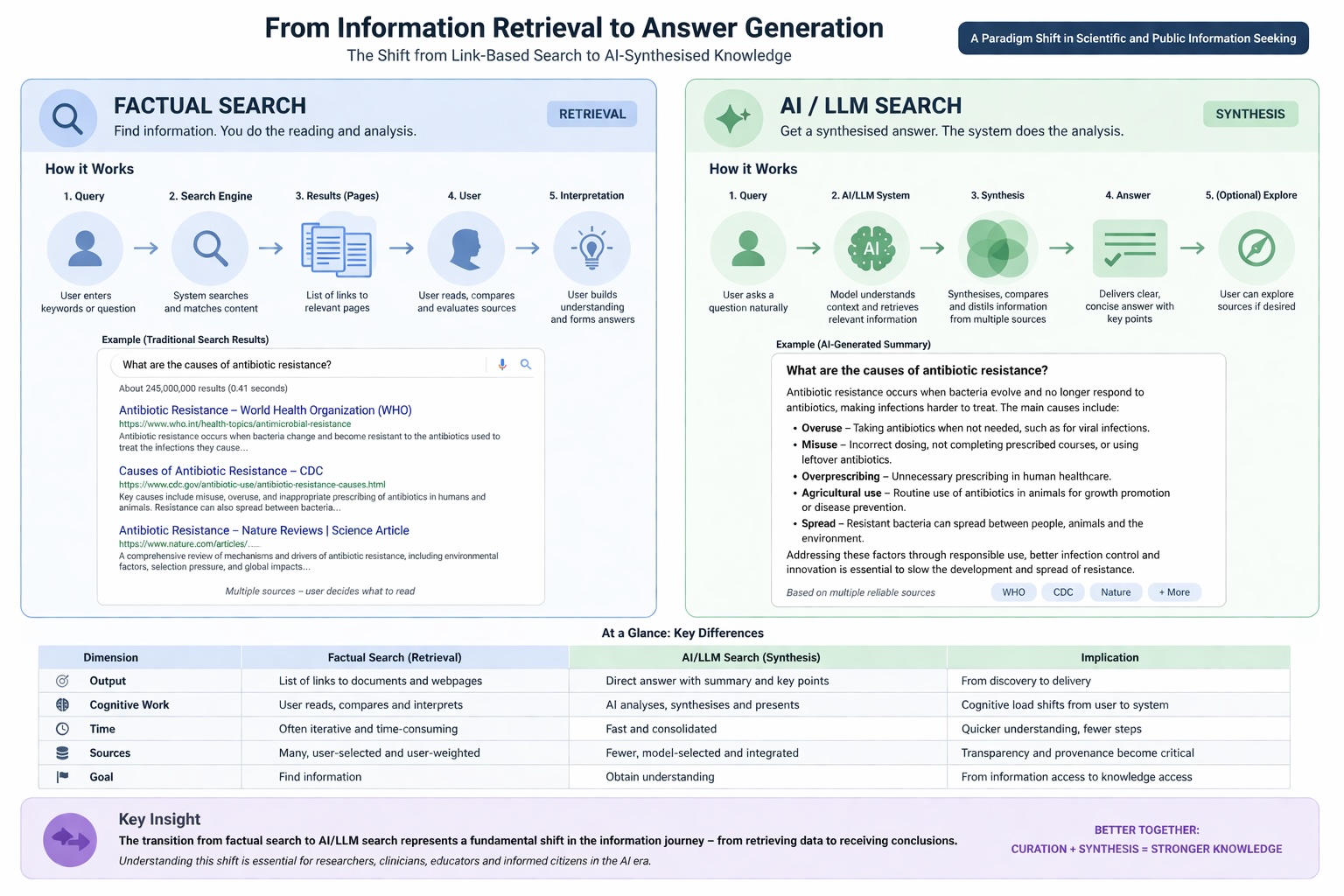
However, omnichannel thinking carries an implicit limitation: it remains narrative-centric. The communicator decides what matters, structures the story, and then pushes it outward. The user’s role is to receive, not to query. This model works well when the question is known in advance. However, it breaks down when the user’s intent is unpredictable, fragmented, or deeply contextual. It is also not well served in a post AI knowledge environment where people expect answers to their questions, not the one you have dictated.
Intent-driven communication (IDC) represents a deeper conceptual shift than a mere refinement of marketing execution. It reframes the fundamental unit of analysis: users do not experience channels, they experience moments of intent. An intent is a cognitive state: I want to decide, understand, or act right now. This recognises that paradigm, the organising question is no longer “Where should we communicate?” but rather “What is the user trying to decide at this precise moment?” [2].
This reframing yields three structural changes. First, fragmented but purposeful messaging: different “slices” of information are delivered depending on the user’s declared or inferred intent. For example:
Second, AI-mediated communication: large language models, recommendation engines, and clinical decision support systems increasingly act as intermediaries. They extract structured data from heterogeneous sources, compare evidence across documents, and select content based on verifiability, clarity, and relevance to the user’s stated question [3]. This shifts power away from narrative control and toward data quality and epistemic robustness: a finding that is ambiguous or poorly structured will simply be filtered out.
Third, precision over presence: the goal is no longer “everywhere” but optimal relevance at the decision moment. In commercial settings, it is believed that this effectively reduces the number of required touchpoints while increasing conversion efficiency [4]. For science, this means that a well-timed, evidence-rich answer delivered via an AI assistant at the point of care may be worth more than a dozen conference posters. However, you want to rephrase that sentence to fit a specific setting, the message is clear, you no longer control the narrative.
Thus, the shift from omnichannel to intent-driven communication redefines what a message is: from a fixed narrative unit broadcast in advance to a context-sensitive, query-responsive bundle of evidence assembled in real time. Delivery timing changes from scheduled campaigns to just-in-time responses. And knowledge structure changes from linear stories to modular, re-composable facts.
This transition is particularly consequential for the dissemination of scientific findings, where the traditional model has been: Publish → distribute → replicate message across channels. Intent-driven communication disrupts this in several profound ways.
Historically, scientific communication has been organised around journals, congress presentations, and static summaries, all packaged in a well-reasoned publication plan. In the intent-driven model, dissemination reorganises around user questions: “Is this treatment effective in elderly patients?” “How does this compare to standard of care?” “What is the safety signal in real-world data?” This implies that scientific content must be modularised into answerable units, and findings must be re-composable across contexts. A single clinical trial might generate dozens of “intent-slices” for different decision moments [5].
Intent-driven ecosystems—especially AI-assisted ones, prioritise structured data, transparent endpoints, and reproducible claims. As noted in the commerce literature, these systems increasingly require “structured, explainable, verifiable data that can be retrieved and reasoned over” [3]. For science, this translates into greater importance of FAIR principles (Findable, Accessible, Interoperable, Reusable), machine-readable trial outputs (e.g., CDISC standards), and evidence graphs rather than narrative-only publications. A 2023 analysis of clinical AI assistants found that they preferentially retrieved those studies with structured abstracts and explicit PICO (Population, Intervention, Comparison, Outcome) formatting, effectively penalising narrative-heavy prose [6].
Traditional dissemination emphasises a single, coherent “paper story” with a beginning, methods, results, and discussion. Intent-driven communication favours layered truth architectures: a core data layer (primary endpoints, effect sizes, confidence intervals), a contextual interpretation layer (subgroup analyses, real-world relevance, limitations), and a validation layer (methodology details, replication status, conflicts of interest). This mirrors the shift from a single description to multi-layered, context-specific truth delivery [7]. A clinician asking “Does this drug work in frailer patients?” does not need the entire Discussion section; they need the relevant subgroup estimate and a risk-of-bias assessment.
It seems fair to expect that in the future, scientific outputs will be judged less by the completeness of their narrative and more by their decision relevance: Does the finding answer a clinical question? Does it reduce uncertainty at the point of care? Can it be compared, queried, or validated quickly? This aligns scientific dissemination with clinical intent pathways rather than publication cycles. A 2022 survey of oncologists found that 68% reported using AI-based summarisation tools to answer treatment questions, and those tools consistently prioritised studies with high decision utility, defined as direct applicability to the patient in front of them, over those with high journal impact factor [8].
In omnichannel models, medical affairs teams, journals, and conferences act as primary gatekeepers and interpreters. In intent-driven ecosystems, AI assistants, clinical decision tools, and search systems become active interpreters and filters. The implication is that scientific credibility now depends on how well findings survive algorithmic interrogation, not just peer review. A study rigorously conducted but poorly structured for machine extraction may become functionally invisible [9].
This transition is not neutral. It introduces several tensions. First, fragmentation versus integrity: breaking science into “intent slices” risks loss of nuance, selective interpretation, and context collapse. A finding that is conditional on specific exclusion criteria may appear absolute when extracted without its methodological caveats. Second, algorithmic gatekeeping: AI systems may prioritise clarity over complexity and consensus over uncertainty, potentially biasing which scientific findings reach decision-makers [10]. Third, governance and trust: as messaging becomes dynamic and personalised, version control, auditability, and provenance become critical. Who ensures that the intent-slice delivered today matches the original validated finding? Without robust metadata and blockchain-like audit trails, intent-driven science could erode rather than enhance trust.
This brings a paradigm shift to delivery of scientific dissemination and also answers a perennial question. First, planning must now involve defining what ‘the questions’ are going to be upfront and going on record as to how they may be addressed – managing data release then becomes a case of providing answers to each of the questions as quickly and efficiently as possible, putting your stamp on the digital narrative. To put your stamp on the e-narrative, the requirement has ramifications that go right to the heart of your study.
Those working in medical affairs have long debated on the best approach to the release of your publications – ‘bomb blast’ or ‘drip feed’ data as it becomes available to build interest in your target [11][12][13][14][15]. With IDC you need to get your ‘answers’ out there as soon as possible. The direction of travel, however, is clear. Omnichannel optimises distribution; intent-driven communication optimises decision-making (and it is what your clients want). For scientific dissemination, this means a shift toward living, queryable knowledge systems rather than static publications, evidence as infrastructure rather than output, and communication as adaptive dialogue rather than broadcast.
For those who appreciate the benefits, this is transformative. It demands that findings are no longer merely published and shared, but structured, interrogable, and dynamically reassembled at the exact moment a decision is being made. The real issue is not the possible reorganisation of scientific knowledge, but more getting your findings seen and being recognised for having made them. The message is no longer a story told to a passive audience. It is an answer waiting for the right question.
References

Get our latest news and publications
Sign up to our news letterResources
Social


Contact us
Address
Niche Science & Technology
Unit 26 Falstaff House
Bardolph Road
Richmond TW9 2LH
United Kingdom