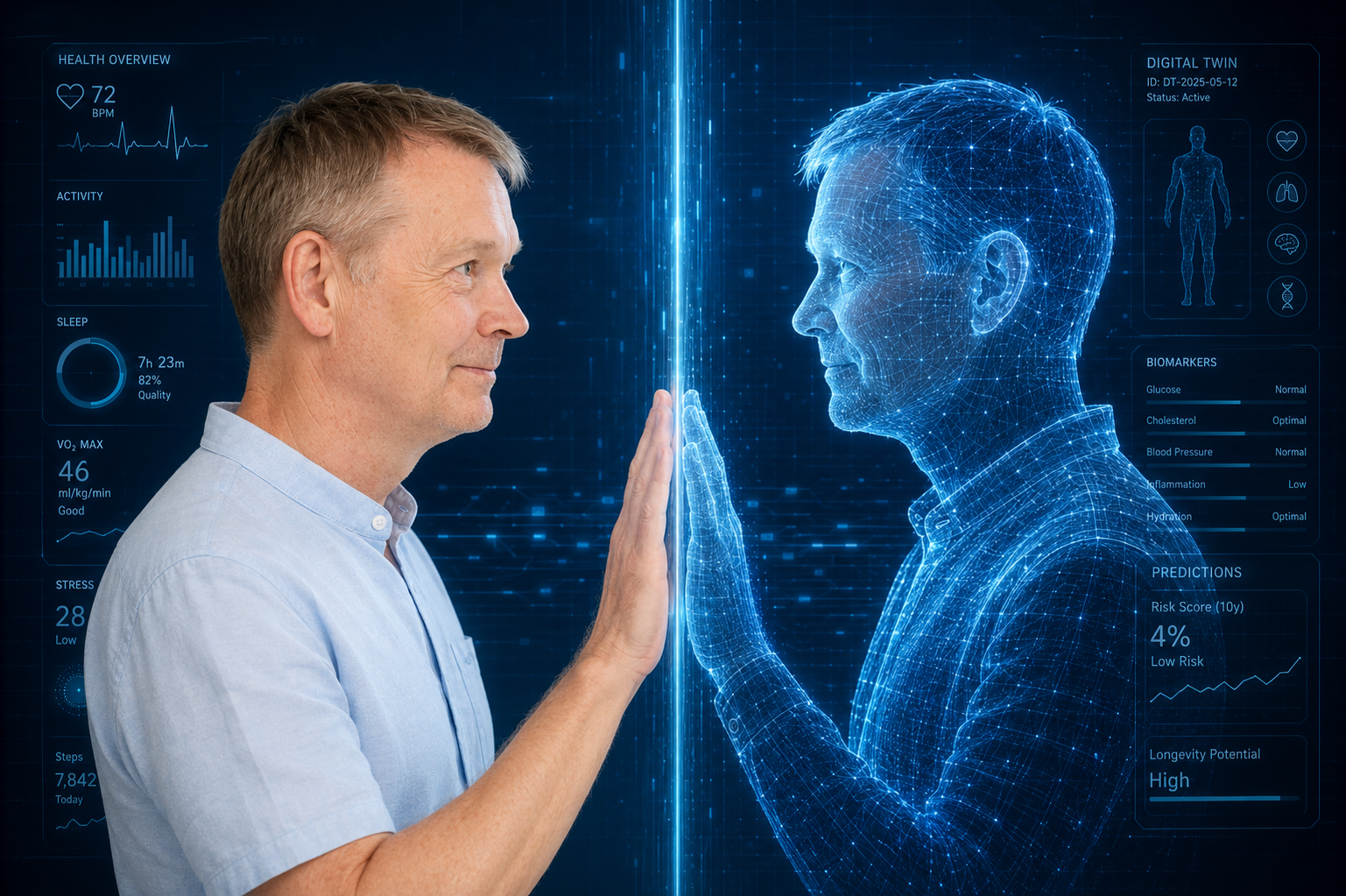
What is all the excitement around digital twins? In the 1990s, I was involved in research with identical twins, where pairs were either discordant (one with and one without) and concordant (both having) for type 1 diabetes [1][2][3][4]. Each participant represented weeks of careful profiling, detailed phenotyping, and painstaking laboratory work. Our question was fundamental: why would one twin develop diabetes while the other not?
Some 30+ years later and people are still interested in twin studies, but now digital twins have captured the attention of biomedical researchers. The promise is breathtaking. Virtual replicas of individual patients, continuously updated with real-time data, could revolutionise how we develop therapies and deliver care. But as someone who has spent a decade studying biological twins, I find myself asking: how much of this promise is real and how much hype?
The Natural Experiment That Started It All
Classical twin studies were built on a simple but powerful design. Identical (monozygotic) twins share almost all their DNA; non-identical (dizygotic) twins share about half. By comparing disease concordance between these groups, researchers might estimate the relative contributions of genes and environment [5][6].
For insulin-dependent diabetes, our studies showed that even among identical twins, the concordance rate was only around 53%, meaning nearly half of genetically identical individuals did not share the disease [6]. This was a profound finding. It demonstrated that genetic susceptibility, however important, was not destiny. Environmental exposures, epigenetic modifications, and random biological events all played crucial roles [7].
One of our diabetes discordant identical twin studies found that abnormalities in a specific cellular transport mechanism were present in both affected and unaffected twins, suggesting these differences reflected inherited susceptibility rather than being consequences of the disease itself. This was precision medicine before we had the word for it, interrogating why two genetically similar individuals followed different biological paths.
The Digital Revolution: What Has Changed?
The transformation since the 1990s is extraordinary. Where we measured a handful of physiological parameters, modern researchers can now examine biology on multiple levels simultaneously: whole genome sequencing, transcriptomics, proteomics, metabolomics, and continuous physiological monitoring through wearable sensors.
This explosion in data synthesis has coincided with the digital twins concept—computational models that integrate biological, clinical, and environmental information to simulate an individual's health trajectory [8][9]. The concept has its origins in industrial engineering for product lifecycle management circa 2002, and from there it has migrated to healthcare with remarkable speed.
A digital twin is a dynamic, multicomponent computational framework rather than a single algorithm. It integrates:
In this framework, the digital twin is the environment or representation, while AI and algorithms provide the reasoning and decision-making functionality. In effect, the digital twin becomes a continuously updated simulation environment, and the algorithms are the mechanisms that drive its behaviour and predictions.
Recent reviews highlight the potential applications. A comprehensive 2024 scoping review of digital twins for health identified applications across personalised health management, precision treatment, risk prediction, and clinical trial optimisation [8][10]. In cardiovascular disease alone, researchers have developed digital twins that simulate cardiac electrophysiology, predict arrhythmia risk, and guide treatment decisions [10]. However, as an old-school empirical scientist, I find it difficult to fully concieve the proposed promise of what is effectively synthetic data extrapolation.
The Promise: What Digital Twins Could Deliver
Revolutionising Clinical Trials
Perhaps the most immediately tangible promise for digital twin data is in drug development. The pharmaceutical industry faces staggering challenges: 96% drug candidate attrition rates and average development costs exceeding $2.6 billion per new drug. Digital twins offer a potential cost-saving solution.
Virtual patient cohorts, groups of digital twins representing diverse patient populations, can be used to simulate clinical trial outcomes before any human participant receives a treatment [9][11]. These in silico trials allow researchers to:
Regulatory agencies are taking notice. The FDA has released guidance outlining processes for applying AI in drug development, while the European Medicines Agency has developed reflection papers on AI and digital twins [14]. The Medical Device Innovation Consortium reports that 65.7% of experts believe computational modelling and simulation use in regulatory submissions has grown significantly over the past 5 years [15][16].
Transforming Clinical Care
Beyond drug development, it has been proposed that digital twins could fundamentally change how clinicians make decisions. Instead of relying on population-level data to predict how an individual patient might respond to a particular treatment, clinicians could simulate different treatment strategies on a patient's digital twin, exploring questions such as:
In cardiology, patient-specific digital twins have already shown promise. Researchers have developed models that incorporate CT scans to personalise anatomical representation, enabling simulations of the heart's electrical behaviour at the individual level [10]. These models can aid in diagnosing arrhythmias and planning interventions.
In oncology, mathematical models of tumour growth and response to therapy are being used to identify effective treatments and predict overall outcomes [10][13]. The potential to simulate how a specific cancer patient might respond to different chemotherapy regimens is moving from concept to reality [13][14].
The Reality: Challenges That Remain
For me, despites all the promise, the gap between vision and implementation remains substantial.
Validation: The Fundamental Challenge
The most critical question is also the most difficult: how do we know a digital twin's predictions are accurate?
This is where the contrast with classical twin studies becomes stark. Our 1990s research had clear validation: we measured real biological parameters in real people. We could compare affected twins with their unaffected co-twins and draw conclusions about what differences were disease consequences versus inherited traits [1][2][3][4]. The evidence was grounded in empirical evidence generated in a gold-standard clinical setting.
Digital twins, by contrast, are computational models that are, at best, validated against clinical outcomes. As a recent perspective article in npj Digital Medicine emphasises, verification, validation, and uncertainty quantification (VVUQ) are essential for ensuring the reliability of digital twin data in healthcare settings [8][16]. Without rigorous validation, it is impossible to know whether a simulation represent biological reality or reflect systematic biases in the data or algorithms.
The challenges are formidable:
The Uncertainty Principle of Biology
The underlying problem with systems in the natural world is that biology is nature’s way of reminding us that ‘predictable’ is only a working hypothesis. It has been said that whereby physics follows the rules, biology enjoys rewriting them. The lesson from decades of twin research is that biology is fundamentally probabilistic. Genes influence outcomes, environments modify risk, and individuals remain biologically unique. Even identical twins with shared early environments can follow markedly different biological paths, nearly half the time if our studies in diabetes are to be believed.
It feels reasonable to anticipate that digital twins will be used as tools to enhance human understanding, but not replace clinical judgement. They may logically simulate possible futures, but not predict clinical certainties. As the National Academies report emphasised, digital twins must be considered as tools for informed decision-making [8].
The Path Forward: How Can We Validate the Promise?
How can we confirm whether digital twins deliver on their promise and convince empirical dinosaurs like me? Several approaches are emerging:
Rigorous Clinical Validation
The most straightforward path is prospective clinical trials that compare outcomes guided by digital twins against data collected under standard care. That will take time but in the field like cardiology, researchers have already demonstrated that patient-specific cardiac models can be employed to define pathways, those reduce atrial fibrillation recurrence rates [10]. In neurodegenerative disease predictions, digital twins have achieved up to 97% accuracy [10]. These are encouraging early signs, but larger, multicentre trials are needed to establish generalisability. The increasing adoption of data sharing across the clinical research community will most likely serve to empower future models.
Building on Twin Research
Perhaps ironically, the classical twin design could help validate digital twins. By employing data from studies in identical twins discordant for disease, we could ask whether digital twins built from their biological data can accurately predict their different outcomes. It would imply important gaps in any specific model if a digital twin cannot distinguish between twins who share almost identical genetics but different health trajectories. Although this type of validation might seem extraordinary, there is an ever-growing number of clinical studies reported in the scientific literature adding to this data set.
Regulatory Frameworks
Regulators are developing frameworks for evaluating digital evidence. The FDA/MDIC collaboration on computational modelling and simulation for medical devices provides a promising precedent. Their ‘End-to-End’ demonstration project applied the ASME V&V 40 standard to a spinal pedicle screw system, serving as a blueprint for validating digital evidence in lieu of physical testing [16]. Similar frameworks will be essential for patient-specific digital twins moving forward.
Addressing Bias and Equity
Thankfully, the potential for algorithmic bias is a serious concern. A digital twin trained predominantly on data from one demographic group may be expected to perform poorly for others [6,16]. Ensuring diverse, representative training data and transparent reporting of model performance across subgroups will be essential for equitable implementation.
Looking Forward: The Continuing Legacy of Twin Research
When I reflect on the twin studies conducted in the 1990s, I see a clear connection to today's digital twin revolution. The technology has changed dramatically, but the central scientific question remains unchanged: how do genes, environment and experience combine to create individual differences in health and disease?
The twins who participated in those early studies taught us that biology cannot be reduced to genetics alone. They demonstrated that even individuals with almost identical DNA can experience different biological futures. Epigenetic differences arise during the lifetime of monozygotic twins [7], environmental exposures modify disease risk, and random biological events introduce variation.
Digital twins represent the next stage of that scientific journey, an attempt to model those complex interactions computationally. The human twins of the past allowed us to observe nature's experiments; digital twins may allow us to model possible futures.
But let us not mistake the map for the territory. Digital twins are models, not reality. Their predictions must be validated, their uncertainties quantified, and their limitations acknowledged. The ultimate goal remains what it has always been: to understand individuals more precisely, predict disease earlier, and develop healthcare that is increasingly personalised, preventative and effective.
The promise of digital twins is genuine, and the potential benefits, reduced drug development costs, improved patient safety, more personalised care, are too significant to ignore. But we must proceed with scientific rigour, acknowledging the challenges while working to overcome them. The twin studies of the past provide both a methodological foundation and a cautionary lesson: biology is complex, individuals are unique, and prediction must always be tempered by a pragmatic grasp of the true size of uncertainty.
References

Get our latest news and publications
Sign up to our news letterResources
Social


Contact us
Address
Niche Science & Technology
Unit 26 Falstaff House
Bardolph Road
Richmond TW9 2LH
United Kingdom