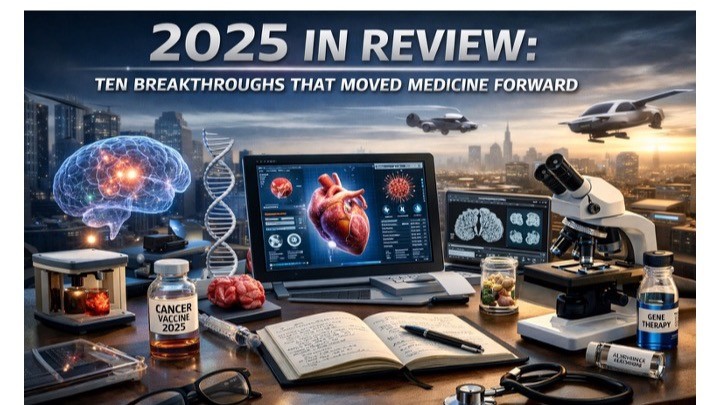
Last year was another remarkable chapter in biomedical science. From discoveries that could reshape how we treat chronic disease to innovations that edge us closer to personalised medicine and regenerative therapies, the breadth of progress underscores both the ingenuity of researchers and the accelerating pace of technology integration into health care. Here is a summary of advances we shared on Linked In selected by readership reach, with a little consideration for what we felt was scientific novelty, and potential impact on us all (in no particular order).
In a discovery that turned conventional thinking on its head, researchers at showed for the first time that lithium, a trace element found in the brain, may protect neural tissue from degeneration and that reducing levels are one of the earliest detectable changes in Alzheimer’s disease pathology. In mouse models, a novel lithium-based compound not only slowed neurodegeneration but also reversed memory deficits without significant toxicity, setting the stage for new diagnostic and therapeutic pathways in dementia research. This unifies decades of observational data and points to a simple element with profound implications for cognitive aging [1]. This offers promise for the millions of people affected by Alzheimer’s and their families. We felt that the idea that a well-studied, inexpensive element (and so potentially easy to register as a new therapy) could play a central role in disease progression, and potentially in its prevention, is revolutionary.
Traditionally, clinical trials are resource-intensive, expensive, and slow. For decades we have heard that drug development takes too long, is too expensive, the regulations are to strict and too many candidates fail. And yet, each decade these hurdles get higher despite our best efforts. This year, scientists at the Mayo Clinic introduced virtual clinical trials that combine advanced computational modelling with real-world patient data to simulate how drugs perform in diverse populations. By reducing the need for extensive physical enrolment and by predicting therapeutic success more efficiently, these models could accelerate the development of treatments for conditions such as heart failure, a leading cause of morbidity worldwide [2]. While patients won’t feel this breakthrough directly, its influence could be enormous: faster discovery of effective medicines and fewer costly failures mean that tomorrow’s therapies might reach clinics years sooner (maybe).
Over the last 25+ years the Niche team have worked extensively on chronic lung diseases: from asthma (RASP-UK), COPD to pulmonary fibrosis. These conditions affect tens of millions globally, often with limited treatment options. Researchers discovered a molecular ‘switch’ in lung cells that determines whether they commit to repairing tissue or fighting infection. Manipulating this switch could inform regenerative therapies that coax the lung to heal itself, offering hope for conditions long viewed as irreversibly progressive [3]. It is hard to image but what if we could encourage lungs could to heal like skin after a cut? Our team felt that this discovery lays the groundwork for a brighter future for millions.
Every biology student learns that our immune systems can serve as double-edged swords: too weak, and we succumb to infections; too strong, and we can attack our own tissues. In 2025, the Nobel Prize in Physiology or Medicine was awarded for research that illuminated the mechanisms of peripheral immune tolerance, the systems that ensure the immune response doesn’t run amok. Understanding this balance will be sure to result in improved treatments for autoimmune diseases and cancer, where the immune system’s behaviour goes awry [4]. Autoimmune conditions like type 1 diabetes, Lupus and rheumatoid arthritis affect millions. Better control of immune tolerance means smarter therapies and fewer side effects.
Through our MID-Frail and Frailomic initiatives the Niche Team have been intimately engaged in aging research. However, progress has been slow, until 2025. The last year delivered insights of startling clarity. Scientists identified factors influencing cellular senescence, including regulatory proteins and compounds that can reverse cellular aging markers and extend lifespan in animal models. These findings deepen our understanding of how aging unfolds at the molecular and cellular levels, potentially guiding future interventions against age-related diseases [5]. As we found from our own research (and why our projects were enthusiastically supported by the EU’s Horizon 2020 initiative), the world is facing an aging crisis: populations are getting older. Although we are living longer it is not necessarily an extension of a life in good health. And who will care for these people? Aging is universal. Progress here isn’t just about longevity, it’s about healthier lives with less frailty and disease.
One of the most practical breakthroughs this year was a UK-developed rapid DNA sequencing system for diagnosing bacterial infections and determining antibiotic susceptibility in under 48 hours. Traditional methods can take days or even weeks. This is far too slow if we want to combat the rising antimicrobial resistance: something we all need to be concerned about. This innovation has the potential to transform antibiotic stewardship, reduce inappropriate broad-spectrum use, and save lives [6]. Antibiotic resistance is a growing public health threat. Faster diagnosis means faster and we hope smarter treatment.
It would be fair to say that 2025 was the year that artificial intelligence (AI) took hold in medical research and healthcare, as we heard in the PCMG conference on AI in the pharmaceutical industry, held at the Royal Society of Medicine in London that the Niche team actively contributed last November [7]. We heard that progress was taking a very different turn from what we predicted in 2022 [8]. The growing role of AI in health care was on full display with the debut of an AI diagnostic system capable of not only recommending diagnoses but also explaining its reasoning in human-like detail. Published alongside a clinician’s case in the New England Journal of Medicine, this tool represents a step forward in AI transparency and may one day assist doctors in making more reliable decisions [9]. Why it’s noteworthy: AI that explains why it thinks a diagnosis is correct could build trust and reduce diagnostic errors, a crucial advantage in complex clinical settings.
Over the past few years, advances in sequencing technologies and systems biology have transformed our understanding of the human microbiome, revealing it as a dynamic, metabolically active ecosystem integral to immunity, metabolism, and disease. Once viewed as passive passengers, microbial communities are now recognised as key drivers of health and therapeutic response, reshaping medicine’s approach to prevention, diagnosis, and treatment. Last year’s microbiome science brought the first clear molecular link between gut bacteria and depressive inflammation. Research showed that a gut bacterium interacts with environmental contaminants in ways that stimulate inflammation, a known driver of depressive symptoms [10]. This opens new avenues for both diagnostics and targeted treatments. If the gut can influence mood via a molecular mechanism, mental health care could one day include microbiome-modulating therapies.
Recent advances in tumour genomics, neoantigen discovery, and mRNA technology have revolutionised cancer vaccines, transforming them from a long-standing aspiration into a realistic therapeutic strategy. Once hindered by tumour heterogeneity and immune evasion, cancer vaccines are now showing promise in generating personalised, durable anti-tumour immune responses and reshaping the future of oncology. Progress in personalised cancer vaccines continued in 2025, with phase 1 trials showing robust immune responses in patients with advanced kidney cancer. Tailoring vaccines to a patient’s tumour profile is a huge step forward in oncology, hinting at cancer therapies that are more effective and less toxic than current standards [11]. Cancer treatment that activates the patient’s own immune system against their disease is not just clever; it’s deeply empowering for patients and providers alike.
Advances in neuroimaging, vascular biology, and computational modelling have transformed our understanding of cerebral blood flow, revealing it as a dynamic regulator of brain health rather than a passive support system. Disruptions in cerebral perfusion are now recognised as central contributors to neurological and neurodegenerative diseases, reshaping how conditions such as stroke, dementia, and migraine are understood and treated. In 2025, neuroscientists uncovered how the brain’s vasculature dynamically redirects blood to active regions, effectively a “coordinated signalling highway” previously unseen with such clarity. This foundational insight into how the brain matches blood flow to function could improve interpretations of brain imaging and guide treatments for neurodegenerative diseases [12]. We felt that this discovery is like discovering an ancient motorway in the amazon jungle, a new set of roads in the brain’s circulatory map, with implications for everything from stroke recovery to cognitive health.
These ten advances, spanning molecules to machines, share a common theme: they make health care smarter, more personalised, and more proactive. Some are poised to change how we diagnose and treat disease; others reshape our understanding of biology itself. Importantly, several offer hope for conditions long deemed intractable, Alzheimer’s, chronic lung disease, antimicrobial resistance, and cancer.
We believe that sharing these advances (and others) with the Linked In community not only keeps you informed of the broad range of advances that are ongoing but also gives a little recognition to the brilliant scientists working for the betterment of us all (some of those are working at Niche). Many of these breakthroughs directly touch issues that affect everyday lives: faster diagnostics, regenerative potential, mood and brain health, and aging. Others, like AI for diagnostics, may seem futuristic but could soon be part of routine clinical care. We should all remember that scientific breakthroughs are often born of serendipity not just hard word, dedication and design, emerging from unexpected observations and cross-disciplinary inquiry, which is why sustaining broad, curiosity-driven funding is essential to ensure the next transformative advance is not inadvertently overlooked.
In the end, 2025 serves to remind us that science is not a linear march but a dazzling interplay of curiosity, technology, and persistence. From revisiting the role of a humble metal like lithium in brain health to rethinking how we do clinical trials, this year’s discoveries span the playful and the profound. They reflect genius and novelty, but perhaps most importantly, they reflect a shared human quest to understand, to heal, and to improve lives.
As we look ahead, these discoveries don’t just belong in textbooks; they belong in conversations with patients, policymakers, educators, and the public, because science progresses only when its fruits are shared, understood, and applied. However, one of the biggest concerns is that much of the research responsible for driving these discoveries was based in the US. We can only hope that the current US leadership, in its ignorance, doesn’t destroy the progress that is being made.
References
Get our latest news and publications
Sign up to our news letterResources
Social


Contact us
Address
Niche Science & Technology
Unit 26 Falstaff House
Bardolph Road
Richmond TW9 2LH
United Kingdom