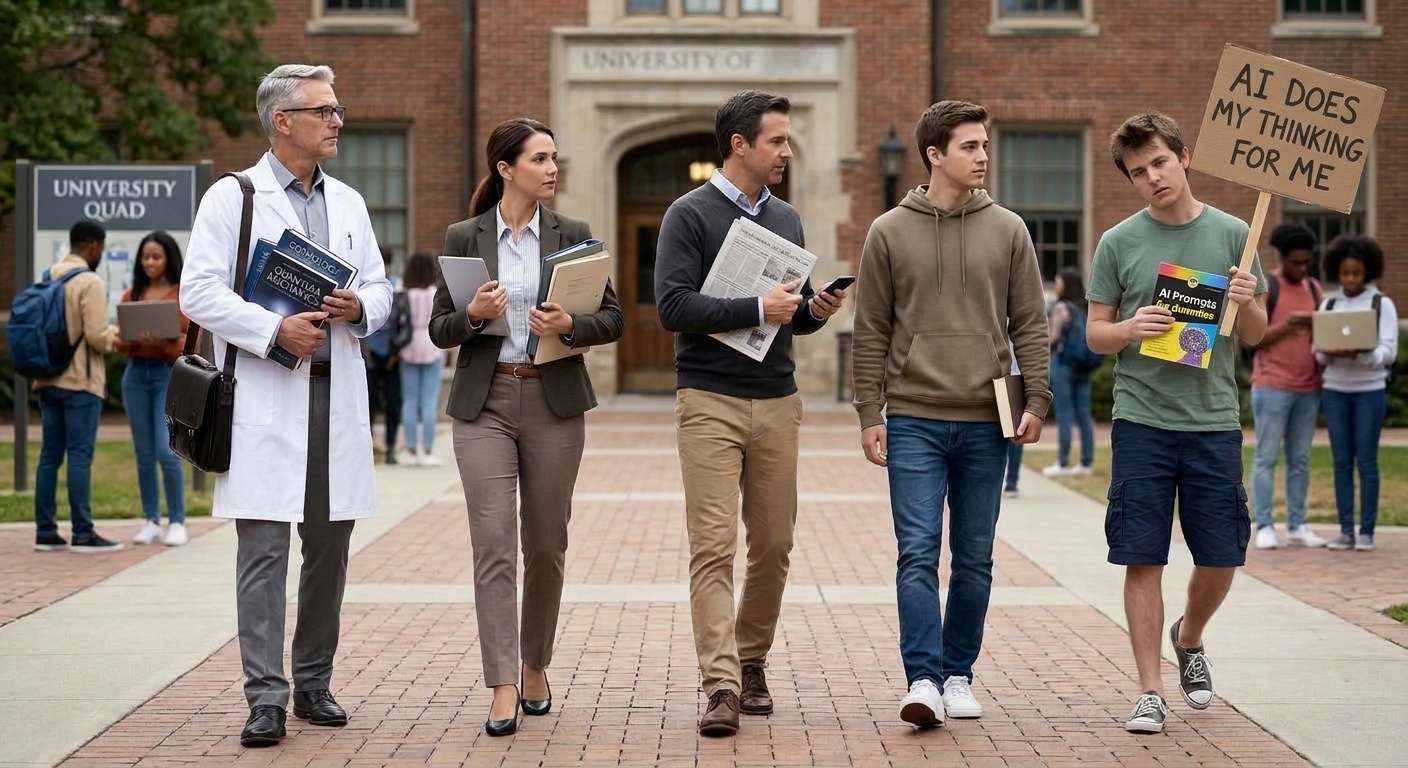
I recently questioned whether the next generation can afford to pursue a career in science [1]. It was an argument focused on economics, opportunity and the diminishing prospects for young people who want to make science their life’s work. But perhaps I was asking the wrong question. On reflection, it seems that the problem is not necessarily where the next generation of scientists will come from. Universities continue to produce graduates in considerable numbers. My own course at Leeds University accommodated approximately 30 students in the 1980s. Today, I understand that the equivalent course produces more than 100 graduates annually. The more important question seems to be what happens after graduation. Where will these young scientists find the jobs, mentors and practical experiences that transform that first academic qualification into the judgement required to conduct clinical research? And what happens if artificial intelligence progressively removes the very entry-level work through which that transformation has traditionally occurred?
The missing apprenticeship
When I studied science, practical work was integral to the learning experience. We worked in small teams, performed experiments and discovered that the seemingly straightforward textbook description rarely survives contact with my rudimentary practical skills. Today, I understand that practical sessions have shifted more towards demonstrations in which a single instructor performs experiments for a much larger group. This raises an important question about the opportunities students get to develop practical competence.
Scientific expertise involves more than acquiring knowledge. It includes recognising when results look wrong, distinguishing a technical failure from a genuine discovery, knowing which questions to ask and appreciating when a procedure is perhaps inappropriate. Professional expertise in anaesthesia illustrates this distinction particularly well. Researchers found that expert practice depends on both explicit knowledge and tacit understanding, and warned that restricting apprenticeship-style training threatens the development of expertise [2]. Research into forensic science has similarly highlighted the importance of learning through participation, where knowledge is transferred through observation, interaction and experience [3].
I feel this is important, much scientific judgement is difficult to teach through lectures or reading standard operating procedures. It develops through doing, making mistakes, receiving feedback and learning from people who have already encountered the problem. A graduate can understand the theory of clinical pharmacology without having the experience to recognise when a patient’s response does not fit the expected pattern. They can understand statistical significance without appreciating how an apparently convincing result might have emerged from a flawed study design. The difference is not intelligence its experience.
The disappearing first rung
Now consider the economics of scientific employment. Young researchers face financial pressures, including education costs, housing affordability and uncertainty about career progression. A study into early-career researchers in Australia found that, despite a strong commitment to science, many respondents considered leaving research. Job insecurity, workplace culture, mentorship and questionable research practices were among the concerns identified [4]. Obviously, the reporting for one national research workforce cannot automatically be generalised to every clinical research setting, but they echo my own observation that enthusiasm for science does not guarantee a sustainable scientific career.
Meanwhile, employers face their own pressures. They must deliver projects efficiently, control costs and demonstrate productivity. Automation can make repetitive laboratory processes faster and more reproducible. AI is already being used to help with literature searches, coding, data analysis, document preparation and other tasks that previously occupied substantial amounts of junior staff time. This is obviously beneficial for service providers. The difficulty arises when the work being automated is also the work through which inexperienced scientists would normally learn.
Historically, a junior researcher might begin by checking data, preparing reports, reviewing source documents or helping investigate an unexpected finding. I have commented on my own humble beginnings washing out urine bottles [5]. Under supervision, these apparently routine responsibilities provide exposure to the practical consequences of scientific decisions. When these tasks are automated organisations need fewer junior employees. But the senior scientists of tomorrow must come from somewhere. We risk creating a professional pipeline in which experienced scientists retire, fewer juniors enter the profession, and those who do enter have fewer opportunities to develop skills and independent judgement.
In addition, research into cognitive automation has identified the potential for skills erosion when people increasingly delegate tasks to automated systems [6]. Its not clear just how the long-term effects of generative AI will affect clinical research careers, but the underlying workforce question is unavoidable: if we automate the training ground, where will future experts acquire their expertise?
When science becomes a black box
I believe this becomes more concerning when we consider the nature of the ‘new’ science we are in the process of creating. Researchers, pundits and polemicists alike are regularly commenting on how AI is likely produce discoveries whose underlying relationships are difficult for humans to understand. At what point will the ability to calculate or predict an outcome break away from our ability to explain what that outcome means. This is something that mathematicians are already expressing concerns about. Clearly, mathematical complexity is nothing new. And many of us have long relied on mathematical representations and computational methods that we cannot intuitively visualise. But Maths, for example, is increasingly capable systems are starting to generate useful hypotheses, identify complex relationships and build upon earlier discoveries faster than we will eventually be able to develop meaningful explanations.
In drug development, such capabilities could be transformative. AI is already identifying candidate molecules, predicting treatment responses and uncovering relationships across enormous datasets. Yet successful predictions do not necessarily establish a causal mechanism, and performance in one dataset does not guarantee reliability in a different population. Equally, biological systems like humans are notoriously unpredictable. The distinction between prediction and understanding therefore still matters enormously in medicine.
With this in mind, if a system identifies an unexpected safety signal, we need to determine whether it reflects a genuine biological effect, a data artefact, an unrecognised confounder or a limitation of the model. If we cannot investigate the result adequately, how confidently should we act upon it? The problem is not that humans must understand every computational operation (possibly unrealistic), it is whether we can understand enough about the evidence, limitations and consequences to make defensible decisions. It seems that we are becoming increasingly capable of building black box thinking that we struggle to comprehend. It challenges the traditional relationship between scientific discovery and human explanation.
What happens to the human in the loop?
The widely used phrase human in the loop is often offered as some reassurance. It suggests that, however sophisticated the technology becomes, a person will remain responsible for the final decision. But don’t be fooled, the presence of a human does not necessarily provide meaningful oversight. Research on automation bias shows that people will come to over-rely on computerised recommendations, sometimes failing to identify errors they may otherwise have detected. A systematic review identified task experience, workload, time pressure and system design among factors influencing automation bias [7].
For me, this defines an uncomfortable paradox. We insist that experienced scientists supervise AI-generated conclusions while simultaneously doing away with the junior roles through which the next generation would acquire the experience necessary to become effective supervisors. A scientist who has spent years investigating inconsistent results is best placed to challenge implausible AI-generated conclusions. Someone who has mainly learned to accept a computer’s outputs will only find that challenge considerably harder.
Human oversight must mean more than simply approving a report or clicking a confirmation button. It requires the competence, confidence and organisational freedom to question the technology. Psychological safety also matters. Research in healthcare teams shows that environments that encourage speaking up are associated with learning, communication and patient safety [8]. Junior scientists must be given the tools and training to challenge senior colleagues and automated recommendations without fearing that doing so will damage their careers. A nominally human-controlled system is not genuinely human-centred if nobody has the knowledge or authority to question it.
Retirement of practical wisdom
There is another dimension to this problem: time. Experienced scientists possess decades of accumulated knowledge about how research actually works. They have seen promising hypotheses fail, apparently reassuring findings unravel and carefully constructed plans collide with unpredictable human biology. As time progresses these scientists will retire, and society must face the risk losing more than technical knowledge. We lose the accumulated judgement that helps distinguish an unusual but meaningful observation from an irrelevant anomaly.
Some of this knowledge can be documented. Some can be taught through structured supervision, case reviews and simulations. But not all expertise can be reduced to a checklist. This is particularly important in clinical research, where human variability, our behaviours, ethical considerations and operational constraints intersect in the Bermuda Triangle of biological uncertainty. The unexpected is not an exception to scientific practice, it’s part of the job.
My concern is not that younger scientists are less capable than my generation. That would be both unfair and unsupported. It is that we may be changing the conditions under which scientific capability develops, while assuming that the resulting workforce will somehow retain the expertise we have stopped cultivating.
From understanding science to managing consequences
I have argued previously that identifying global threats is only part of the challenge. Scientific evidence cannot, by itself, compel society to act [9]. The same principle applies to AI-driven science. Humanity needs scientists who can generate evidence, interpret uncertainty, challenge assumptions and communicate inconvenient conclusions to those who have the power to act. We also need leaders who can differentiate between technological capability from genuine progress. If we develop systems that can generate scientific results beyond our capacity to explain them, the responsibility for scrutiny becomes greater, not smaller.
This is not an argument for rejecting AI. Used appropriately, it helps us all explore possibilities that will otherwise take years or decades. It also frees researchers from repetitive tasks and allows them to concentrate on more intellectually demanding work. But these benefits will not materialise automatically. They will depend on how we organise scientific education, employment and professional development. Employers must consider efficiency gained by automation versus removal of repetitive tasks that help train juniors comes at the expense of future capability. Universities must provide meaningful opportunities for students to conduct experiments, investigate failures and learn from uncertainty. Experienced researchers must be given time and recognition for mentoring, rather than being judged exclusively on immediate productivity.
We should also assess whether AI-assisted training genuinely develops independent judgement, rather than simply producing competent users of increasingly autonomous tools.
Who will understand the science we create?
Ultimately, the question is not whether we will continue to produce science graduates. It is whether we will continue to produce scientists. The distinction matters. A scientific workforce cannot be sustained simply by recruiting qualified people and giving them access to increasingly sophisticated technology. Expertise requires opportunities to practise, responsibility for real problems, experienced mentors and the freedom to question established answers. If we neglect those conditions, we will precipitate a future in which scientific output increases while our capacity to interpret, challenge and govern that output dissipates.
Perhaps AI will help us understand nature in ways we cannot currently imagine. Perhaps it will reveal relationships that eventually transform our understanding of biology and medicine. I hope it does. But we should not assume that greater computational power automatically produces greater human understanding. We may get left behind. The next generation of clinical researchers will need to do more than operate systems that produce answers. They will need to recognise when those answers are provided in a way we cannot engage with and demand further investigation.
The future needs experienced scientists more than ever. Experience requires practice. And practice requires opportunities. If we (humans) want to remain meaningfully involved in the future of science, society needs to invest now (not divest) in the people who will do the questioning, not just the machines that generate the answers. Otherwise, we will wake up one morning to discover that we are no longer relevant, having lost the ability to understand what it all means. And by the time we recognise the problem, the scientists who once knew how to look under-the-hood will be long gone.
References
- Hardman T. Love What You Do? A Decade Later, Can Today’s Scientists Still Afford To? Niche Science & Technology. 2026 Jul 14.
- Smith A, et al. Expertise in practice: an ethnographic study exploring acquisition and use of knowledge in anaesthesia. Br J Anaesth. 2003;91(3):319-28.
- Doak S, Assimakopoulos D. How do forensic scientists learn to become competent in casework reporting in practice: a theoretical and empirical approach. Forensic Sci Int. 2007 Apr 11;167(2-3):201-6.
- Christian K, et al. A survey of early-career researchers in Australia. Elife. 2021;10:e60613.
- Hardman T. Honorary Fellowship. Niche Science & Technology. 2024 Jul 24.
- Rinta-Kahila T, et al. The vicious circles of skill erosion: a case study of cognitive automation. Information and Organization. 2023;33(4):100487.
- Goddard K, Roudsari A, Wyatt JC. Automation bias: a systematic review of frequency, effect mediators, and mitigators. J Am Med Inform Assoc. 2012;19(1):121-7.
- O’Donovan R, McAuliffe E. A systematic review of factors that enable psychological safety in healthcare teams. Int J Qual Health Care. 2020;32(4):240-50.
- Hardman T. Don’t Look Up. Or perhaps just don’t look too closely at the people in charge? Niche Science & Technology. 2026 Oct 15.