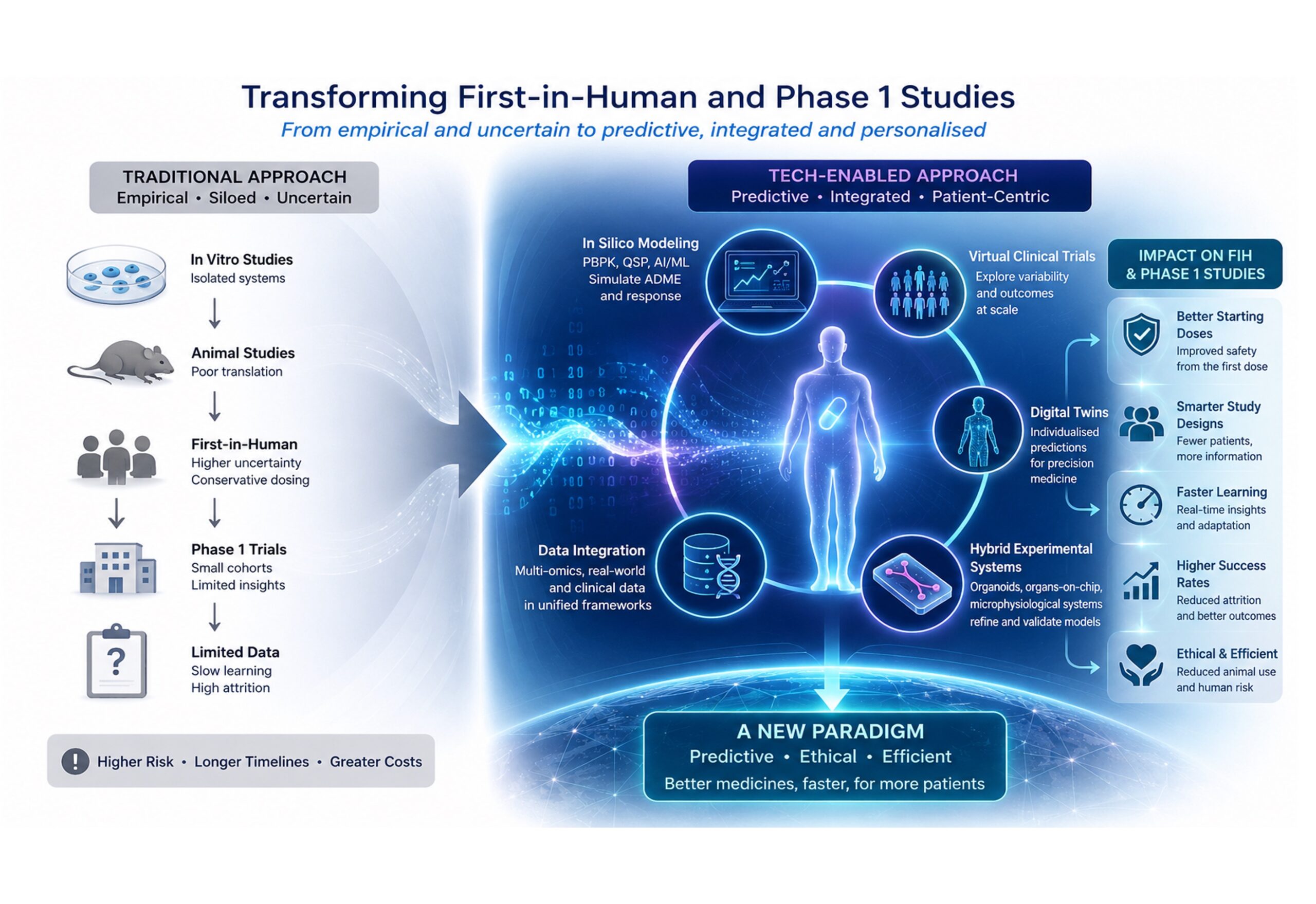
Early clinical pharmacology has historically been characterised as the threshold between preclinical experimentation and human investigation. In vitro systems and animal models have served as proxies for human biology, yet the transition to first-in-human (FIH) studies has remained a point of considerable uncertainty. In 2026, this paradigm is undergoing a fundamental transformation. The emergence of in silico, virtual, and hybrid experimental systems is reshaping early clinical pharmacology into a more predictive, integrated, and ethically refined discipline. These approaches are no longer peripheral innovations but are increasingly embedded within decision-making frameworks and regulatory pathways, redefining how evidence is generated, interpreted, and applied in early-phase drug development [1][2].
At the core of this transformation lies a suite of interrelated methodologies. In silico simulations, particularly physiologically based pharmacokinetic (PBPK) modelling, integrate mechanistic understanding of drug disposition with anatomical and physiological parameters to predict absorption, distribution, metabolism, and excretion [3]. Quantitative systems pharmacology (QSP) extends this concept by incorporating mechanistic disease pathways and target engagement dynamics, enabling simulation of drug action within complex biological networks [4].
Virtual clinical trials extend this concept to the population level. By simulating cohorts of patients, these trials enable the exploration of variability in drug response, including rare or extreme outcomes that would be difficult to capture empirically [5]. Closely related is the concept of digital twins, individualised computational representations of patients that incorporate genetic, physiological, and disease-specific parameters to simulate personalised drug responses. A digital twin of RAS wild-type metastatic colorectal cancer comprising over 1,400 patients has recently demonstrated the feasibility of predicting progression-free and overall survival with reasonable accuracy [6].
Complementing these computational approaches are advanced human biological models. Organoids, 3-dimensional cell cultures derived from stem cells, replicate key aspects of tissue architecture and function. Microphysiological systems and organ-on-chip technologies conceptualise ‘virtual reality’ (in the literal sense) even further, incorporating fluid flow and mechanical forces to mimic organ-level physiology [7]. When combined with computational frameworks, these form hybrid systems in which experimental data iteratively refine simulations (and vice versa). For example, organ-on-chip data modelling drug transport and metabolism can directly inform PBPK model parameters, effectively creating a closed loop between physical and virtual experimentation.
The increasing utility of these systems appears to be increasingly driven by the convergence of multiple technological advances. High-performance computing has enabled the execution of complex, multiscale simulations that would have been computationally prohibitive less than a decade ago. Advances in systems biology have facilitated the integration of molecular, cellular, and organ-level data into coherent frameworks. Artificial intelligence and machine learning further enhance predictive capability by identifying patterns within large and apparently heterogeneous datasets, including those derived from genomics, proteomics, and clinical records [8][9].
Importantly, these developments allow for the integration of preclinical, clinical, and real-world data streams into unified modelling frameworks. Such a fusion can only enhance the robustness and generalisability of predictions (though we still need to confirm this), supporting a more continuous and iterative approach to knowledge generation across the drug development continuum. A PBPK model developed using in vitro data on drug metabolism can be refined with preclinical pharmacokinetic data and further validated against clinical data from early-phase trials, creating a virtuous cycle of model improvement.
However, this convergence also introduces challenges. The quality and completeness of underlying data remain critical determinants of model accuracy. Systematic bias in training data can propagate through to predictions, and ‘overfitting’, where a model describes training data well but generalises poorly, remains a substantial risk, particularly when complex AI architectures are applied to limited datasets [10]. These limitations require robust validation frameworks that include external datasets and prospective testing.
The impact of these innovations on early clinical pharmacology is profound. FIH studies, historically characterised by cautious dose escalation and significant uncertainty, are increasingly informed by model-based predictions. Model-informed drug development (MIDD) has evolved into a central paradigm, guiding decisions on dose selection, escalation strategies, and study design [11] [12].
PBPK and QSP models are becoming almost routinely used when estimating safe starting doses and predicting pharmacokinetic and pharmacodynamic relationships across a range of scenarios [13]. For therapeutic proteins and bispecific antibodies, where traditional approaches such as the Minimal Anticipated Biological Effect Level (MABEL) may produce overly conservative starting doses, QSP models can be used to refine dose selection and accelerate dose escalation [14]. Such an approach serves to reduce reliance on purely empirical approaches and allows for more targeted and efficient study designs.
Critically, simulations can anticipate potential safety signals before human exposure. QSP models of T-cell engagers, for example, have been used to predict cytokine release syndrome risk and inform dose fractionation strategies, enabling proactive risk mitigation [15]. This represents a significant advance over traditional approaches, where safety signals were first observed during human dosing.
Nevertheless, safety first. The predictive accuracy of these models depends on the fidelity of their underlying biological assumptions. Disease states may alter drug disposition and response in ways that are incompletely captured by current models, and validation against more traditional clinical data and observation remains essential [3].
The virtualisation of clinical trials represents a further evolution of this paradigm. Virtual cohorts enable the simulation of population-level variability, while synthetic control arms offer an alternative to traditional comparator groups, potentially reducing the number of participants required in early-phase studies [5]. The continued requirement of placebo cohorts in clinical pharmacology studies has long been questioned [16]. A synthetic control arm constructed from historical trial data can provide a benchmark for experimental treatment effects without exposing patients to placebo, addressing both ethical and practical concerns.
Digital twins take this concept further by enabling patient-specific simulations [17]. These models can be used to explore individual responses to different dosing regimens, identify optimal therapeutic strategies, and assess risk profiles. In oncology, digital twins incorporating tumour growth dynamics and drug pharmacokinetics have been used to predict individual responses to combination therapies [18]. While still evolving, such approaches have the potential to transform early-phase trials from exploratory exercises into confirmatory studies grounded in prior simulation.
However, these innovations also raise important questions regarding model validity, generalisability, and ethical acceptability. Ensuring that virtual representations accurately reflect real-world biology remains a central challenge. Furthermore, the regulatory position on evidence generated from virtual cohorts is still being considered, with different agencies adopting varying standards for acceptance [1][2].
Regulatory agencies have increasingly recognised the value of these approaches. The U.S. Food and Drug Administration (FDA) has incorporated model-informed strategies into its evaluation frameworks through initiatives such as the Model-Informed Drug Development (MIDD) pilot programme, which provides a pathway for qualification of modelling and simulation approaches [1]. The European Medicines Agency (EMA) has issued guidelines on the qualification and reporting of PBPK modelling, establishing expectations for model documentation, verification, and validation [2].
These frameworks support the use of in silico data to inform dosing strategies, optimise study designs, and, in some cases, justify the reduction or waiver of clinical studies. For example, PBPK models are now accepted for waiving dedicated drug-drug interaction studies when simulations predict low interaction risk [13,19]. This marks a significant shift from earlier regulatory scepticism and reflects growing confidence in the scientific validity of these models.
Nevertheless, regulatory integration necessitates rigorous standards for model validation, verification, and transparency. Clear documentation of assumptions, data sources, and uncertainties is essential to ensure that model-based decisions are robust and reproducible. The International Council for Harmonisation has recently advanced guidance on MIDD credibility assessment, emphasising a risk-based approach where the stringency of validation is proportionate to the model's influence on regulatory decisions [20].
One of the most significant benefits of in silico and hybrid systems is their potential to reduce unnecessary human exposure. By improving dose prediction and identifying potential risks in advance (assuming that they do!), these approaches enhance the safety of FIH studies and align with ethical principles such as beneficence and non-maleficence.
These approaches also resonate with the "3Rs" framework, replacement, reduction, and refinement, which has traditionally applied to animal research but is increasingly relevant to human studies [7]. The use of virtual cohorts and synthetic controls further contributes to the reduction of participant numbers without compromising scientific validity. A recent analysis suggested that synthetic control arms could reduce placebo group sizes by 40–60% in early-phase oncology trials, substantially lowering participant burden [21].
However, risks require careful attention. Model overfitting, data quality limitations, and reproducibility concerns all demand robust validation frameworks. The integration of artificial intelligence introduces additional challenges related to interpretability. ‘Black box’ models, while powerful, may lack the transparency required for regulatory acceptance and independent scientific scrutiny, as they should [10]. Overconfidence in simulation outputs, where model predictions are accepted without adequate empirical verification, represents a distinct risk that must be mitigated through continued focus on prospective validation and cautious adoption.
Perhaps the most profound consequence of these developments is the erosion of the traditional boundary between preclinical and clinical pharmacology. Computational models and advanced biological systems now generate data that are directly relevant to human outcomes, challenging the conventional distinction between hypothesis-generating and confirmatory evidence [3][4]. This convergence fosters a more iterative and integrated approach to drug development, in which insights flow bidirectionally between simulation and experimentation.
Looking ahead, hybrid trial designs combining virtual and physical components may become the standard for early-phase studies. It is conceivable that aspects of Phase 1 trials will be partially virtualised, with human studies serving primarily to confirm predictions generated through simulation. This would represent a fundamental shift in the epistemology of drug development, from sequential experimentation to integrated prediction. Such a transition necessitates new organisational structures and skillsets, with increasing demand for computational pharmacologists capable of bridging biology, mathematics, and data science [9].
In the last 12 months we have seen in silico, virtual, and hybrid experimental systems less and less becoming adjuncts to traditional drug development and taking on a more direct part in its evolution. By enabling more accurate dose prediction, reducing unnecessary human exposure, and blurring the boundaries between preclinical and clinical research, these approaches are redefining both the practice and the philosophy of early clinical pharmacology. The challenge is to balance innovation with rigour, ensuring that these powerful tools are used responsibly and transparently. In doing so, the field moves toward a future in which simulation and experimentation are not distinct phases but integrated components of a unified scientific process.
What might be the practical upshot? Could we see the end of Phase 1 in clinical development? Might we see more of an adoption of a straight to patient approach as some have predicted [22]?
References

Get our latest news and publications
Sign up to our news letterResources
Social


Contact us
Address
Niche Science & Technology
Unit 26 Falstaff House
Bardolph Road
Richmond TW9 2LH
United Kingdom