Ah, the day after England’s elimination from the FIFA World Cup at the hands of Argentina. It’s painful.
I’ve been writing a lot about this World Cup but, truth be told, rugby union is my game and the main sport in my home area of the Forest of Dean. I spent many a frosty Sunday morning watching my son play for our local club over the years.
A memory from a local Derby match against another Forest team teaches me how to approach today.
Playing at full-back, my son passed the ball and left his ribs exposed for a late cheap-shot from his opponent. Things got testy after that, carrying on to the end of the game, which we lost.
Queuing up for a bacon roll and coffee after the game with one of the opponents’ Dads, we looked at each other trying to calm down after the match. Someone had to break the ice and he eventually said “Least Said, Soonest Mended”. Wise words.
And that’s my motto for today. There will be no dissection of last night’s match from me. I was hoping to write about England’s greatest scientists after victory in the final on Sunday but, alas, the time has come for this valedictory piece.
England has an astonishing history (and present) of science and currently has five universities in the Top 20 Global Universities for Life Sciences and Medicine (Oxford, Cambridge and the London Colleges Imperial, University and King’s) [1]. Actually, it’s the “Top 11” as King’s College sits at Number 11. For comparison, the entire European Union has only one in the Top 20, the Karolinska Institute, Sweden.
If you were composing a list of greatest English scientists of all time, you could include Sir Isaac Newton, Charles Darwin, Michael Faraday, Robert Hooke, Francis Crick, Dorothy Hodgkin, Stephen Hawking and Tim Berners-Lee. There are many more.
Thinking back to the days of my PhD at the Drury Lane Biophysics Unit of King’s College London, I was lucky enough to encounter many great scientists. For example, Maurice Wilkins, who won the Nobel Prize with Watson and Crick for his role in discovering the double helix structure of DNA. The range of his life experience was truly astounding [2].
Best known for his work on DNA, he actually started his career working on radar technology in World War 2 improving cathode-ray tube screens to enable more effective aircraft tracking. From there he moved to University of California, Berkley, and worked on the Manhattan Project to develop the atomic bomb, specialising in mass spectrography and uranium isotope separation. After the publication of the DNA structure, Wilkins spent 7 years verifying the hypothetical model that Watson and Crick had constructed.
Radar, The Bomb, DNA.
Wilkins was so affected by the impact of the atomic bomb, that he founded the British Society for Social Responsibility in Science and campaigned for nuclear disarmament.
John Gurdon was another great scientist I briefly encountered [3], famous for his nuclear transplantation experiments in which he took an egg cell from a frog (Xenopus laevis), destroyed its DNA, and inserted DNA from a tadpole‘s gut. The modified egg grew into a normal tadpole. Conducted in 1962, this work eventually provided the basis for the cloning of Dolly the Sheep and earned him the Nobel Prize in 2012 with Shinya Yamanaka, subject of one of my previous posts [4].
But who is or was the greatest?
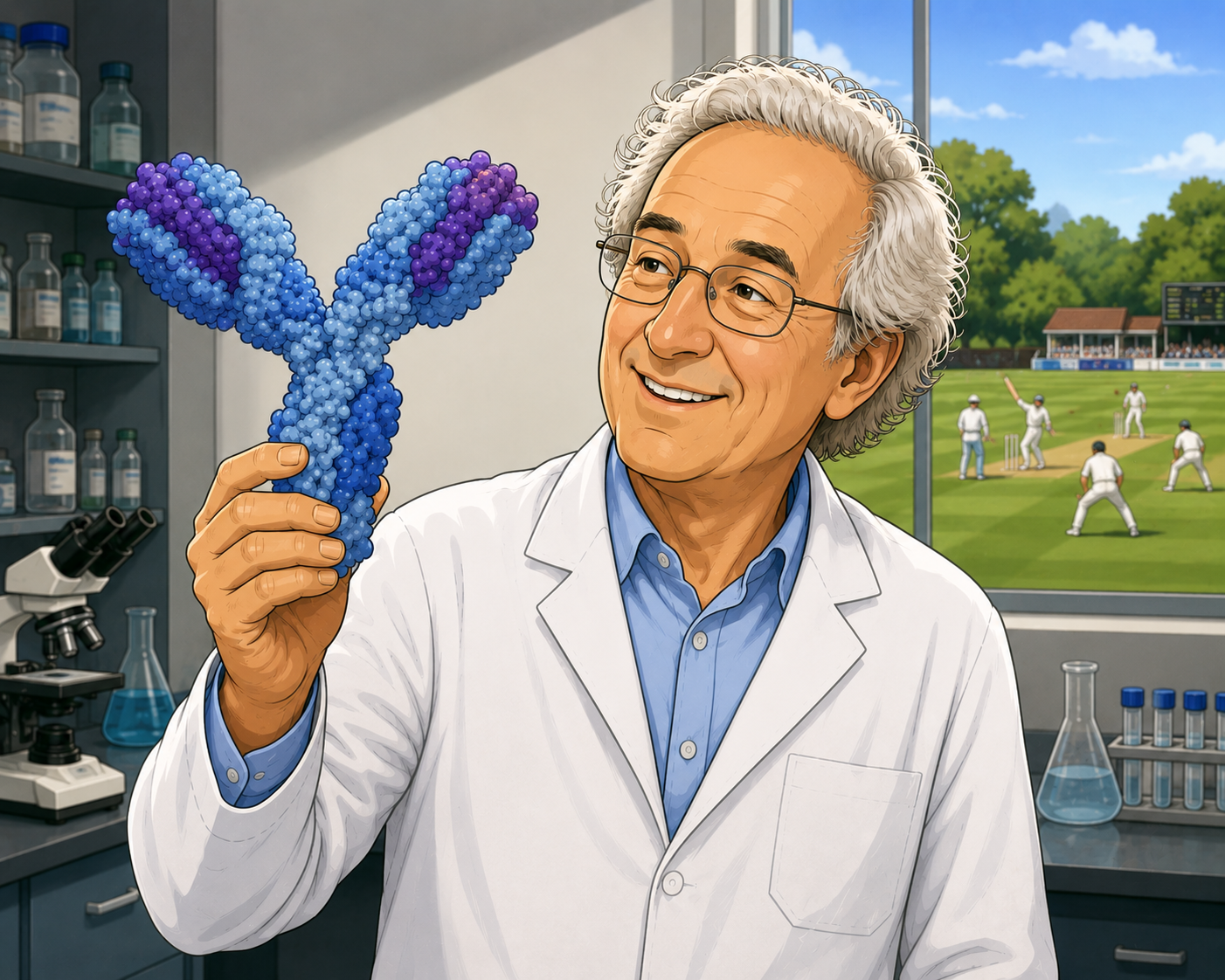
Well, it’s a personal choice and it has a bias towards the most recent decades, but I remember my wonder on hearing Greg Winter explain his phage display technique for isolating antibody fragments when I was a PhD student back in the 1990s [5].
He engineered combinatorial libraries of DNA fragments that encoded random variable regions of antibody fragments displayed on the surface of the filamentous bacteriophage M13. He then selected and extracted those with the highest affinity for specific epitopes using affinity-chromatography and used them to create high-affinity engineered antibodies specific for defined targets. His discoveries enabled the development of new medicines for cancer, autoimmune diseases, and inflammatory disorders, including the tumour necrosis factor blocker Humira (adalimumab) a blockbuster treatment for autoimmune conditions.
He was the greatest for me.
Winter’s impact has indirectly been felt by all at Niche over the years. We have worked on countless engineered antibody therapies, specific for disease targets. In the last couple of months alone, we have worked with two clients who are developing treatments that target specific interleukins to treat immune-mediated inflammatory diseases.
For England, the World Cup is over, third place play-off notwithstanding.
But let’s be optimistic, it’s summertime, the sun is out and there’s always the cricket. An England versus India one-day international today… now, who are India’s greatest scientists…?
References
Get our latest news and publications
Sign up to our news letterResources
Social


Contact us
Address
Niche Science & Technology
Unit 26 Falstaff House
Bardolph Road
Richmond TW9 2LH
United Kingdom