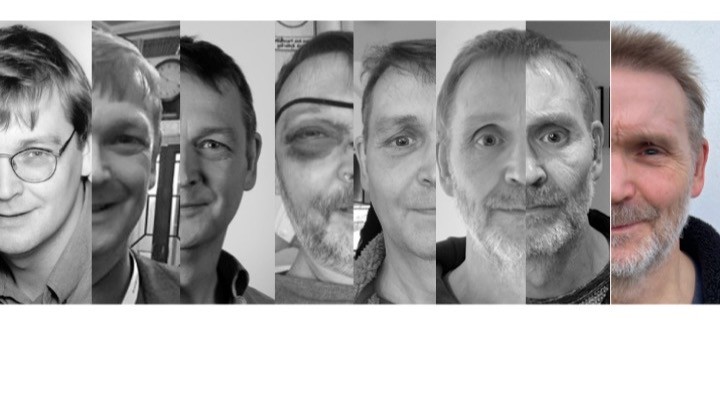
I have just updated my LinkedIn profile picture. Updating it had never crossed my mind. But yesterday, I realised that not only did my profile picture (taken in 2012) pre-date COVID, it was also taken prior to a craniofacial reconstruction. Even if your own skull has escaped involuntary reconstruction courtesy of an inattentive driver, time itself has a habit of quietly editing our faces. In the words of Percy Shelley's Ozymandias:
"Look on my works, ye Mighty, and despair!
No thing beside remains. Round the decay
Of that colossal wreck, boundless and bare
The lone and level sands stretch far away."
In today's professional world, your LinkedIn profile picture is often your first impression. It is the digital equivalent of a handshake, a friendly wave, or a knowing nod across a crowded room. But when your profile photo is decades out of date, that first impression might be more misleading than memorable.
Take, for example, the cautionary tale of Tim and Bill, two colleagues meeting for the first time in person after some months of virtual collaboration. They agreed to meet in the lobby of a London hotel. Tim arrived early, scanning the room for Bill, a distinguished-looking middle-aged man defined by the picture on his LinkedIn profile (which he was surreptitiously checking). Meanwhile, Bill wandered the lobby, peering around for a fresh-faced, clean-shaven professional, as Tim's profile suggested. A few minutes passed. Finally, Tim saw another gentleman also checking LinkedIn and scanning the room for his connection; he was just six feet away.
The Science of a Snap Judgement
This anecdote highlights a fundamental aspect of human psychology: the power of first impressions. Research consistently shows that people form surprisingly stable judgements of competence, trustworthiness, and warmth from facial photographs in as little as 100 milliseconds, sometimes even faster [1][2]. These snap judgements, while of limited accuracy, significantly influence recruitment, networking, and professional credibility [1]. This phenomenon is related to ‘thin slicing,’ where humans are remarkably adept at making rapid social judgements from very small amounts of information [3]. Your LinkedIn photograph becomes one of those "thin slices" from which people infer professionalism, confidence, competence, approachability, and leadership, often before reading a single word of your profile [4].
Your Photo as a Professional Signal
A profile photograph is not merely for identification; it is a vital component of your personal brand [5]. The image you choose communicates confidence, authenticity, accessibility, expertise, and personality before your headline is ever read [6]. In this context, authenticity is paramount. While modern smartphones, portrait filters, and AI enhancement make it tempting to "improve" photographs, excessive retouching can be counterproductive [7]. Research suggests that photos retouched by experienced professionals can generate better impressions, but self-retouching after a professional edit can decrease perceived trustworthiness and competence [7]. An authentic image that reflects your current self signals conscientiousness, attention to detail, and professionalism. An outdated or heavily filtered photo may unintentionally signal neglect or create an expectation that reality cannot meet [8].
The Practical Implications
The hotel story can be strengthened by understanding recognition memory. Humans rely heavily upon facial recognition. When the stored mental image differs substantially from reality because of ageing, facial hair, hairstyle, weight change, or surgery, recognition becomes surprisingly poor [9]. This links your anecdote directly to cognitive psychology and explains why Tim and Bill's meeting was so comically delayed.
Furthermore, studies show that recruiters often inspect profile photographs before reading CVs, and profiles with professional photographs receive more engagement [10]. The arrival of generative AI introduces another temptation: creating an idealised profile picture that bears only a passing resemblance to its owner. While technically impressive, such images undermine the very purpose of a profile photograph, namely, helping another human recognise you.
A Final Word
Keeping your LinkedIn profile picture current is not an exercise in vanity; it is an exercise in accurate communication. Your photo should reflect who you are now, not a nostalgic version of yourself. An outdated image can lead to confusion, missed connections, or, as in Tim and Bill's case, a comically delayed meeting. If nothing else, updating it every few years demonstrates authenticity, attention to detail, and respect for the people who expect to recognise you. After all, networking is difficult enough without two perfectly competent professionals standing six feet apart, each searching for a younger version of the other.
References
- Willis, J., & Todorov, A. (2006). First impressions: Making up your mind after a 100-ms exposure to a face. Psychological Science, 17(7), 592-598.
- Todorov, A., Pakrashi, M., & Oosterhof, N. N. (2009). Evaluating faces on trustworthiness after minimal time exposure. Social Cognition, 27(6), 813-833.
- Ambady, N., & Rosenthal, R. (1992). Thin slices of expressive behavior as predictors of interpersonal consequences: A meta-analysis. Psychological Bulletin, 111(2), 256-274.
- Todorov, A. (2017). Face Value: The Irresistible Influence of First Impressions. Princeton University Press.
- Gorbatov S, Khapova SN, Lysova EI. Personal Branding: Interdisciplinary Systematic Review and Research Agenda. Front Psychol. 2018 Nov 21;9:2238.
- Labrecque, L. I., Markos, E., & Milne, G. R. (2011). Online personal branding: Processes, challenges, and implications. Journal of Interactive Marketing, 25(1), 37-50.
- Fang, W., & Lee, Y. C. (2025). Retouching headshot photo by myself or professionals while job application? Difference between various retouching approaches on facial impressions perception. International Journal of Industrial Ergonomics, 105, 103700.
- Reinecke, L., & Trepte, S. (2014). Authenticity and well-being on social network sites: A two-wave longitudinal study on the effects of online authenticity and the positivity bias in SNS communication. Computers in Human Behavior, 30, 95-102.
- Burton, A. M. (2013). Why has research in face recognition progressed so slowly? The importance of variability. The Quarterly Journal of Experimental Psychology, 66(8), 1467-1485.
- Zide, J., Elman, B., & Shahani-Denning, C. (2014). LinkedIn and recruitment: How profiles differ across occupations. Employee Relations, 36(5), 583-604.