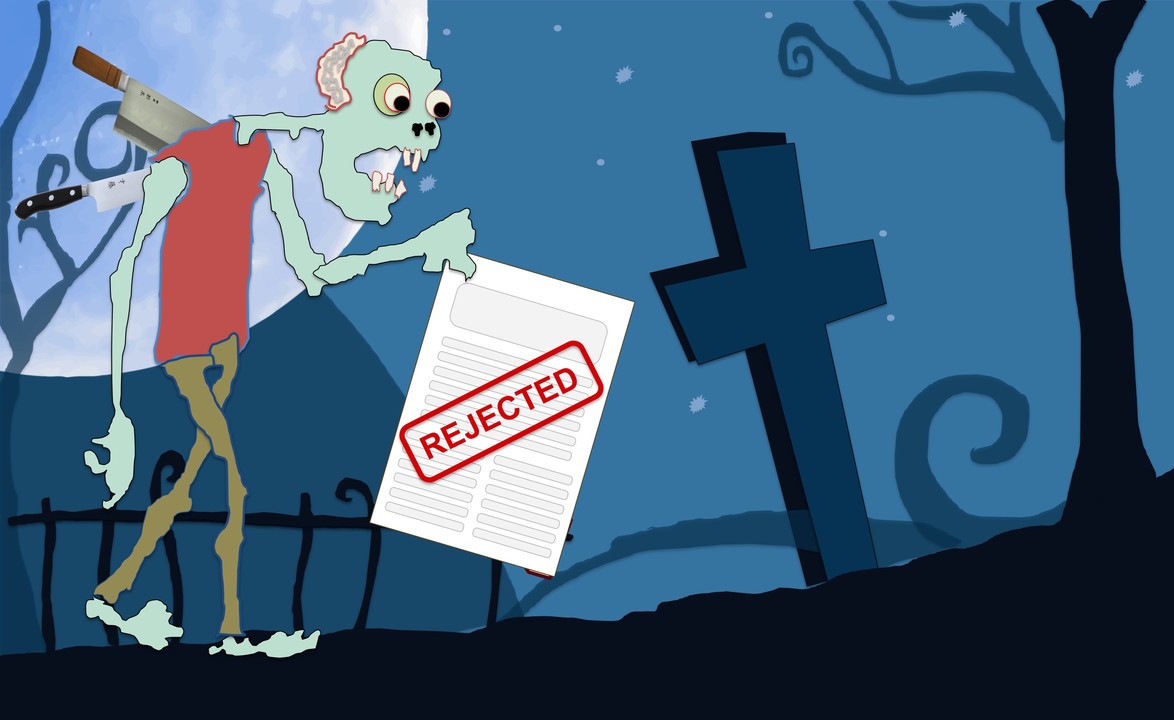
There is a deadly pathogen lurking in the shadowy corridors of medical publishing. We call it the Zombie Manuscript.
While the Good Publication Practice (GPP) guidelines introduced in 2005 and updated in 2009 (GPP2) were designed to exorcise the ghosts of unethical writing, they could not fully eliminate the shambling shells of poorly developed scientific papers [1][2]. For the uninitiated medical writer, getting entangles with a zombie manuscript can sap the life out of you. The vital signs are there for all to read, a title, an abstract, a methods section, but the soul is missing. The Investigator provides no valuable insights; the Sponsor assumes that their manuscript is alive (somewhere) and all is well.
From the unique perspective of the undead (who appreciate the value of a functioning brain), we argue that the core pathology of the zombie manuscript is vascular. Specifically, a blockage of the arteries of communication leads to tissue necrosis of the text. The behavioural warning signs of an impending zombie outbreak are there to see. Here are some prophylactic measures to keep your manuscript firmly among the living.
The lifecycle of a zombie manuscript begins with a critical error: the failure to hold a proper kick-off meeting to discuss objectives and establish roles and responsibilities in an open setting. The GPP guidelines emphasise the importance of transparency and planning early in the development process [2]. Pulling the team together in the face of conflicting calendars is too much effort and might take time. The zombie manuscript is born when the contributors adopt an attitude along the lines of, "The writer doesn't need to speak with the whole team."
Without the light of collaborative scrutiny, the first draft ends up being produced in a vacuum. It is reviewed poorly as D1 is imply considered a rough draft. The Investigator irritatingly adds a handful of single-word edits; the Sponsor, assuming the Investigator has been thorough, adds two more. As noted in general publication ethics, a lack of detailed feedback often reflects a lack of engagement, which is a primary driver of editorial rejection [3]. The manuscript shambles forward, draft after draft, accumulating minor changes but lacking direction and structural integrity. The text often starts to ramble, no one tracks the sources used and the changes made at each step fail to get logged.
Eventually, at a late stage, the team realises the product is not what they ordered. It has become a monster! The messages have drifted from the clinical findings, and the target journal’s scope does not fit the emerging story. This late-stage realisation is the equivalent of realising your Frankenstein has the wrong head and heart).
As a medical writer, you need to tune into the situation (the low moans) to avoid fright scares. Your alarm bells should ring if you observe the following clinical signs of the undead:
If these signs are present, your manuscript is seriously infected.
In our fictional world, the undead crave brains. In the real world, zombie manuscripts crave clarity. To stop the shambling progression toward project failure and manuscript rejection, the medical writer must act decisively.
First, introduce (or revisit) a manuscript template – an example manuscript from the journal you want to submit to (target journal [5]) that looks something like what the team are trying to create. Using a template manuscript is a pragmatic way to reverse-engineer what a journal consistently accepts, but it only works if you’re copying structure and signals of quality, not someone else’s science. Here’s a grounded breakdown of what to look for when selecting a template, and what elements are worth mimicking. A strong template isn’t just from the same journal, it’s aligned on multiple dimensions:
You also need to consider structural elements. These are the highest-value 'copyable' features, safe, expected, and often decisive.
(e.g., relatively short intro, heavy methods/results, focused discussion)
It is important to capture the right details for methods and depth of reporting. This is where many submissions fail—templates help calibrate expectations.
This is one of the most journal-specific “fingerprints.”
The final and perhaps most subtle but powerful characteristics to mimic are the editorial ‘acceptance signals.’ These include:
Template manuscripts act as your ‘stake’; it forces specific project information into specific boxes, leaving little room for speculation and ambiguous wandering [2]. Second, document everything (retrospectively if there are no records from the project so far). GPP guidelines provide the framework for ethical publication, but the writer is responsible for enforcing these standards [2][4]. Plan a route to redemption, provide clear review timelines and document who is responsible for what. If an Investigator fails to engage, the written record protects the writer from blame when the project collapses.
Third, get the life-blood flowing. Open communication is the circulatory system of a manuscript. The writer must explicitly state to the team: “I am adhering to GPP3. Please explain the part you have a problem with following the guidelines” [4]. This forces your ‘undead’ team members to confront their responsibilities rather than lurking in the shadows. A 2009 editorial in The BMJ supporting GPP2 noted that transparent collaboration is the only way to exorcise the ghosts haunting professional medical communication [2]. We argue that this behaviour is equally true for zombies.
Zombie manuscripts are real. They are toxic and, like fish, they rot from the head down. They are the result of disengaged teams and closed communication loops. However, they are preventable (and rectifiable). By enforcing a rigid structure (templates), shining a light on the process (documentation), and forcing the lifeblood of open dialogue from the very first briefing session, the medical writer can redeem the undead.
Do not let your manuscript stagger toward a journal rejection. Keep the lines open; keep your manuscript alive.
References

Get our latest news and publications
Sign up to our news letterResources
Social


Contact us
Address
Niche Science & Technology
Unit 26 Falstaff House
Bardolph Road
Richmond TW9 2LH
United Kingdom