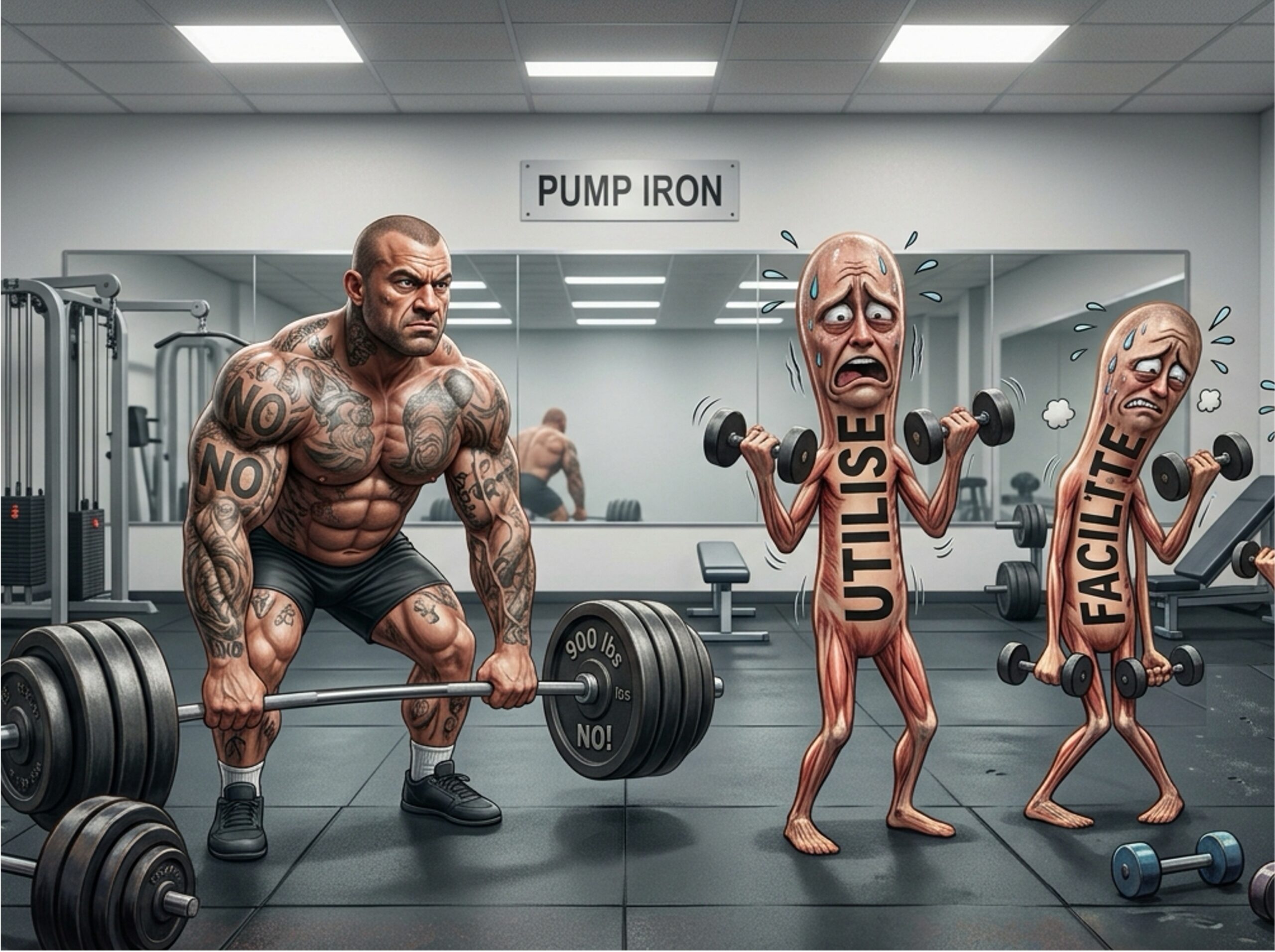
Modern science writing has become extraordinarily verbose. Its only to be expected since we are required to discuss complex concepts such as polygenic risk scores, transcriptomics, and quantum entanglement. Authors work hard to compile documents that can clearly inform the reader. Specialist disciplines acquire their own vocabulary, and often for good reason. Precision matters.
However, if you have just 3 seconds to alter another human being's behaviour, you probably wouldn’t choose a 12-syllable technical term. You would say: no, yes, stop, go, etc. This raises an intriguing scientific question, why are some of our smallest words the most powerful?
We can only speculate on the origins of human language. We have no record of humanity's first conversations. We can only imagine that those first discussions were brief.
Across many languages, some of the most common words have demonstrated remarkable stability over time. Research on language evolution suggests that frequently used words change more slowly than less common vocabulary [1]. This does not mean that all short words are ancient. But it does suggest that high frequency words can persist across time.
Interestingly, studies of language acquisition in children suggest that they begin with simple semantic combinations before mastering grammatical function words [2]. This should not be interpreted as evidence that function words are historically primitive. It is not. Rather, it reveals something rather more surprising: apparently tiny words may encode remarkable grammatical sophistication. It seems that the smallest parts of language are often doing the most invisible work.
The Brain Likes Familiarity
One reason short words remain useful may be brutally practical. Our brains are not unlimited information processors. Psycholinguistic research shows consistently that the most frequently used words are recognised and processed more rapidly than those used less often [3]. Familiarity reduces the effort required to identify a word, leaving more mental capacity to contextualise just what a word is doing in the sentence. For example, nocan reject, contradict, warn or protect. Yes can reassure, confirm or commit. Why can express curiosity, scepticism, confusion or accusation. Stop can be advice, instruction or an emergency command. We can describe a group or create one. You can establish intimacy or confrontation. I can signal identity, responsibility or self-interest.
Communication is full of such flexibility that need interpreting. We listen while thinking about what has just been said. We speak while planning what comes next. We read while holding earlier ideas in working memory. Speed matters. Familiar words give the brain a head start.
Word length and communicative power are clearly not the same thing. Some of the most consequential words in human history would fit comfortably on a Scrabble rack.
Brevity Is Bigger Than Words
When considering short words its all to easy to assume that brevity operates only at the level of vocabulary. In reality, the same principle appears repeatedly throughout communication. For example, scientific papers with shorter titles often attract more citations, although the relationship is not always consistent across disciplines and study designs [4]. The effect appears to arise not because brevity is inherently superior, but because concise titles are often easier to process, easier to remember, and more likely to communicate their central message quickly.
The same principle appears at the sentence level. Writing guides have long advocated removing unnecessary words from scientific prose, not because complexity is undesirable, but because every additional word imposes a small cognitive cost on the reader [5]. A sentence that reaches its point efficiently leaves more mental resource available for understanding the actual science. Thus, brevity is not the absence of information. It is the removal of unnecessary information. A short word, a short sentence and a short title represent the same underlying phenomenon: communication systems evolving towards efficiency.
In that sense, abbreviation and initialisation (in my humble opinion) can be a trap. An abbreviation saves space for the writer, but the reader may have to stop and mentally decode it. DNA, PCR and ATP have become part of everyday scientific language but a document packed with unexplained TLAs is different. Reading becomes less like communication and more like code breaking.
Orwell and the Problem of Big Words
The relationship between short words and effective writing has long attracted attention. In Politics and the English Language, George Orwell advised: "Never use a long word where a short one will do." Like many famous writing rules, this is frequently misunderstood. Orwell was not arguing that complex ideas should be simplified to a point of nonsense. Scientific terminology is often indispensable and no serious researcher should replace polymerase chain reaction with the thing that copies DNA. Precision exists for a reason. The problem arises when complexity serves status rather than understanding.
For example, compare:
The longer words are not necessarily wrong. They are simply ‘heavier’ (for want of a better term).
Simple language does not mean simple thinking. In fact, explaining a difficult idea clearly will often require a deeper understanding. As Pascal famously observed, “If I had more time, I would have written a shorter letter.” Good communication is often what remains after the unnecessary twaddle has been removed.
The Spoken Word Hits Different
The written word provides the audience with a broad range of communication benefits. For example, they can go back. A reader confronted with a complicated sentence can reread it. In contrast, the audience at a conference cannot rewind a speaker. Speech therefore places special demands on working memory, attention and processing your speed [6]. The listener has to keep earlier information active while the speaker is already delivering the next idea.
This is where small words become particularly effective. They create rhythm, emphasis and space. “We know” lands immediately. “The currently available evidence provides sufficient justification for concluding that…” may be accurate, but it is also gambling with the audience’s ability to stay engaged. For those of a certain age, it is rather like the monologues of Sir Humphrey in the brilliant 1980s sitcom, Yes Minister: exquisitely constructed, almost impossible to pin down.
Churchill understood the point. His most memorable speeches did not depend on obscure vocabulary. They relied heavily on familiar words arranged with extraordinary skill. In 1949 he said of it, “Broadly speaking, the short words are the best, and the old words best of all.”
This matters even more when audiences are diverse. A specialist conference shares assumptions and vocabulary. Public audiences do not. They contain different ages, backgrounds, professions, cultures, native languages and levels of expertise. Familiar language gives more people a way in. The objective is not to reduce every scientific presentation to nursery language. Complex ideas remain complex. But complex ideas and complex language are not the same thing. The best communicators simplify the path into the science without simplifying the science itself.
This is one reason effective public speakers often rely on brief sentences. Short sentences create natural processing checkpoints. They allow listeners to consolidate meaning before the next idea arrives. Brevity in speech is therefore not merely stylistic. It is neurological [7][8].
Emotion Lives in Small Words
Language does more than transfer information. It carries emotion. Early humans needed ways to signal fear, pain, attachment and danger long before anyone needed to discuss laboratory results.
Many emotionally loaded words are strikingly short: love, hate, fear, etc. Culture shapes their meaning, so no word produces an identical response in every person. Emotionally significant words are not processed like our emotionally neutral scientific lexicon. They can attract attention and influence memory differently [9]. A word can therefore arrive carrying years of personal experience, cultural meaning and emotional association.
Which brings us to swearing, which are often short, punchy words of sharp phonetic structure that create a fast, powerful emotional impact. These taboo words with amazing consistency across cultures, are used to express anger, surprise, pain, humour, solidarity, identity and emphasis. Their power comes less from their linguistic complexity than from the emotional and social meaning attached to them.
Observations from experimental pain research are interesting. In one study, participants who repeated a conventional swear word while immersing a hand in cold water tolerated the discomfort for longer than participants repeating a neutral word [10]. Later research found a similar effect and showed that the benefit did not simply arise because any novel or funny word was emotionally arousing. Swearing increased pain threshold and tolerance [11].
Context Is Everything
None of this means that short words possess magical properties. Context is everything.
Love whispered to a partner is different from love printed on a billboard. Stop shouted during an emergency is different from the use of the word stop in a contract. A swear word exchanged between close friends may communicate affection, while the same word directed at a stranger may communicate hostility.
Meaning emerges from the interaction between speaker, listener, relationship, timing, culture, tone and intention. Words do not carry their full power alone. Humans give it to them – now that is magic.
AI and the Age of Linguistic Abundance
Large language models are bringing a new twist to scientific writing. They can generate sophisticated prose almost instantly. They can summarise, elaborate, explain and persuade. They can also produce 1,000 words where 100 would do. The technology has solved much of the problem of generating language. It has not solved the problem of deciding what matters.
Fluency is not the same as communication. Nor is complexity evidence of intelligence. In an age when machines can manufacture linguistic abundance, the human skill may increasingly lie in deciding what to remove. That is why brevity is becoming more than a writing preference. It may become a form of expertise: knowing when another word adds meaning, and when it merely adds weight. The challenge for future communicators may not be generating language but editing it. Knowing what to remove may become as important as knowing what to include. In that world, brevity becomes a form of expertise, and it has been identified as one reason AI won’t replace professional medical writers any time soon [12].
The Old Words Remain
Words like I, you, we, etc., are not powerful because they are primitive, or because they are intellectually simple. They are powerful because they sit at the intersection of evolution, cognition, culture, emotion and human experience.
Perhaps that is the deeper lesson. Humans do not value brevity simply because short is good. We value efficient communication: the greatest meaning with the least unnecessary effort. The principle appears in memorable speeches, scientific titles, well-constructed sentences, emergency warnings, conversations and expressions of love and grief. Even in the occasional swear word.
It’s clear that scientific language will continue to expand. New proteins, diseases, algorithms, neural architectures and technologies will demand new names. That is progress. But beneath the expanding vocabulary sits an older communication system, one still capable of doing an extraordinary amount with very little. We can explain a mechanism in a paragraph, but sometimes a single word can change what another human does next.
References

Get our latest news and publications
Sign up to our news letterResources
Social


Contact us
Address
Niche Science & Technology
Unit 26 Falstaff House
Bardolph Road
Richmond TW9 2LH
United Kingdom