
Writing Great Titles
For authors: how to write the title readers see first, so your work gets noticed.
Download the free guideClinical Operations
Clinical Project ManagementStudy Monitoring and Site ManagementTrial Master File and Document ManagementQuality and Vendor Management SystemsStudy DocumentsRegulatory Affairs
Regulatory StrategyRegulatory WritingAgency Communications and SubmissionsDocument Editorial, QC and SubmissionQC, Review and RedactionLegal RepresentationPharmacovigilanceILAP SubmissionsMedical Communications
Publication PlanningStrategic CommunicationsScientific CommunicationsMedical EducationMedical IllustrationGrant Applications and Project PartnershipInsider’s Insights / Look Your Best
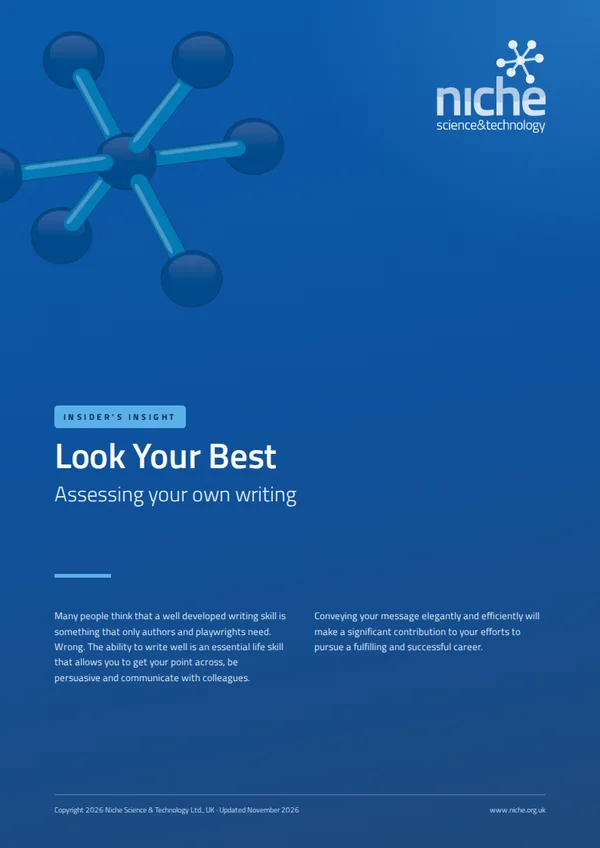
Practical techniques to edit your own scientific and medical writing, overcome word-blindness and write clearly and concisely.
Six things you will be able to do after reading this guide.
Why it is hard to edit your own text, and how letting it rest, printing it and reading it aloud help.
Check structure first, then technicalities, then the fine detail of tone and wording.
Jargon, clichés, passive voice, rambling and overwriting, with examples.
Replace verbose phrases, cut filler words and give your language authority.
Style guides, readability checkers and colleagues, and where each one falls short.
Read widely, know your weaknesses, practise and ask for feedback.
Three quick questions taken from the guide. Test what you already know.
0of 3 correct so far
Question 1 of 3
How long should you ideally let a draft rest before reviewing it, if your schedule permits?
Question 2 of 3
What is a realistic Flesch Reading Ease target for academic authors?
Question 3 of 3
Which of these is not one of the four basic categories of well-written communication?
The guide covers each of these in depth, with a checklist for every editing round.
Download the free guideA few of the 24 pages, so you know exactly what you are getting.


“Make your text as concise as you can. Less is more.”Our House Editor, from the interview in this guide
Good writing is an essential life skill that influences how others perceive your intelligence, competence, and professionalism. Poor writing—even in emails—can make you appear uneducated or careless, while strong writing communicates clarity, confidence, and credibility.
Effective writing is built on four foundational elements: readability, correctness, appropriateness and thought. These ensure clear style, coherent structure, suitable tone for the audience, and logical, thoughtful organisation of ideas.
Word‑blindness occurs when you’re too familiar with your text to see mistakes. Solutions include letting your draft rest for at least a day or two, printing it out, and reading it aloud to shift perspective and spot errors you’d normally miss.
Frequent pitfalls include jargon, clichés, passive voice, rambling, overwriting, inconsistent formatting, poor structure, and assuming the reader knows what you know (the “curse of knowledge”). Addressing these strengthens clarity and improves reader engagement.
We recommend continuous reading in your field, studying high‑quality examples, using readability tools, keeping a personal style‑mistakes log, practising different writing genres, attending writing courses, and seeking constructive feedback from peers.
For authors: how to write the title readers see first, so your work gets noticed.
Clinical, regulatory and scientific documents written, edited and quality checked by experienced medical writers.
Resources
Social


Contact us
Address
Niche Science & Technology
Unit 26 Falstaff House
Bardolph Road
Richmond TW9 2LH
United Kingdom