Synthesize And Summarize: Mastering Medical Review Writing

Keeping up with research requires considerable time investment. This feeds a need for well-conceived reviews that summarise the state-of-play and provide an opportunity to dig deeper into the topic of interest. Writing timely and relevant review articles is a complex process.

Learn about:

Types of review articles
Sources and searches
Protocols and formats
The writing process
Adding value
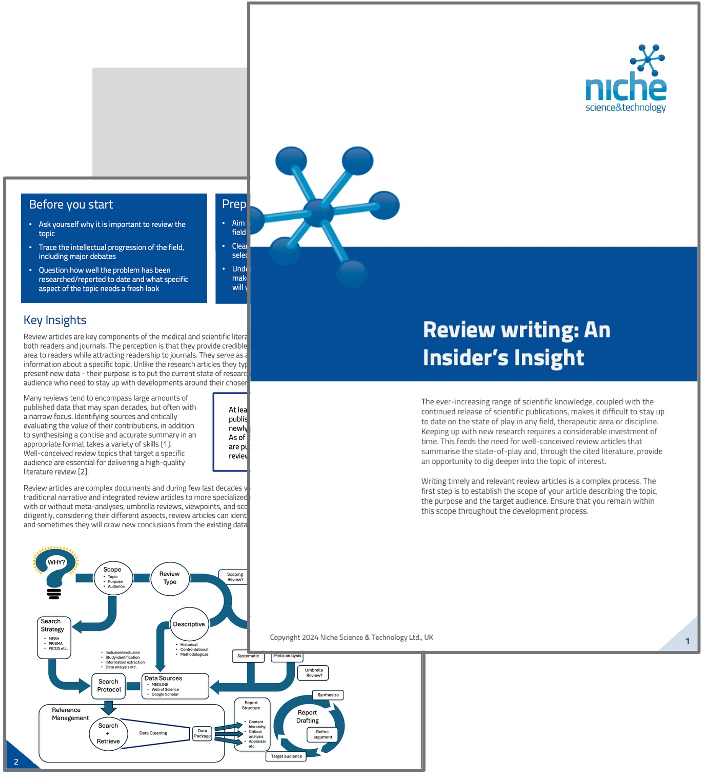
A document page showing Review writing: An Insider's Insight with flowcharts, bullet points about preparation steps, and key insights about scientific review writing processes.
Join the other 20,000+ pharma colleagues who have downloaded our Insider’s Insights.

Get your Insider's Insight

* indicates required

Frequently Asked Questions about the Insider’s Insight: 
Review Writing

To help you get the most out of our resource library, we have compiled answers to the most common questions regarding the development, application, and distribution of our specialist guides.

At Niche Science & Technology, we believe that sharing expertise is the first step toward industry-wide excellence.
A review article summarises and critically evaluates existing research on a specific topic to help readers stay informed about current knowledge, debates, and developments. Unlike primary research articles, reviews do not typically present new data but instead place existing findings into context for a broader audience.
Start by defining the scope—the topic, purpose, and target audience. A clearly defined scope helps limit the number of relevant source articles and ensures the review remains focused and manageable.
Review articles generally fall into two categories:
- Descriptive (narrative) reviews, which qualitatively summarise literature and may follow historical, confrontational, or methodological themes.
- Integrative reviews, including systematic reviews and meta‑analyses, which use explicit, rigorous methods to identify, evaluate, and synthesise evidence.
A strong review article:
- Uses clear methodology and transparent search strategies
- Critically evaluates the quality and limitations of included studies
- Synthesises information rather than simply describing it
- Provides clear conclusions and identifies gaps or future research opportunities

Get our latest news and publications

Sign up to our news letter

© 2025 Niche.org.uk     All rights reserved

HomePrivacy policy Corporate Social Responsibility
chevron-down