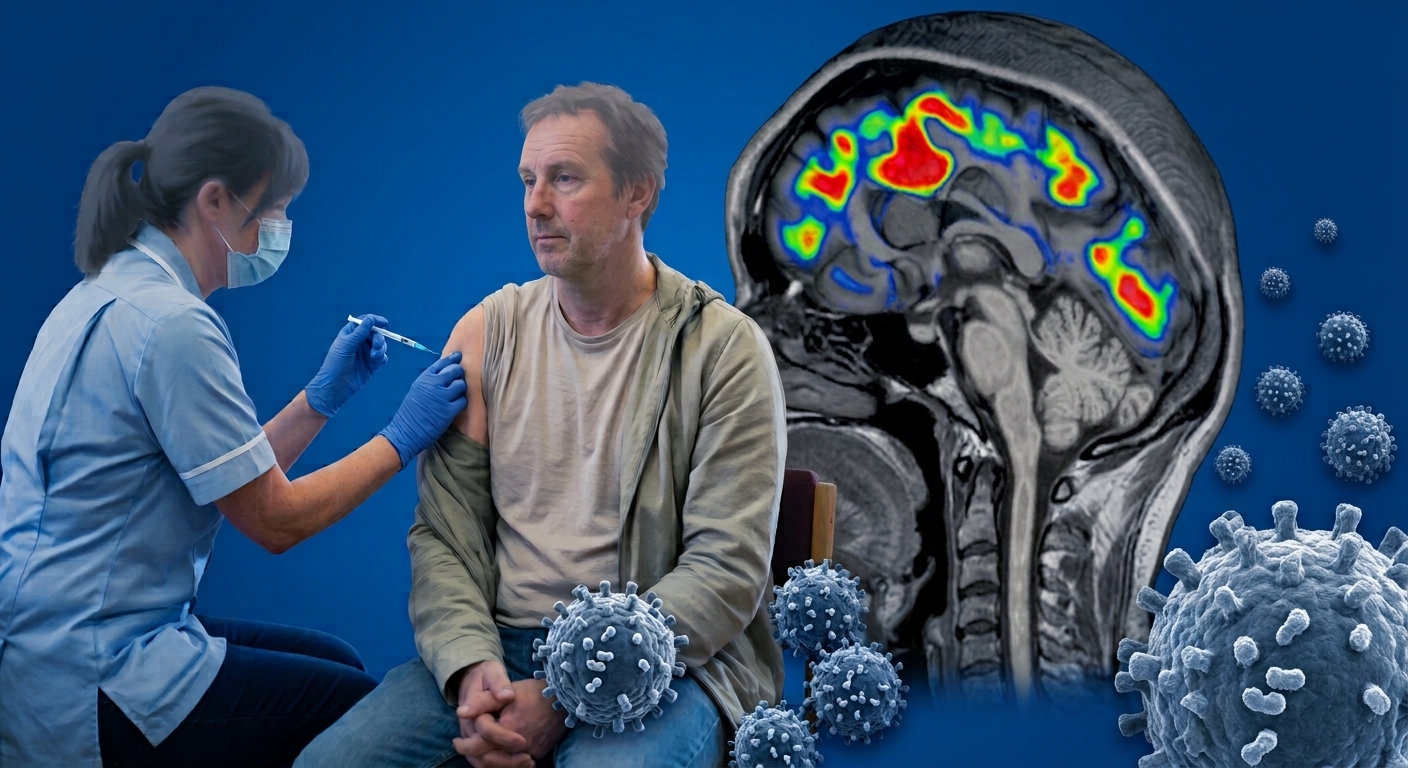
An eminent professor who was advising me on my career development once told me that the problem in medicine today is that the low-hanging fruit had all been picked. What we are left with are the complex problems for which simple answers have eluded us. One must realise of course that every once in a while, a simple answer can still pop up. And when it does, we may ponder in perplexity. Such was my reaction when I recently heard the curious discovery that shingles vaccination may offer a significant degree of protection against development of dementia.
A study conducted by Oxford University and published in Nature, describes results from a large-scale "natural experiment" that exploited a unique feature of the “shingles” vaccination programme in Wales. Eligibility for the live attenuated vaccine (Zostavax) depended on an exact birth-date cutoff (2nd September 1933). People born just before and just after this date were considered to be identical in all regards except that those born after the date were eligible for vaccination and those born before were not [1]. Remarkably, those that received the shingles vaccine had a reduced probability of a new dementia diagnosis over a follow-up period of 7 years by 3.5% (P = 0.019). This corresponds to a 20.0% relative reduction in the risk of a new dementia diagnosis. While the exact mechanism remains unknown the potential clinical implications are substantial.
One possible explanation is that a viral pathogen has an influential role to play, specifically in the pathology of Alzheimer’s disease. Like many retrospective chart-review studies that investigate associations with dementia, the Oxford study did not examine Alzheimer’s specifically, but rather looked at all-cause dementia. Often, diagnoses in electronic health records are generally more reliable at this level. Distinguishing Alzheimer's disease from other forms of dementia is difficult in routine clinical practice and many older adults have mixed forms of dementia anyway (e.g. Alzheimer's plus cerebrovascular disease), making a single subtype diagnosis uncertain. However, Alzheimer’s disease is the most common cause of dementia, accounting for around 60-70% of all dementia cases in the UK [2]. A further 10% have mixed dementia which may include Alzheimer's.
Although a viral factor in the pathology of Alzheimer’s disease is not entirely an unexpected finding, the emerging evidence for a potentially important role for the varicella zoster virus (VZV), the herpes family virus that causes chickenpox and its reactivation disease, shingles, is a relatively new arrival on the scene.
Herpes dunnit!
The first serious proposals that a virus might contribute to Alzheimer's disease appeared as early as 1982 when M. J. Ball observed that Alzheimer's disease has a predilection for the brain’s limbic structures, including the hippocampus and temporal regions, and noted the similarity to the areas particularly affected by herpes simplex virus (HSV) encephalitis [3]. Ten years later, the discovery that HSV-1 DNA could be found in the brains of both Alzheimer's patients and healthy individuals prompted investigation into whether this virus may contribute to the disease [4]. Consequently, research on a viral element to Alzheimer’s focused mainly on HSV-1.
Breakthroughs over the next few years revealed associations between HSV-1 in the brain and Alzheimer's risk among people who carry the epsilon 4 allele of the apolipoprotein E gene (APOE-ε4) [5]. Furthermore, experimental HSV-1 infection in mice induced key molecular changes associated with Alzheimer’s disease: production of beta-amyloid (Aβ) and abnormal tau phosphorylation [6]. When HSV-1 DNA was identified in the amyloid plaques of brains from Alzheimer’s patients [7], a potential role for HSV-1 seemed incontrovertible.
By 2018 a model was developing in which HSV-1 reactivation, rather than the simple presence of infection, might influence development of dementia [8]. This perspective was reinforced by epidemiological evidence that people treated with anti-herpes drugs (mostly acyclovir and valacyclovir) appeared to be less likely to develop all-cause dementia later in life [9].
The hypothesis remained controversial, but it had moved from a fringe proposal to a recognized area of Alzheimer's research. The debate shifted from "Could a herpesvirus be involved?" to "How large a role does it play?" The strongest position supported by the evidence was that HSV-1 may be a significant contributing factor in a subset of people—especially those carrying APOE-ε4—rather than the sole cause of the disease.
The reasons for the focus on HSV-1 are clear. The virus is highly neurotropic and establishes lifelong latency in neurons, it was found in brain tissue early on and a plausible mechanism was developed linking HSV-1 reactivation to the amyloid and tau pathology associated specifically with Alzheimer's.
Along comes Zoster
The unexpected new character in the plot is a different herpes virus, VZV. This virus received comparatively little attention as a potential factor in Alzheimer’s until relatively recently. Although VZV establishes lifelong latency predominantly in sensory ganglia, its reactivation can also produce disease within the central nervous system.
Furthermore, VZV typically reactivates much less often than HSV-1, usually as clinically apparent episode of shingles, whereas HSV-1 reactivates repeatedly throughout life, often asymptomatically. This led those in the Alzheimer's field to view HSV-1 as a more plausible source of cumulative neural injury.
Despite these assumptions, researchers began to notice epidemiological clues indicating a possible role for VZV over the last eight years. Large population studies revealed an association between VZV infection and increased risk of all-cause dementia [10] [11], suggesting that VZV might influence neurodegeneration, even if it does not directly cause dementia in general or Alzheimer's pathology in particular.
Then in 2022 the evidence shifted significantly. Researchers at Tufts University and University of Oxford used cultured human neural cells to demonstrate that VZV reactivation could in turn drive the reactivation of latent HSV-1, leading to Alzheimer's-like changes [12]. A new model emerged in which VZV reactivation may trigger HSV-1, which in turn leads to increased amyloid and tau abnormalities.
What role for the shingles vaccine?
While several large observational studies have reported an association between VZV vaccination and a reduced subsequent risk of all-cause dementia, a major criticism has been their susceptibility to the so called "healthy vaccinee effect". This postulates that vaccinated people are often healthier and more engaged with healthcare than unvaccinated people.
This is why the large-scale ‘natural experiment’ from Oxford University is particularly influential, as it largely avoids this bias. Those born just before and just after the 2nd September 1933 were essentially identical in all ways other than vaccine eligibility [1].
The same research group subsequently extended this approach to Australia, where shingles vaccine eligibility also depended on age-based rules in a different healthcare system. This study found a 1.8% reduction in dementia diagnosis over 7.4 years among those eligible for vaccination [13]. In a separate study, the same group also found evidence that broadens the potential significance of VZV vaccination from dementia prevention to the possibility of effects across the dementia disease course [14].
These results led me to wonder if there is evidence for a difference in effect between the two shingles vaccines. One study found that recipients of the recombinant VZV vaccine (Shingrix) had 17% more time without a dementia diagnosis than those who received the live attenuated vaccine (Zostavax) over six years follow-up [15]. However, the strongest epidemiological studies have been based on Zostavax as it has been in use since 2006. Shingrix was introduced in 2018 and has a shorter follow-up period. Despite this, Shingrix has largely replaced Zostavax in many countries including the UK and US because it provides longer-lasting protection against shingles.
Before 2025, herpesviruses were regarded as an interesting but relatively peripheral hypothesis within dementia research. While the epidemiological evidence is currently stronger than the mechanistic explanation, the studies mentioned here have nevertheless shifted that point of view. Although it is unclear whether VZV has a direct effect, e.g., by inducing neuroinflammation, or an indirect effect via HSV-1 reactivation, many researchers now consider VZV a plausible contributor to risk of dementia.
Effective prevention
Commentators in the Alzheimer’s field argue that if a licensed vaccine costing a modest amount can reduce dementia incidence by around 20%, it would represent one of the most effective preventive interventions available [16]. Sometimes the most interesting scientific discoveries occur when an intervention designed for one disease unexpectedly changes the risk of another.
Handling the unexpected
Findings that challenge an established scientific narrative can present a particular publication challenge. The data may be sound, but the story still needs to be constructed carefully: the evidence needs to be distinguished from interpretation, alternative explanations addressed and the right journal audience identified. These are precisely the sorts of challenges that experienced medical writers encounter when developing manuscripts from complex or unexpected datasets.
At Niche Science & Technology, this is one of the areas in which our Medical Communications team provides practical support, from manuscript development and journal selection through submission and response to peer review.
References:
Get our latest news and publications
Sign up to our news letterResources
Social


Contact us
Address
Niche Science & Technology
Unit 26 Falstaff House
Bardolph Road
Richmond TW9 2LH
United Kingdom