We’ve all been there, working on a manuscript on a new subject. You have just run your first-pass literature search. The database, PubMed, Web of Science, Scopus, it does not matter which, spins for 5 seconds, then spits out 1,963 possible candidates.
Damn! You need to understand the landscape of this field. You need to identify the key findings, the reliable methods, the gaps your own manuscript will fill. You also need to cite supporting literature in your introduction, justify your experimental approach in your methods, and situate your results within a broader narrative in your discussion. And the deadline for your first draft is 6 weeks away.
It’s impossible to read and digest 1,963 papers in that time. If you skim too superficially, you might miss that crucial paper that would have saved you from a fatal flaw. If you read too deeply, you will never finish the search phase. Re-running the search with different term combinations provides a less promising lists of titles.
Here is the problem that every scientific writer faces but few are taught to solve: Relevance is not enough. You also need quality, and you need efficiency. A potential paper can be perfectly relevant to your search terms but methodologically worthless. Another paper can be beautifully executed but entirely irrelevant to your specific research question. A third of your candidates may be both relevant and rigorous, but if you spend 3 hours assessing each one, you will only be able to read maybe 30 papers before your deadline, less that 2% of your search results.
How do we effectively triage, evaluate, and extract value from the scientific literature specifically to build a sound baseline subject understanding. You are not reading for curiosity. You are reading for ammunition, for context, and for credibility. Here’s a way you can ensure that every paper you ‘touch’ earns its place.
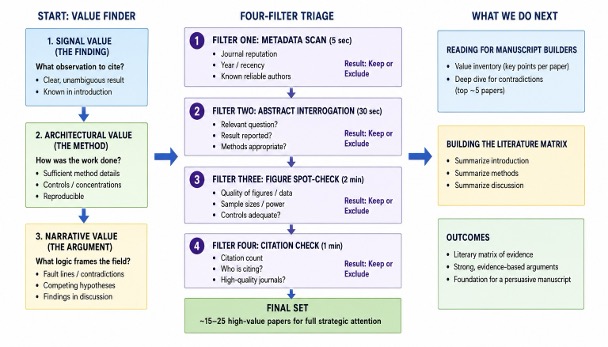
Before you click on a single title, you need to define your mission. As a writer building a collection of publications for a specific purpose like writing a manuscript, you are hunting for three distinct types of value. Take care not to conflate them.
Some papers are valuable simply because they report a finding you need to cite. "Compound X inhibits Transporter Y in vitro." That is a fact. You may take it at face value or you may doubt it, but the paper's utility lies in the observation itself. These papers typically end up in your Introduction, establishing what is known.
What to look for: A clear, unambiguous result statement in the abstract or conclusion. If the authors hedge heavily ("suggests," "may indicate," "is consistent with"), the signal is clearly weak. Strong signal value comes with statistically sound confidence intervals and/or replication.
Some papers are valuable because of how the authors did their work. You are planning to measure Protein Z by western blot, but you are unsure which antibody works. A paper that used the same antibody, reported their dilution and blocking conditions, and included a clean representative blot has architectural value. These papers end up in your Methods section or inform your experimental design.
What to look for: Sufficient detail in the Methods section. Catalogue numbers. Concentrations. Incubation times. Positive and negative controls. A paper that says "cells were treated as previously described" has lower architectural value versus one that gives you all you need to know to reproduce the work.
Some papers are valuable because of how they interpret the field. A well-written discussion section can reveal fault lines in the literature, contradictions, open questions, competing hypotheses. These papers help you frame the contribution of your own manuscript. Such manuscripts tell you what the field thinks it knows and where it is confused. These papers tend to end up in your Discussion section, where you situate your findings.
What to look for: A discussion that acknowledges limitations, cites contradictory evidence, and proposes specific next questions. Avoid papers that present their conclusions as the final word. Science is never final.
Every paper you decide to read ‘in full’ must deliver at least one of these three values. Remove it from your list if it delivers none.
You cannot read 1,963 papers (don’t even try). But you can filter them through four increasingly expensive (in time) screens until you have a manageable set. This is not skimming. This is strategic triage.
PubMed gives you the title, authors, journal, and year, enough to perform a first cut.
Action after Filter One: Consider removing any candidate where the journal is completely unknown (possibly predatory), the paper is >10 years old for a fast-moving field (e.g., genomics, immunotherapy), or the author has a documented history of retractions. Following this you have eliminated perhaps 30–40% of candidates, leaving you with roughly 1,200 papers (still too many to read).
Read the abstracts. But do not read them passively. Ask three questions:
Be ruthless. If an abstract is vague ("we investigated the role of... and found significant differences" without telling you what those differences were), that can be taken as a red flag. A good abstract gives you numbers, *p*-values, and clear conclusions. A poor abstract (we assume reflecting a poor manuscript) sells no more than a promise.
Action after Filter Two: Keep only papers where the answer to at least one of the three questions is a clear "yes." Eliminate papers where the question is adjacent but not central, or where the abstract is too poorly written to trust the full paper. This should leave you with roughly 200–400 papers.
This is where the real triage happens. Download the PDF.
Note: If you don’t have access to an institutional licence (giving access to locked publications) you may want to give consideration to separating out those manuscripts that are not free to access. In the first instance, leave these out until after you have fully completed your triage. Revisit these manuscripts if you are unhappy with your final list.
Scroll directly to the figures and assess them for:
Action after Filter Three: Keep papers where the figures suggest rigorous, well-controlled experiments. Eliminate papers where the figures are sloppy, underpowered, or missing controls. You should now have roughly 60–90 papers (or 40 papers if you are only have free-to-download candidates).
Look at the citation count for each of your candidates papers and who is citing it.
Action after Filter Four: Prioritise papers that are either (a) highly cited and from reputable labs, or (b) recent and directly relevant even if uncited. You now have your final set: 15–25 papers that you will read with full strategic attention.
You should now have 15–25 high-value candidates. Its time to read them. But you read them with a different goal than simply the curious scientist. You are reading to extract key materials.
Create a blank document. Title it "Paper Value Log – [Your Project Name]." For each paper, create an entry with three headers exactly as follows:
If a paper gives you nothing for all three headers, delete it from your library. You have just saved yourself from citing a dead end.
The most valuable papers for your discussion section are the ones that disagree with each other. Contradictions in the literature are not annoyances, they represent opportunities. Your manuscript will advance the field by offering to resolve or highlight a contradiction that previous authors have ignored.
Take your top five papers, the ones most central to your hypothesis. Read their discussions side by side. Ask:
Critical note: Do not fall in love with your own hypothesis. If the literature mostly contradicts what you believe to be true, you have two choices: change your hypothesis, or design an experiment that definitively resolves the contradiction. Ignoring contradictory papers is not a strategy. It is a path to rejection.
At this point you have read the available literature strategically. You have extracted signal, architectural, and narrative value. You have identified contradictions. Now you must assemble this raw material to support the foundation of your own work.
Create a table. Rows are your 15–25 papers. Columns are:
| Paper | Key Finding (Signal) | Methods I Can Borrow | Contradictions Noted | Quality Score (1–5) |
The Quality Score is your subjective judgment based on sample size, controls, journal reputation, and citation history. Give a 5 to ironclad studies. Give a 1 to papers you are citing only because you felt obliged to include it.
Now use your matrix to guide the content of three key sections of your manuscript:
Here is a practical constraint. You have 6 weeks to draft your manuscript. You cannot spend 4 of those weeks reading. So, impose a strict time budget:
That leaves you with roughly 30 hours to write your first draft. This is realistic. This is achievable. This is how professionals work and it doesn’t mean you can’t revisit you literature if needed.
Its time to ask one final question: If a reviewer looked up this paper, would they respect my judgment or question it? A reference list full of predatory journals, obscure conference proceedings, and/or papers from retracted authors will hurt your manuscript’s credibility. A reference list that includes the key papers from top journals, balanced by appropriate caveats, signals that you are serious.
This does not mean you should only cite articles from Nature and Science. It means you should be able to defend every citation. If you cite a low-quality paper because it is the only one that supports your claim, that is fine, but address its limitations explicitly. *"Although limited by a small sample size (N=4), one study has suggested..."*
That single phrase protects you. It tells the reviewer: I know this evidence is weak. I am citing it because I am thorough, not because I am naive.
Every paper that survives your filters becomes a brick in the foundation of your manuscript. Every paper you reject is a distraction you have courageously set aside. The difference between a stalled writer and a productive one is not intelligence or reading speed. It is the discipline to say: "Not now. Not relevant. Not rigorous enough."
Further reading:

Get our latest news and publications
Sign up to our news letterResources
Social


Contact us
Address
Niche Science & Technology
Unit 26 Falstaff House
Bardolph Road
Richmond TW9 2LH
United Kingdom