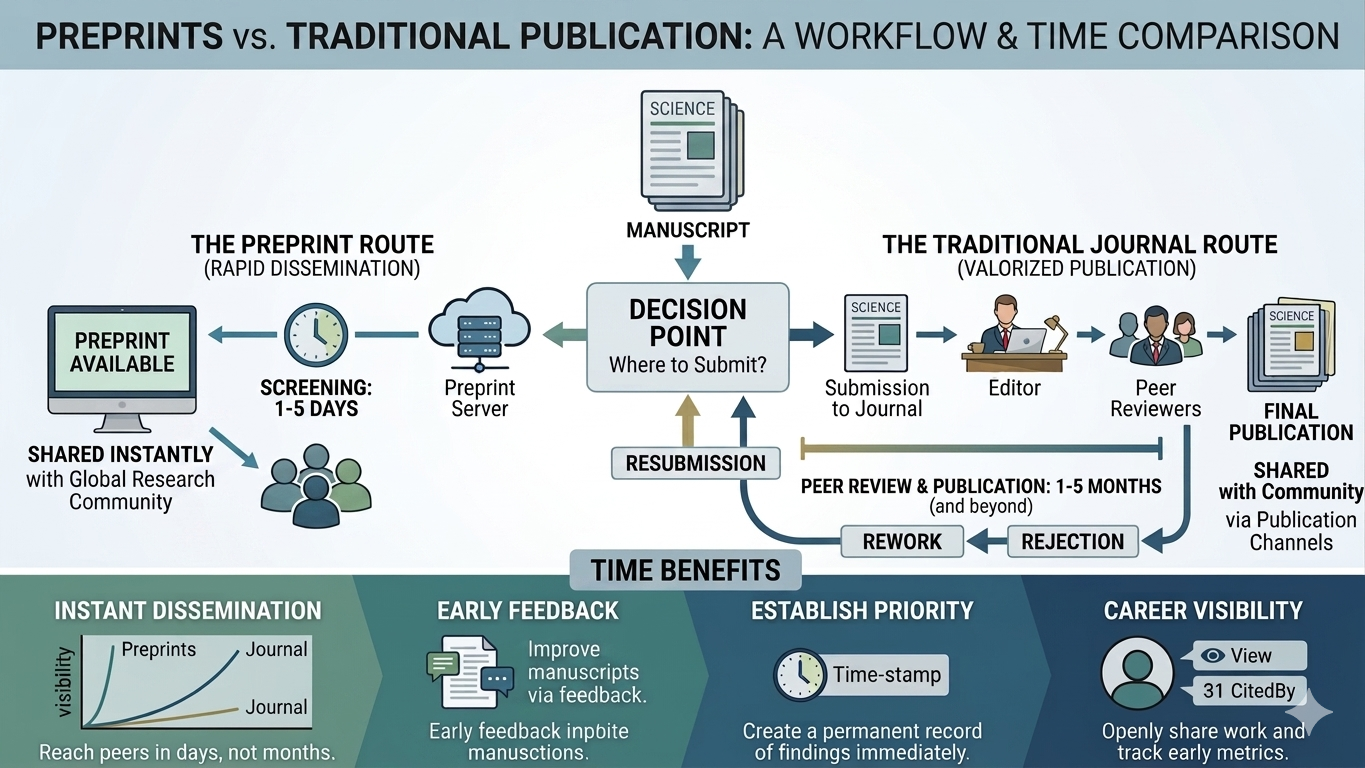
Preprints are becoming increasingly popular, but the debate over the advantages and disadvantages continues. Should you consider publishing your research on a preprint server?
The term preprint refers to a manuscript or research paper that is 'published' on an online preprint server (online platforms for sharing scientific research) before or around the time of a manuscript submission to a journal for peer review. Preprints can take various forms, including reviews and case reports [1]. Submissions are subjected to certain 'quality' checks intended to ensure that basic publication ethics are followed [2].
The primary intention of preprints is the rapid dissemination of research findings, circumventing the sluggish process of peer and editorial review associated with traditional scientific journals. Public availability of data on a preprint server is almost immediate (roughly a 2-day wait). Making data readily available on preprint servers has been seen to facilitate discussions between authors and other researchers holding similar interests. As such, they are believed to foster real-time collaboration among researchers. Preprint server traffic can also aid in identifying important fields where there is intense interest, such as what we saw with the COVID-19 pandemic [3]. In addition to collaboration, preprints serve as a crucial mechanism for establishing priority and providing "scoop protection" for researchers working in highly competitive fields [4].
The main difference is that a preprint has yet to undergo peer review, whereas a publication/published article has been 'filtered' by a journal's editorial team (as to whether or not it would be of interest to their readership) and has been assessed by referees identified by the journal in an academic journal. Peer review is a process whereby experts in the field evaluate your manuscript to determine its scientific validity and quality. Once a paper has been peer-reviewed, you are required to provide robust responses to their comments before it can be accepted for publication; it will typically undergo further editing and formatting before it is published in a journal [5][6]. However, it is important to note that the COVID-19 pandemic highlighted that peer review does not always guarantee large improvements in reporting completeness; some studies have found that the improvements made to preprints during peer review were "modest" or "trivial" [7][8].
Preprints do not preclude the need to publish your work in an academic journal. Effectively, they do not have the same academic clout; they are not recognised as a valid publication by a range of funding agencies and institutions.
Journals accept articles that have been published on preprint servers. In fact, many journals now encourage authors to post preprints of their work before submitting them for peer review. However, always check whether your target journal has any policies around which preprint server to use, or whether it is against publishing work that has been on a preprint server [12].
Preprints can be especially beneficial for researchers hoping to refine their work or better explain their findings through feedback before submitting it for peer review. However, it is important to give thorough consideration to the possible advantages and disadvantages before making a decision. Articles that express radical opinions or data that contradicts current thinking can undergo intense criticism that could preclude appropriate consideration.
Posting a manuscript on a preprint server does not mean that it will be accepted by a journal. The work will still need to follow the established process of validation via peer review and editorial approval. Your preprint work may contain oversights, errors or misinterpretations that you may have overlooked. It is therefore important to use great care in preparing your preprint. Equally, care is needed when citing preprint data in your reporting, clearly indicating that any such work has not yet undergone peer review.
As with traditional publications, it is possible to cite data published on a preprint server in your research work.
It is an acceptable way of giving credit to researchers for their work before it has undergone peer review. However, it is important to provide sufficient information to help readers locate the work and confirm it for themselves: author(s), title, the name of the preprint server, date of posting, and a persistent identifier (such as a digital object identifier, or DOI, if available) [16][17][18].
The preprint version of your manuscript can still be available on the preprint server following its formal publication in a peer-reviewed journal. Data suggests that it serves as an additional means of promoting your work [12]. Research supports this, showing a positive causal effect of posting preprints on subsequent citation counts for the published article [10]. It is important, however, to update the preprint with a link to the published paper and to include a note indicating that the paper has been peer-reviewed and published. This helps to ensure that readers are aware of the final, validated version of your research.
arXiv: started in 1991 and hosted by Cornell University, it focuses primarily on physics, mathematics, and computer science.
bioRxiv: started in 2013 and hosted by Cold Spring Harbor Laboratory, it focuses primarily on the biological sciences.
medRxiv: started in 2019 and hosted by Cold Spring Harbor Laboratory, it focuses primarily on medicine and related fields, such as public health and epidemiology.
PsyArXiv: started in 2016 and hosted by the Society for the Improvement of Psychological Science. It primarily focuses on psychology and related fields, such as neuroscience and cognitive science.
SocArXiv: started in 2016 and hosted by the Center for Open Science, it focuses primarily on social sciences, such as sociology, political science, and anthropology.
Feedback can come in various forms including recommendations for new research directions or data interpretation. Because reviews are open, they can be more comprehensive in their considerations. They are also more likely to identify any flaws in your thinking for that same reason.
If you are looking to increase the chances of getting your work published in a peer-reviewed journal, we are here to provide support! We offer a range of services identifying approved journals to target [21][22] to help improve the quality of your manuscript before submission. Our team can provide editing, proofreading and/or manuscript formatting to match your target journal's requirements and assistance in submitting your manuscript and manage in the peer review process [5][6].
References

Get our latest news and publications
Sign up to our news letterResources
Social


Contact us
Address
Niche Science & Technology
Unit 26 Falstaff House
Bardolph Road
Richmond TW9 2LH
United Kingdom