[Contains spoilers]
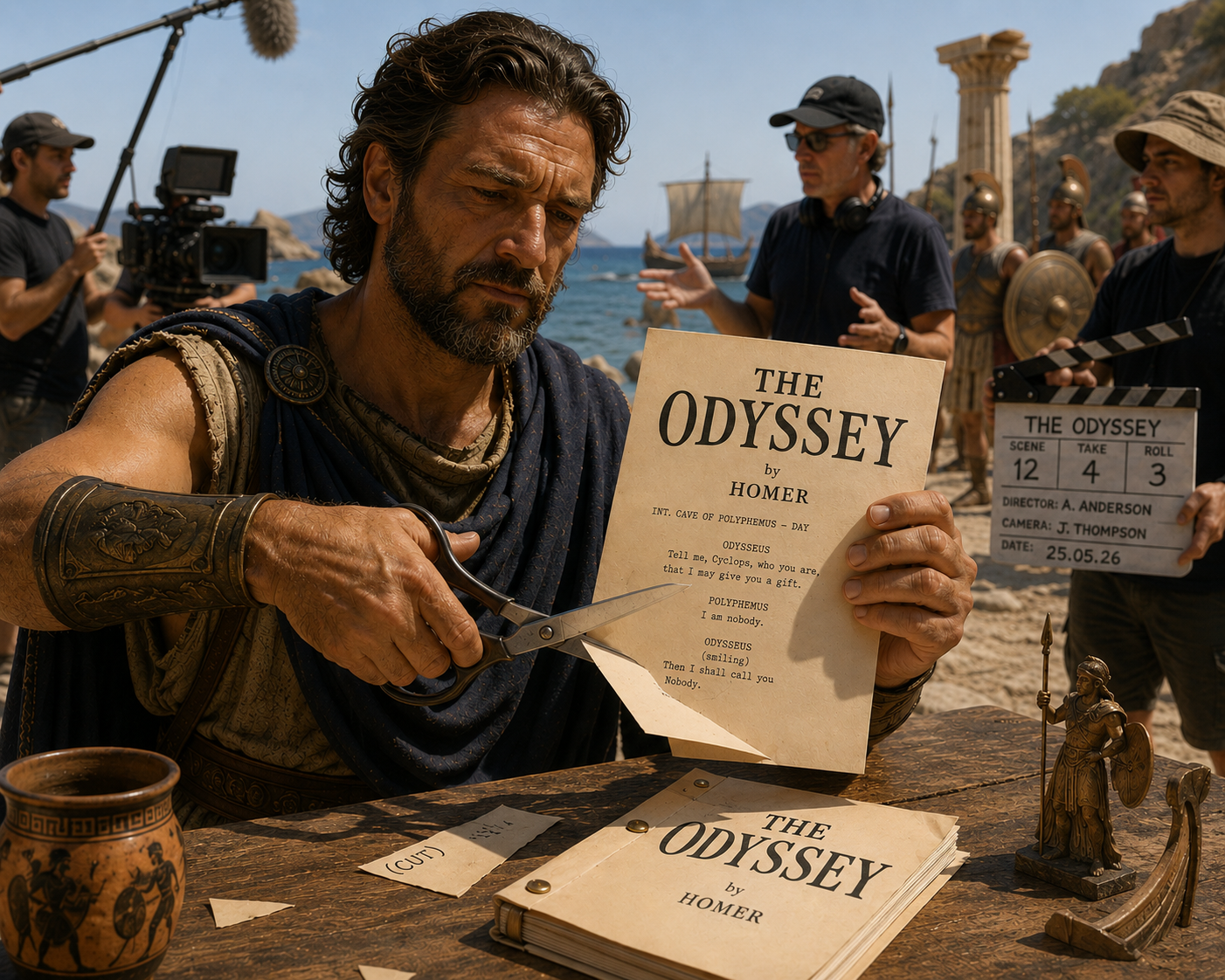
Have you seen it yet... Christopher Nolan’s re-imagining of Homer’s poem The Odyssey, the greatest story of Ancient Greece and a foundational work of western culture [1]?
I’ve always had an interest in The Ancient World, stemming in part from my failed attempt to pass Latin O level. Despite my failure, I have found my Grade D Latin to be invaluable during my career as a science writer. Given my result in Latin, I never graduated to Ancient Greek.
Queuing for popcorn in the cinema the other evening, I pondered how you cram the myths and legends from a 135,000-word poem into a 3-hour film. At some point, you have to decide what to keep in and what to leave out; Nolan had to leave a lot out, but his final cut is magnificent.
Homer’s epic focuses on Odysseus’s 10-year journey home to Ithaca after the Greeks’ decade-long siege and battle of Troy. His cunning and innovation have created the Trojan horse in which the Greeks smuggle themselves through the impenetrable city walls to victory. But, he never wanted to go to Troy in the first place and now it is time to return home.
At the core of The Odyssey lies his desire, his destiny in fact, to return to his family and homeland, to reunite with his wife Penelope and his son Telemachus, whom he left 20 years earlier as a babe-in-arms. During his travels, two women, one of them a Goddess, offer marriage, but he refuses their offers as he is compelled to return to Penelope. He is even offered immortality by the Goddess Calypso if he stays with her, but he refuses as he must return home. Nolan does not include these details in his film.
What else does Nolan leave out? When Odysseus encounters the cyclops Polyphemus, the one-eyed giant asks his name. Rather than giving his real name he replies “Outis”, which means “No man” or “Nobody”. When Odysseus and his men attack the cyclops to escape captivity, Polyphemus shouts to alert his fellow giants “Nobody is attacking me, Nobody is attacking me”, and unsurprisingly no one runs to help.
Odysseus journeys to the underworld Hades, where he meets the blind prophet Tiresius and several of his brethren from the Battle of Troy including Agamemnon, all represented in the film. In the epic, however, he also meets Achilles. As a youngster, the great hero was offered the opportunity to live a heroic but brief life or a mundane and long life by his mother, the goddess Thetis. As he valued honour and heroic fame, Achilles chose the former. However, when talking to Odysseus in Hades, Achilles confides he made a terrible mistake. He would “Rather be a tenant on earth, serving another man—while alive—than to rule all the dead in that darkness.” The conversation with Achilles didn’t make the cut.
Selecting what should be included and excluded from the documents on which we work is a frequent activity for the medical writers at Niche. Decisions are often difficult and require experience and understanding of the document type and the entire body of available data.
Most documents we create include an up-front summary of the entire content of the document to allow readers to understand key points, data and messages included in the main body.
Regulatory documents usually require a summary/synopsis and guidance is provided as a page count; no specific word count is imposed. There is no immediate and obvious disadvantage in exceeding the guidance but, as a rule, reviewers prefer brevity and adherence to guidelines.
The summary section of the Investigator’s Brochure (IB) should be brief, “preferably not exceeding two pages” [2], although IB summaries we see are routinely two or three times longer than that. To be honest, I can’t remember the last time I saw a 2-page summary in an IB.
Clinical trial reports require a synopsis “usually limited to 3 pages” [3]. Once again, this guidance is more observed in the breach than the adherence, with synopses often much longer than the 3-page limit. Not only must the synopsis include all the parameters measured in the trial, but also trial administrative and methodological information.
What can you leave out? Well, there are several approaches that can help to ensure the appropriate level of detail is included in the clinical trial report synopsis. First, it’s worth saying that every assessment made in the trial should get at least a mention in the synopsis. It’s the level of detail that is the adjustable factor. At the most basic level, the primary endpoint of the trial generally receives more detail than the secondary endpoints, which in turn should receive more detail than the exploratory endpoints. Practically, this means a full description of primary endpoint data. For secondary and exploratory endpoints, experience and knowledge of the different types of assessments in clinical trials helps. For example, pharmacokinetic assessments can generate a host of parameters and data points. Talk in general terms about levels of exposure and excretion, selecting a few key data to support statements you make. Data do not need to be repeated by rote. If you are uncertain, seek advice from someone who knows. It should be possible to inform the reader whether changes observed are large or small, in which direction they lie, and whether they are of any statistical or clinical significance.
Protocol summaries are a different beast altogether.
They are often the starting point not the end point in protocol creation, generated as a brief and convenient vehicle to help design the trial. A summary of 6–10 pages enables the trial team to capture design ideas, stimulates discussion on fundamental aspects of a trial and enables team agreement before the Sponsor invests the resources required to develop the full protocol.
At Niche, we call this vehicle the Concept Protocol and have a specific MS Word template that includes key aspects of the trial design: rationale, objectives and endpoints, population selection criteria, trial assessments and statistical methods. It is invaluable in designing clinical trials and, as it is a brief document, allows rapid review and update using an iterative process to deliver a final design. The concept protocol can be used as the Protocol Summary, possibly with appropriate reductions. Guidance on using Concept Protocols can be found in our Insider’s Insight to Concept Protocols [4].
Every medical journal article requires an abstract written according to the specific journal requirements. Abstract word limits in medical journals are strongly enforced by the journal and usually range from 150 to 500 words. Adhering to the word limit involves rewording text and removing unnecessary and redundant words while preserving the meaning and message that the article is meant to convey. Remember, no repetition; you only need to say things once. Check out our Insider’s insight on Amazing Abstracts for more tips [5].
When I was starting as a medical writer back in the Bronze Age, I was directed to a quote by Samuel Johnson who said “Read over your compositions, and where ever you meet with a passage which you think is particularly fine, strike it out.” He felt that the sentences or sections of which the writer was most proud were also the most likely to be decorative, pretentious, or out-of-place. The quality of the whole piece improves when they are removed. A good tip to consider… but, even with my 30 years’ experience, I don’t think I would have the nerve to edit Homer.
Get our latest news and publications
Sign up to our news letterResources
Social


Contact us
Address
Niche Science & Technology
Unit 26 Falstaff House
Bardolph Road
Richmond TW9 2LH
United Kingdom