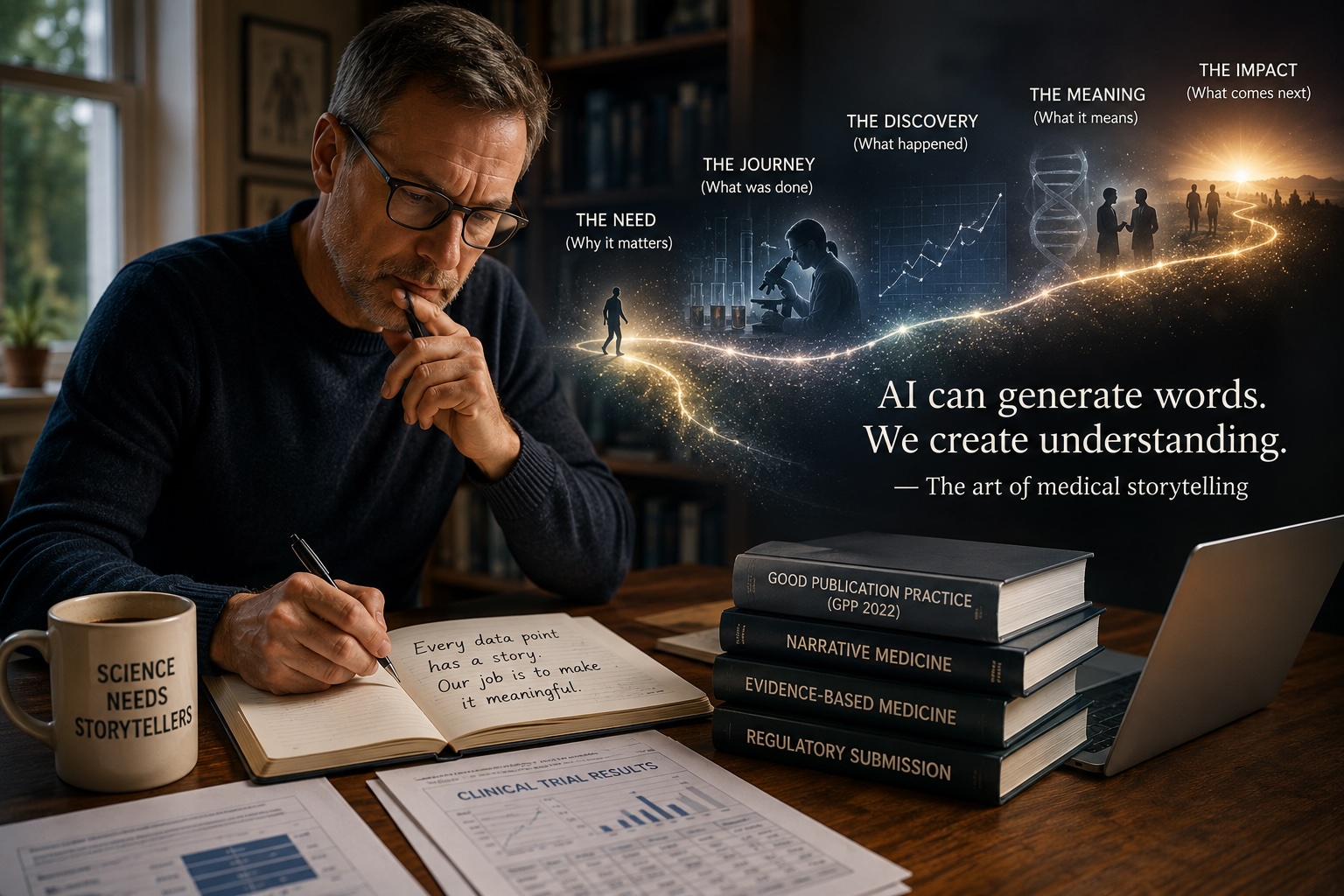
Medical writers take complex scientific data and render it into language that regulators, clinicians, and researchers can understand. The most effective among them do not merely translate data; they craft stories. And in an era when large language models can generate fluent prose at scale, the ability to tell compelling, evidence-based stories may be the single capability that distinguishes human writers from their algorithmic counterparts.
This is not a fashionable assertion. It is a conclusion grounded in decades of cognitive science, narrative psychology, and the practical realities of scientific communication. Understanding why storytelling works, and why it is essential to medical writing, requires us to look beneath the surface of how humans process information.
We think in stories
The human brain did not evolve to process spreadsheets. It evolved to process narratives. Long before written language, our ancestors used stories to share survival-critical information: which plants were poisonous, how to cooperate in hunting, what behaviours signalled danger. Storytelling was not entertainment; it was an information compression system of extraordinary efficiency [1].
Cognitive psychologists have established that narrative structure serves as a mental scaffold for organising complex information. We possess two fundamentally distinct modes of thought: the logical-scientific and the narrative. While the logical mode seeks universal truths through abstraction, the narrative mode seeks to understand particular experiences through stories [2]. We remember events as sequences of causally connected episodes, not as isolated data points [3], and we evaluate communication based on narrative coherence and fidelity [4].
The neurological basis of narrative processing provides compelling evidence. When we encounter stories, our brains activate not only language regions but also sensory and motor areas, effectively simulating the described experience [5]. Stories trigger the release of oxytocin, a neuropeptide associated with empathy and social bonding [6]. This neurochemical response helps explain why narrative information is remembered so much better than abstract data: stories engage multiple brain systems simultaneously, creating richer and more durable memory traces.
Daniel Kahneman's work on cognitive biases described how the brain operates using two systems: System 1, which is fast and intuitive, and System 2, which is slow and analytical [7]. Stories are remarkably effective because they engage System 1, reducing cognitive load while improving comprehension. A well-constructed narrative provides a ready-made mental model that organises information into a predictable structure, allowing readers to anticipate what comes next and integrate new information efficiently [8]. When we become immersed in a story, we experience reduced counter-arguing and increased belief in the story's claims [9]. This has profound implications for medical writing: a well-told scientific story is not merely more engaging but also more persuasive.
In essence, storytelling is not an optional literary flourish. It is the format that human cognition prefers, the structure through which we make sense of causality, and the medium in which we remember best.
Storytelling improves the writer as much as the reader
There is a common misconception that writing is the process of recording what one already knows. In reality, writing is a process of discovery. Constructing a coherent narrative forces the author to think more clearly, to identify gaps in reasoning, and to confront inconsistencies that might otherwise remain hidden.
The concept of external cognition, the idea that we use physical and symbolic systems to augment our thinking, explains why writing is such a powerful tool for reasoning [10]. By externalising our thoughts onto the page, we create an object that we can inspect, critique, and revise. This process is fundamentally different from internal reflection because it makes our reasoning visible and manipulable. Reflective practice, a concept developed in professional education, describes how practitioners learn by systematically examining their own actions and decisions [11]. Medical writers engage in reflective practice every time they craft a narrative: they must decide which evidence to include, how to sequence it, and what interpretations to offer. These decisions require metacognition, the ability to think about one's own thinking.
Cognitive offloading, the tendency to use external tools to reduce mental workload, is another mechanism through which writing improves thinking [12]. By committing ideas to paper, writers free cognitive resources for higher-level reasoning. This is why experienced medical writers often discover weaknesses in a scientific argument while writing rather than before writing. The act of constructing a narrative reveals logical gaps that were not apparent during passive reading or internal deliberation.
This is a profoundly human insight that artificial intelligence cannot replicate. When a writer struggles to articulate a causal relationship or to connect two pieces of evidence, that struggle signals an underlying problem in the argument. A large language model, by contrast, generates text based on statistical patterns in its training data; it has no sense of whether the narrative it produces is coherent or whether a reader will understand it. The model cannot experience the frustration of a poorly constructed paragraph or the satisfaction of an elegantly resolved argument. This metacognitive awareness, the capacity to reflect on one's own understanding and to recognise what may be difficult for others to grasp, remains a uniquely human capability.
Medicine has always depended upon stories
The clinical practice of acknowledging, absorbing, and interpreting patient stories has been termed Narrative Medicine [13]. Effective medical care requires not only scientific knowledge but also the capacity to understand the patient's experience of illness. This is not a soft skill; it is a clinical competency with demonstrable effects on diagnosis, treatment adherence, and patient outcomes.
Patient histories are themselves narratives: sequences of events with causal connections, temporal progression, and emotional significance. A patient does not present with a list of symptoms; they present with a story about how their life has changed, what they fear, and what they hope. The medical writer who translates a clinical trial into a regulatory submission must similarly understand the story behind the data: the patients who participated, the burdens they bore, and the benefits they experienced.
This empathic understanding is not easily captured by stochastic modelling. Large language models can generate text that appears empathetic, but they cannot genuinely understand the human experience of illness or communicate that understanding with authentic resonance. The medical writer's ability to empathise with patients and to convey that empathy to readers is a deeply human skill that AI cannot replicate [14].
Critically, narrative and evidence-based medicine are complementary rather than opposing approaches [15]. Evidence-based medicine provides the tools for evaluating the validity of clinical research; narrative medicine provides the framework for understanding how that research applies to individual patients. A clinical trial report that presents only data without narrative context is scientifically correct but clinically impoverished. The most effective medical writers integrate both perspectives, presenting data within a story that makes its meaning clear.
Every scientific document tells a story
Whether authors recognise it or not, every scientific document contains a narrative structure. The standard format of a journal article, with its introduction, methods, results, and discussion, is fundamentally a story: the introduction establishes the problem, the methods describe what was done to address it, the results reveal what happened, and the discussion explains what the observations mean.
This narrative structure extends across all forms of medical writing. A Clinical Study Report tells the story of a trial from its inception to its conclusion. An Investigator's Brochure tells the story of a drug's development. A protocol tells the story of a planned investigation. A regulatory submission tells the story of why a product should be approved. Health technology assessment dossiers, grant applications, white papers, and systematic reviews all answer the same fundamental questions: What problem exists? Why does it matter? What was done? What happened? What does it mean? What should happen next?
The writer must decide which details to include, which to emphasise, and how to sequence them for maximum clarity. These decisions are not merely stylistic; they determine whether the reader understands the science, trusts the conclusions, and acts upon the recommendations.
Artificial intelligence can mimic this narrative structure, generating documents that follow the expected format and include appropriate language. However, the AI has no understanding of why certain information is key, which arguments are compelling, or which details might raise concerns for regulators. It cannot recognise that a particular piece of evidence is ambiguous or that a certain interpretation might be challenged. These judgements require scientific expertise, strategic thinking, and human intuition.
How medical writers deliberately build stories
Experienced medical writers do not leave narrative structure to chance; they deliberately craft it. The process follows a recognisable arc that mirrors the structure of compelling stories in any medium. The beginning establishes context, defines the unmet need, and creates scientific tension. The middle provides logical progression, presenting evidence in a hierarchical order that supports the central argument, using signposting and transitions to guide the reader through complex material. The end offers interpretation, implications, and future directions, bringing the narrative to a satisfying resolution while pointing toward future work.
Specific narrative techniques include the problem-solution structure, the hypothesis journey, question-answer formats, case-based framing, thematic storytelling, and progressive disclosure of information. Each technique serves a different purpose and suits different document types, but all share the same goal: making complex scientific information accessible and memorable.
Crucially, good storytelling never distorts evidence. The goal is not to exaggerate findings or to conceal limitations but to present them in a way that readers can understand and evaluate. A well-told scientific story improves comprehension without compromising accuracy. This requires judgement, integrity, and a deep understanding of both the science and the audience [16].
Storytelling in the age of artificial intelligence
Large language models have transformed scientific writing, offering capabilities that were unimaginable just a few years ago. These systems can generate coherent drafts, suggest alternative phrasings, and even mimic the style of specific journals. For medical writers, AI tools can accelerate drafting, reduce routine workloads, and provide useful starting points for complex documents.
However, these capabilities come with significant limitations. AI cannot reliably determine scientific importance, clinical relevance, regulatory nuance, strategic emphasis, emotional resonance, or ethical judgement. These are human capabilities that require contextual understanding, professional experience, and moral reasoning. AI has no sense of what matters; it can only generate text that resembles what it has seen before.
The role of the medical writer is therefore evolving. Rather than generating text, writers increasingly act as narrative architects, scientific editors, critical reviewers, and strategic communicators. The future value lies less in producing words and more in designing the story that AI helps to articulate. This requires a higher level of skill, not a lower one. Prompt engineering has emerged as a key competency in this new landscape, with effective prompts specifying the audience, purpose, narrative structure, desired emotional tone, scientific depth, and persuasive intent. Writing with LLMs is a partnership: the AI handles the legwork, and the human turns the output into genuine engagement. The writer must critically evaluate AI-generated content, restructure the narrative, refine the language, and ensure that the story resonates with readers. The final document should be recognisably human, with the clarity, coherence, and empathy that only human judgement can provide.
Practical guidance for medical writers
For medical writers navigating this evolving landscape, several practical recommendations emerge. Understand your audience before writing; a document for regulators differs fundamentally from one for clinicians, patients, or payers. Identify the central message before drafting; every document should have a single, clear takeaway that everything else supports. Define the conflict or unmet need early; the reader must understand why the research matters before they will invest attention in the details. Create logical narrative flow; each section should build upon the previous one, advancing the argument without repetition. Use headings to reinforce the narrative progression, making the structure visible to the reader. Avoid unnecessary detail; every paragraph should advance the story. Use AI to assist drafting but never outsource judgement; the AI can generate a first draft, but the writer must critically evaluate, revise, and refine it. Remember that much of what makes writing effective is not captured in any training dataset. The AI cannot know what it is like to struggle with a difficult concept, to find the perfect phrase, or to connect with a reader on a human level. These experiences are uniquely human, and they are what make writing valuable.
Medical writing has never simply been about documenting science. Its purpose is to communicate scientific truth through stories that readers can understand, remember, and trust. Storytelling is not decoration; it is the architecture of scientific communication, the framework upon which understanding is built and upon which trust depends. In the era of artificial intelligence, storytelling becomes an even more valuable human capability because AI can generate words, but experienced medical writers create meaning. In a world awash with algorithmic content, it is the truly human work that stands out: the writing that connects, persuades, and endures. A great medical writer is not a translator of data but a storyteller who weaves evidence into narrative, transforming information into understanding. And that is a story worth telling.
References

Get our latest news and publications
Sign up to our news letterResources
Social


Contact us
Address
Niche Science & Technology
Unit 26 Falstaff House
Bardolph Road
Richmond TW9 2LH
United Kingdom