Bonfire Night reminds us that few human inventions capture the wonder of science quite so vividly as fireworks. For a few fleeting moments, chemistry becomes theatre. Carefully engineered mixtures of oxidisers, fuels, binders and metallic compounds transform darkness into an explosion of colour, sound and spectacle [1]. Strontium produces brilliant reds, barium creates vibrant greens, copper contributes blues, while aluminium and magnesium generate dazzling silver-white flashes. The result is a sensory experience that has captivated human audiences for centuries.
Fireworks occupy a unique place in our relationship with science. They are unapologetically celebratory. We gather to watch them not because they solve a problem, but for me at least, because they remind us that scientific understanding can be transformed into something beautiful. The explosion is the point. Yet, as I have discussed previously, the display is only part of the story. The colours fade. The noise subsides. The crowds go home. But the smoke remains [2].
Research has consistently demonstrated that major fireworks events are associated with substantial increases in airborne particulate matter, including PM₂.₅ and metal-containing aerosols capable of affecting air quality and respiratory health [3][4][5][6][7][8]. These effects are typically transient, but they serve as a reminder that every technological achievement has a footprint extending beyond its most visible moment. It is a small example of a much larger phenomenon. Throughout history, our species repeatedly falls in love with the explosion while paying far less attention to what happens after the smoke clears.
History's Favourite Mistakes
If we scientists have a recurring habit, it is that we tend to become enamoured with the promise of a discovery long before we understand its consequences. Few examples illustrate this more clearly than radioactivity. Following the discoveries of Henri Becquerel and Marie Curie, radioactive compounds became a symbol of scientific and societal progress. Radium was incorporated into medical treatments, consumer products, cosmetics, novelty items and even health tonics. Products containing radioactive materials were marketed as invigorating, rejuvenating and beneficial to health [9][10][11][12].
Today such practices seem amusingly extraordinary. Yet at the time they were considered the cutting edge of science. Radioactivity was exciting precisely because it was poorly understood. It appeared almost magical. Only later did the darker reality emerge. Radium accumulates within bone tissue where it causes marked biological damage, including malignancies [10][11]. The very property that made it scientifically fascinating also made it dangerous.
The same pattern can be seen in the history of leaded petrol. When tetraethyl lead entered widespread use during the 1920s, it solved an important engineering challenge by reducing engine knock. The benefits were immediate and commercially valuable. Although hard to believe, warnings about toxicity emerged almost immediately, particularly among workers exposed during manufacturing, yet these concerns were overshadowed by lack of any commercially comparative or equally convenient solution [13][14]. It was some decades later when it became acceptable to acknowledge that lead exposure is associated with profound neurological consequences, particularly in developing children. The eventual removal of lead from petrol is now regarded as one of the great public-health successes of the modern era [13][14][15]. How enlightened we have become.
Then there was DDT. Initially celebrated as a revolutionary weapon against insect-borne disease, DDT undoubtedly contributed to major public-health gains. However, its environmental persistence, accumulation within food chains and ecological consequences gradually became impossible to ignore [16][17]. What had once appeared to be a triumph of chemistry evolved into one of the defining environmental cautionary tales of the twentieth century.
History contains countless smaller examples, some bordering on comedy. Radioactive drinking water was marketed as a health product. Asbestos was sold as a miracle material. Tobacco advertisements featured physicians. Medical devices of questionable effectiveness promised rejuvenation, vitality and improved wellbeing. In each case, a genuine scientific property became transformed into something larger: a social movement, a commercial opportunity or a cultural obsession. The discovery itself was real, the enthusiasm would always outrun the evidence.
We Fall for It Every Time
The obvious question is why this keeps happening. Why do allegedly intelligent societies repeatedly underestimate downstream risks? Part of the problem lies within our own psychology. We are naturally attracted to novelty. Neuroscientific research has demonstrated important links between dopaminergic systems and novelty-seeking behaviour, exploration and reward processing [18]. New ideas are exciting because our brains are wired to find them exciting.
This makes perfect sense from an evolutionary perspective. Curiosity drives discovery and discovery creates opportunity. The issue is that benefits and risks tend to emerge on very different timescales. The benefits of innovation are often immediate, visible and emotionally compelling as they often address a well-recognised problem. In contrast, the risks are frequently delayed, uncertain and distributed across large populations. A revolutionary technology attracts headlines today. Its unintended consequences take much longer (possibly decades) to float into our collective consciousness.
Psychologists refer to this tendency as temporal discounting. You won’t be surprised to learn that we value immediate rewards more highly than future outcomes. Whether investing money, making lifestyle choices or evaluating new technologies, we repeatedly display a preference for short-term gains over long-term uncertainty. Science is not immune to this phenomenon. Indeed, the structures surrounding science often amplify it. Universities compete for breakthrough discoveries. Companies compete for innovation. Governments compete for technological leadership. The media competes for attention. Nobody writes headlines about the absence of unintended consequences. The reward system overwhelmingly favours the BANG!
The Age of Being Bamboozled
There is another challenge that is increasingly relevant. Modern science has become extraordinarily complex. Most people intuitively understand the basic principle of a firework, far fewer can explain gene editing, machine learning, synthetic biology, quantum computing or advanced climate modelling. As the complexity of our science increases, a gap emerges between expertise and public understanding. This is not a criticism of the public. No individual can realistically master the growing volume of specialised knowledge generated by modern scientific disciplines. However, the consequence is that scientific narratives increasingly function as matters of trust rather than understanding.
We currently find ourselves at a point where something interesting happens. Science begins to acquire a quasi-mythological quality. Technologies are not merely described as useful. They are described as revolutionary, transformative, disruptive and/or world-changing. The language becomes grander. The claims become bolder. The public becomes fascinated. And occasionally, people become thoroughly bamboozled by the science.
The philosopher Karl Popper argued that science advances through criticism, doubt and falsification rather than certainty. Yet public discussions of science often operate in reverse. Confidence attracts attention. Doubt, the traditional language of science, appears less exciting. Questions can be interpreted as resistance to progress. History repeatedly shows the danger of that mindset. The most scientifically valuable question is often not whether something can be done. Rather the question should be whether it should be done, how it should be done and what might happen afterwards.
Bigger Breakthroughs, Bigger Consequences
We stand at a technological crossroads unlike any previous generation; artificial intelligence is advancing rapidly; gene-editing technologies are becoming increasingly precise; synthetic biology allows unprecedented manipulation of living systems; and geoengineering proposals contemplate interventions at planetary scale.
These developments promise to deliver remarkable benefits. AI could accelerate scientific discovery. Gene editing may transform medicine. Synthetic biology could create sustainable manufacturing systems and novel therapies. The opportunities are extraordinary. But hang on, before you get carried away, so too are the uncertainties.
Sociologists and experts in organisational risk have long recognised that increasingly complex systems offer the potential to generate failures that are difficult or impossible to predict fully. Who might have contradicted the meme of the unsinkable Titanic? Charles Perrow's concept of "normal accidents" suggests that complex, tightly coupled technological systems inherently create new opportunities for unforeseen consequences [19]. The lesson from history is not that innovation should be feared. The lesson is that capability and responsibility must evolve together. Every increase in power magnifies the consequences of mistakes. A faulty medicine may harm thousands. A persistent pollutant may harm millions. A sufficiently powerful technology could reshape societies, economies or ecosystems.
For the first time in history, some of our innovations may possess genuinely civilisation-scale implications. What could go wrong?
Looking Beyond the Bang
In the age of super-massive rockets, fireworks may not provide a powerful metaphor for the scientific age. However, nobody will attend a firework display this weekend to watch the smoke. The spectacle captures attention while the residue quietly drifts overhead. Science often works in much the same way. We celebrate discoveries, breakthroughs and innovations. We admire ‘the bang’. We share the headlines. We marvel at the possibilities. Only later do we begin asking serious questions about sustainability, governance, ethics, resilience and unintended consequences.
Recent discussions have elevated those concerns from matters of public policy to questions of human survival itself. The recent Lancet Commission on 21st Century Global Threats to Health identified a series of interconnected catastrophic threats facing humanity and highlighted both nuclear conflict and the malicious use of artificial intelligence as possessing extinction potential beyond conventional public-health risks [20]. These threats extend beyond medicine, affecting global security, social stability and the future trajectory of civilisation itself.
That observation resonates strongly with themes explored in my recent article, Digital Parasite [21]. There I argued that artificial intelligence differs from many previous technologies because it has the potential not merely to solve problems but to influence the very information ecosystems through which humans understand reality. Like radium, DDT and countless innovations before it, AI has arrived amid extraordinary excitement, ambitious claims and widespread fascination.
Perhaps that excitement will be justified. Indeed, we can be certain that many of its promises will ultimately prove transformative. History simply suggests that transformation is rarely the complete story. The lesson is not that progress should be feared. The lesson is that history's most important chapters are often written once the celebrations are over.
As science becomes more sophisticated, the bangs are going to get bigger and bigger. The consequences no longer remain confined to individuals, industries or even countries. They extend across societies, ecosystems and generations. Increasingly, they are going to affect the future of humanity itself. And that is why the most important scientific question is not, and never has been:
"What happens when this works?"
It is:
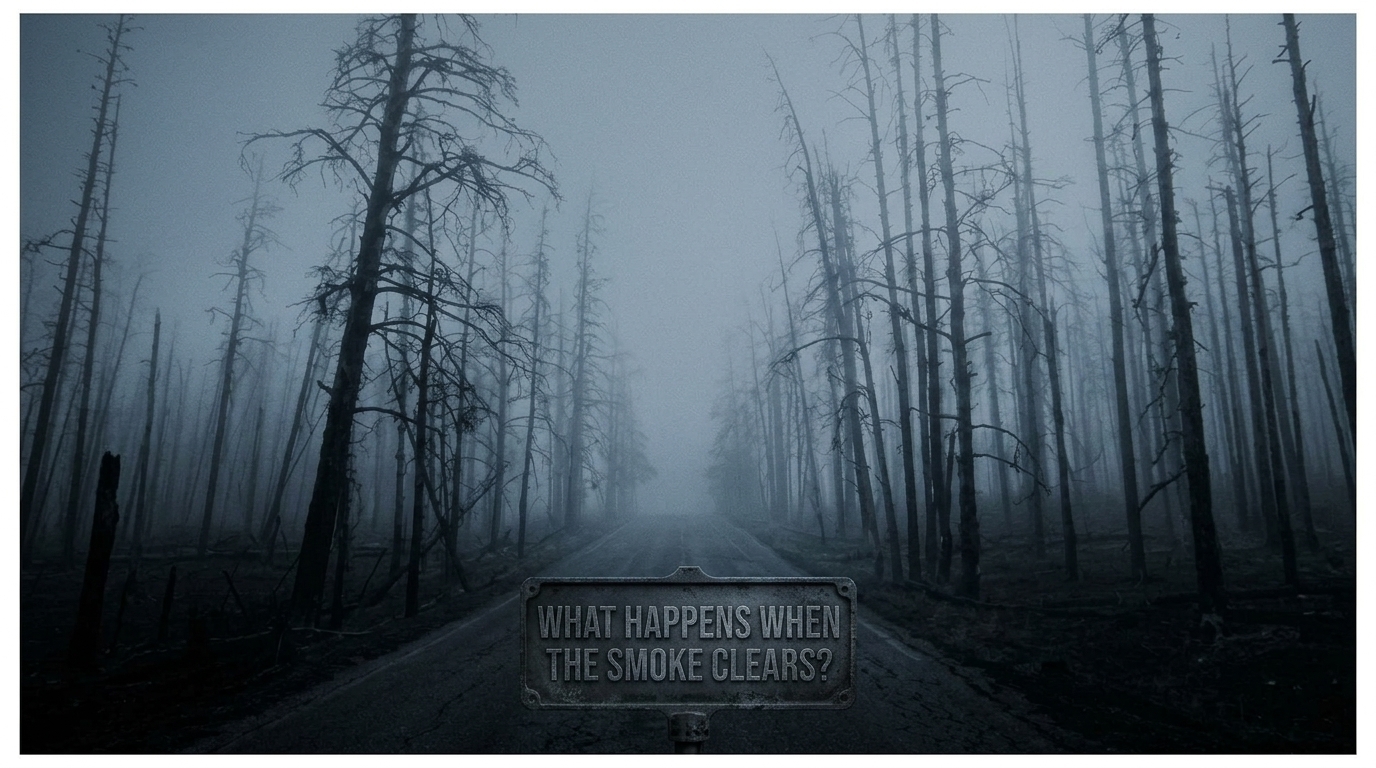
"What happens when the smoke clears?"
References
- Hardman TC (2021). Fireworks.
- Hardman TC (2025). Medical Mischief of Fireworks.
- Gouder C, Montefort S. Potential impact of fireworks on respiratory health. Lung India. 2014;31(4):375-379.
- Lin CC. A review of the impact of fireworks on particulate matter in ambient air. J Air Waste Manag Assoc. 2016;66(12):1171-1182.
- Shah R, et al. Personal exposures to particulate matter <2.5 μm during the burning of six commonly used firecrackers in India. Lung India. 2019;36(4):324-329.
- Hoyos CD, et al. Effects of fireworks on particulate matter concentration in a narrow valley: the case of the Medellín metropolitan area. Environ Monit Assess. 2020;192(1):6.
- Mahilang M, et al. Influence of fireworks emission on aerosol aging process and associated health risks. Atmospheric Pollution Research. 2020;11(7):1127-1141.
- Zhang X, et al. The effects of fireworks discharge on atmospheric PM2.5 concentration during the Chinese Lunar New Year. Int J Environ Res Public Health. 2020;17(24):9333.
- Blaufox MD. Radioactive artifacts: historical sources of modern radium contamination. Semin Nucl Med. 1988;18(1):46-64.
- Charkiewicz AE, et al. Radium: from discovery to the present day. Clin Exp Med. 2026;26(1):301.
- Tyler AN, et al. The radium legacy: contaminated land and the committed effective dose from ingestion of radium contaminated materials. Environ Int. 2013;59:449-455.
- Rentetzi M. Packaging radium, selling science: boxes, bottles and other mundane things in the world of science. Ann Sci. 2011;68(3):375-399.
- Needleman HL. The removal of lead from gasoline: historical and personal reflections. Environ Res. 2000;84(1):20-35.
- Kovarik W. Ethyl-leaded gasoline: how a classic occupational disease became an international public health disaster. Int J Occup Environ Health. 2005;11(4):384-397.
- Angrand RC, et al. Relation of blood lead levels and lead in gasoline: an updated systematic review. Environ Health. 2022;21(1):138.
- Jaga K, Brosius D. Pesticide exposure: human cancers on the horizon. Rev Environ Health. 1999;14(1):39-50.
- Hellou J, et al. Review on DDT and metabolites in birds and mammals of aquatic ecosystems. Environ Rev. 2013;21(1):53-69.
- Costa VD, et al. Dopamine modulates novelty seeking behavior during decision making. Behav Neurosci. 2014;128(5):556-566.
- Perrow C. Normal Accidents: Living with High-Risk Technologies. Princeton University Press; 2011.
- Murray C, et al. The Lancet Commission on 21st century global threats to health. The Lancet, 2026; 408, 1603-1661.
- Hardman TC (2026). Digital Parasite.