We have some strange terms in the pharma industry, and one that new entrants often find most difficult to grasp is that of suspected unexpected serious adverse reactions (SUSARs). The term refers to an adverse event that occurs in a clinical trial subject, which is assessed by the sponsor and/or study investigator as being unexpected, serious, and having a reasonable possibility of a causal relationship with the investigational medicinal product [1,2]. That’s a mouthful, yes?
The concept and regulatory importance of SUSARs emerged from international efforts to standardise pharmacovigilance terminology and reporting requirements, particularly following high-profile safety failures and the globalisation of clinical research [3].
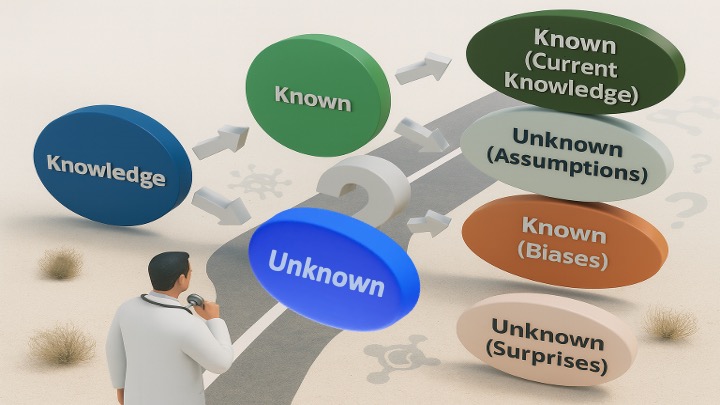
It's not just the pharmaceutical industry that uses obscure terms. On February 12, 2002, Donald Rumsfeld gave a response to a question at a US Department of Defense news briefing about the lack of evidence linking Iraq with weapons of mass destruction. His now-famous remarks on “known knowns,” “known unknowns,” and “unknown unknowns” resonate strongly with risk management in medicine and drug development, where unanticipated harms often pose the greatest threat to patient safety [4].
In clinical research, unknown unknowns are particularly dangerous, as they represent adverse effects or risks that are neither predicted nor actively monitored. This reality underpins the rationale for intensive safety surveillance systems, expedited reporting of SUSARs, and adaptive risk management plans [5]. Interestingly, what Rumsfeld did not mention are unknown knowns, things we know but are not consciously aware of. In medical writing, this distinction can determine whether a document is perceived as authoritative, precise, and trustworthy, especially in regulatory contexts where ambiguity can have real-world consequences [6].
Ordering adjectives
Believe it or not, the superpower is little more than knowing about the correct order in which to use adjectives when we write. The skill is described beautifully in the 2013 book ‘The Elements of Eloquence: How to Turn the Perfect English Phrase,’ by Mark Forsyth [7]. The book, which explains classical rhetoric, dedicates chapters to rhetorical figures with illustrating examples, particularly in the works of William Shakespeare. Regarding adjectives, Forsyth states:
“…adjectives in English absolutely have to be in this order: opinion-size-age-shape-colour-origin-material-purpose Noun. So, you can have a lovely little old rectangular green French silver whittling knife. But if you mess with that word order in the slightest, you’ll sound like a maniac. It’s an odd thing that every English speaker uses that list, but almost none of us could write it out.”
While this may seem trivial, linguistic precision plays a critical role in regulatory and scientific writing, where subtle shifts in phrasing can alter meaning or interpretation [8]. Forsyth’s description of adjective order illustrates how native speakers unconsciously apply complex grammatical rules, lending their writing fluency and credibility, attributes that are particularly valued in regulatory documentation [6,9]. In other words, the order of adjectives has to be: opinion-size age-shape-colour-origin-material-purpose. Change this order in any way and you give away your non-English roots. And yet, most English people would not be able to tell what they are doing [10].
While many native English speakers show little interest in formal grammar, studies of scientific communication consistently demonstrate that linguistic clarity improves comprehension, reduces reviewer burden, and supports more accurate interpretation of medical data [11]. French and German speakers are a lot more interested in the mechanics of their languages, they'll argue about grammar and go and get Le Bon Usage to settle a dispute [12]. Nevertheless, there are a lot of rules like this that we don't know. We're lucky that, as native speakers, we can just open our mouths and it comes out. Whether it's the odd rules about the order of adjectives or ablaut reduplication, or the bits of etymology that are utterly obvious once you point them out. As Mark Forsyth says "there’s a reason there may be little green men on Mars, but there certainly aren’t green little men” [7]. As with any rule, there are always exceptions, but these are simply obeying another commonly unknown rule of English usage, that of ablaut reduplication.
Criss-crossing
Reduplication rules, such as ablaut reduplication, are another example of tacit linguistic knowledge that native speakers follow instinctively. Although these patterns rarely appear in regulatory writing, violations can immediately mark non-native usage and subtly affect perceptions of author expertise [13]. In regulated environments, such perceptions, however unfair, can influence how clearly risks, benefits, and uncertainties are understood [6].
Getting tense
Even experienced native English-speaking medical writers often apply complex tense structures correctly without consciously knowing the grammatical rules they follow. Tense choice is especially important in scientific writing, where it signals evidence strength, temporal relationships, and causal inference [14]. For example, inappropriate tense use can blur distinctions between established knowledge, observed results, and speculative interpretation—an issue repeatedly highlighted in guidance on biomedical manuscript preparation [15].
Mastery of tense, aspect, and modality often requires prolonged immersion and exposure, which explains why non-native speakers may struggle to achieve the same level of narrative flow despite strong technical knowledge [11,16].
Clearly, English is a complicated language, and even native speakers are often unaware of its intricacies. In regulatory and medical contexts, however, these subtleties matter. Ambiguous or awkward phrasing can obscure safety signals, weaken risk communication, or complicate regulatory review [1,6]. This makes a strong case for involving experienced native English-speaking medical writers when preparing clinical and regulatory documents, particularly those related to safety reporting and pharmacovigilance.
References
- International Conference on Harmonisation. ICH E2A: Clinical Safety Data Management: Definitions and Standards for Expedited Reporting. Geneva: ICH; 1994.
- European Medicines Agency. Guideline on the management of clinical safety data during clinical trials. London: EMA; 2011.
- Edwards IR, Aronson JK. Adverse drug reactions: definitions, diagnosis, and management. Lancet. 2000;356(9237):1255–9.
- Stirling A. Risk, Uncertainty and Precaution: Some Instrumental Implications from the Social Sciences. January 2003 DOI: 10.4337/9781843765653.00008
- Hauben M, Aronson JK. Gold standards in pharmacovigilance. Drug Saf. 2007;30(8):645–55.
- Gopen GD, Swan JA. The science of scientific writing. Am Sci. 1990;78(6):550–8.
- The Elements of Eloquence: Secrets of the perfect turn of phrase. Mark Forsyth Oct 07, 2014 (ISBN 9780425276181)
- Schriver KA. Plain Language for Expert or Lay Audiences: Designing Text Using Protocol-Aided Revision. ERIC Number: ED334583.
- Halliday MAK, Martin JR. Writing science: literacy and discursive power. London: Falmer Press; 1993.
- Hyland K. Disciplinary discourses: social interactions in academic writing. Ann Arbor: University of Michigan Press; 2004.
- Moher D, Simera I, Schulz KF, Hoey J, Altman DG. Helping editors, peer reviewers and authors improve the clarity, completeness and transparency of reporting health research. BMC Med. 2008 Jun 16;6:13.
- Le bon usage. Grammaire francaise, 16e edition 16 by Goosse, Andre, Grevisse, Maurice (ISBN: 9782807300699)
- Pinker S. The Language Instinct. New York: HarperCollins; 1994.
- Day RA, Gastel B. How to Write and Publish a Scientific Paper. 6th ed. Cambridge: Cambridge University Press; 2006.
- CONSORT Group. The CONSORT statement: revised recommendations for improving the quality of reports of parallel-group randomized trials. JAMA. 2001;285(15):1987–91.
- Flowerdew J. Scholarly writers who use English as an additional language. J Engl Acad Purp. 2008;7(2):77–91.