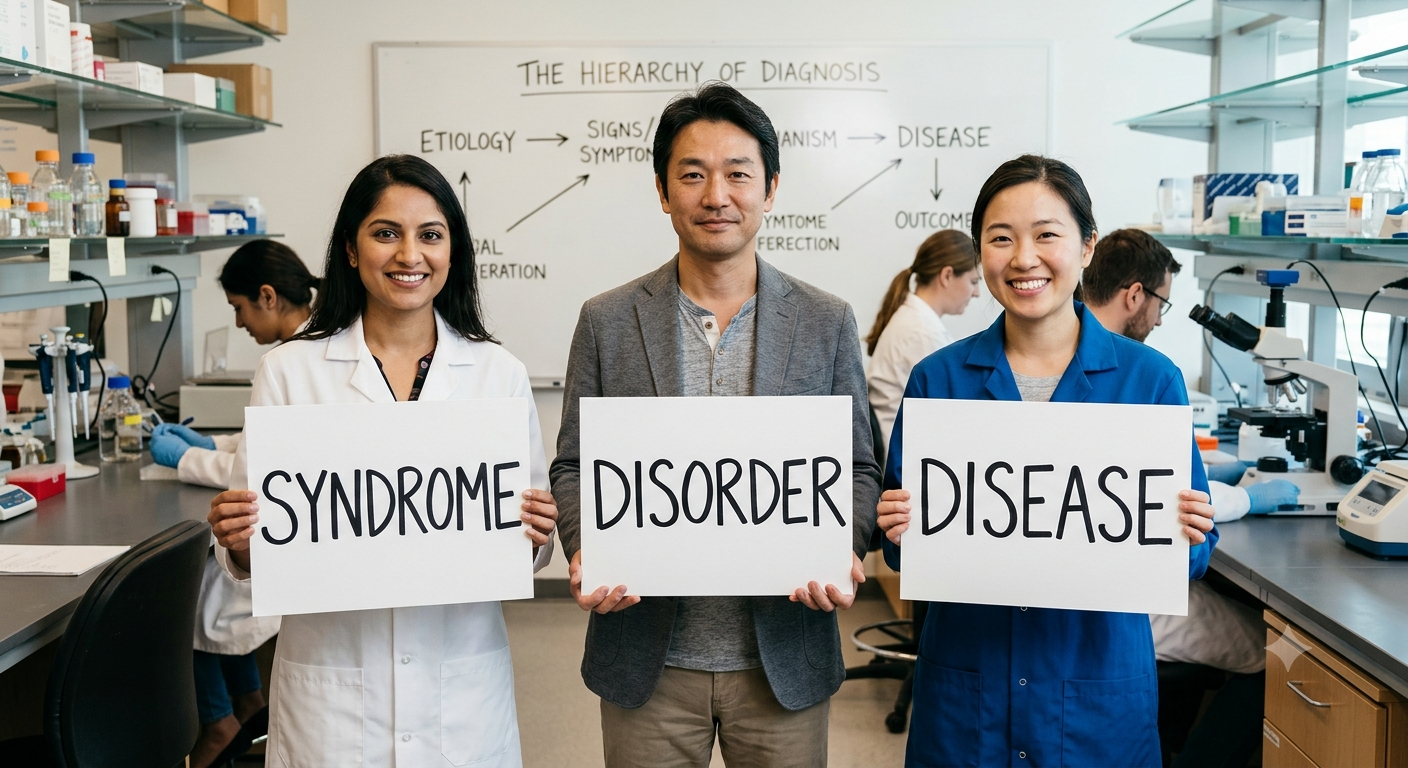
In the complex landscape of modern medicine, precision in language is paramount. Yet, in both clinical settings and public discourse, terms such as ‘disease,’ ‘disorder,’ and ‘syndrome’ are frequently used interchangeably (and incorrectly). This can obscure important distinctions in pathophysiology, diagnosis, and treatment. While these terms are related and may describe overlapping concepts, they represent a hierarchy of health states with distinct characteristics that influence clinical reasoning and patient care [1][2].
Our experience of illness typically begins with subjective symptoms: headache, pain, fatigue, or dysfunction that deviates from our normal state of wellbeing. These symptoms can be fleeting or may herald an underlying health problem requiring medical attention [3][4]. At this preliminary stage, clinicians and patients alike recognise that something is "wrong," but the nature and cause of the problem remain unclear.
It is at this juncture that the terminology we employ becomes crucial. We might report to our doctor with ‘conditions,’ a broad term defined by the Oxford English Dictionary as both "a person's state of health or physical fitness" and "an illness or other medical problem". In clinical practice, the term serves as a neutral descriptor of an unhealthy state or abnormal health status, without implying specific aetiology or pathophysiology [3][4]. It represents the starting point in the diagnostic journey, acknowledging that the patient's state deviates from normal wellbeing.
When multiple signs and symptoms occur together in a recognisable pattern, they are often classified as a syndrome. The term derives from the Greek ‘syn’ (together) and ‘drome’ (run), literally meaning ‘to run together’. A syndrome represents a collection of findings that tend to appear together in individuals, we might expect due to a single cause or set of related causes, although the exact cause may or may not be understood.
The clinical utility of identifying a syndrome lies in its pattern recognition value. Syndromes provide a framework for organising clinical observations and can suggest diagnostic possibilities. For example, carpal tunnel syndrome develops due to compression of the carpal tunnel, putting pressure on the median nerve and causing characteristic symptoms of numbness, tingling, or weakness in the affected wrist and hand. Similarly, complex regional pain syndrome (CRPS) can develop after injury and affects one limb with severe chronic pain, though its exact cause remains poorly understood [5].
Syndromes have historically been named after the physicians who first described them, Down syndrome, Marfan syndrome, and others represent conditions first identified by astute clinical observation [6]. However, it is crucial to understand that a syndrome does not imply a known specific cause or underlying pathology. Rather, it signifies that a consistent pattern has been observed across multiple patients, suggesting an underlying process even when that process lacks our understanding.
A disorder represents a more defined clinical entity than a syndrome, characterised by functional impairment and disruption to normal body function and structure [7][8]. However, unlike diseases, disorders often lack a clearly established aetiology, there is typically not enough clinical evidence for a definitive diagnosis of a specific disease.
Disorders can affect both physiological functioning (such as metabolic disorders) and psychological functioning (such as mental health disorders). They may be classified as mental, physical, genetic, emotional, behavioural, or structural. Examples include post-traumatic stress disorder (a mental health condition developing after traumatic events) and anxiety disorders (characterised by persistent and overwhelming feelings of worry and fear).
The distinction between disorder and disease is particularly important in autoimmune conditions, where definitive diagnosis can take years. Patients may have clusters of symptoms that clearly indicate an autoimmune disorder but lack sufficient clinical evidence for a specific disease diagnosis. During this diagnostic interval, patients experience the full reality of their condition, the functional impairment and symptom burden remain real and challenging irrespective of diagnostic certainty [7][8].
As one authoritative source notes, "A disorder refers to a group of symptoms involving abnormal physiological functioning... The cause of a disorder is not always known". A disruption to regular bodily structure and function characterises a disorder, and while dysfunction may be apparent, the precise mechanism may remain elusive.
A disease occupies the most definitive position in this diagnostic hierarchy. Diseases represent pathophysiological responses to internal or external factors, characterised by three essential features: an established biological cause, a defined group of symptoms, and consistent changes in anatomy or function [1]. Unlike disorders, diseases have specific causes that have been identified and are characterised by distinct and measurable pathological processes.
Diseases are generally accepted to fall into one of four categories: pathogenic (infectious), hereditary (genetic), physiological, and deficiency [1]. Examples include Lyme disease (caused by the bacteria Borrelia) and Crohn's disease (an inflammatory bowel disease with identifiable pathological changes) [1]. Importantly, all diseases have a specific cause, when the cause of a disorder is discovered, the condition can be reclassified as a disease [9].
The distinction becomes clear when considering rheumatoid arthritis. When patients present with joint pain, stiffness, and swelling, they may receive a diagnosis of an arthritis disorder. However, when the specific cause, the immune system attacking the joints, is identified, the condition is properly classified as an autoimmune disease [10]. As the medical literature explains, "A disease is a pathological process that healthcare providers are able to see, touch, and measure" [1][10].
The distinctions between syndrome, disorder, and disease have practical implications for clinical practice. Identifying a recognised syndrome helps healthcare providers determine the underlying disorder. At that point, there is no direct implication that the symptoms result from a specific cause or underlying pathology. When the cause of the disorder can be determined, the diagnosis of the disease can be given [11].
Treatment approaches differ accordingly. Syndromes are typically managed symptomatically, as the underlying cause may be unknown. Disorders often require addressing the underlying functional issues, even if the cause remains uncertain. Diseases, by contrast, allow for treatment directed at the specific aetiological agent or pathological process [4].
The diagnostic hierarchy also has significance for patient understanding and communication. A patient may have a syndrome, a disorder, or a disease, each term conveying different information about what is known regarding their condition [2]. This is particularly relevant in chronic and autoimmune conditions, where patients may live with significant symptoms and functional impairment for years before receiving a definitive disease diagnosis [4][11].
Precision in medical terminology matters, it reflects our understanding of pathophysiology, guides treatment decisions, and communicates prognostic information to patients. While disease, disorder, and syndrome are often used interchangeably in common parlance, they represent distinct concepts in clinical medicine. A disease has a known cause and demonstrable pathology; a disorder involves functional disruption without a fully understood aetiology; and a syndrome is a collection of associated signs and symptoms whose cause may not yet be established.
As medical knowledge advances, the boundaries between these categories shift, conditions once classified as syndromes or disorders may be reclassified as diseases as their causes are discovered. This diagnostic refinement represents progress in medical science, allowing for more targeted interventions and improved outcomes. Clinicians must maintain precision in their language, employing these terms correctly to communicate effectively with colleagues, educate patients, and advance medical knowledge.
References

Get our latest news and publications
Sign up to our news letterResources
Social


Contact us
Address
Niche Science & Technology
Unit 26 Falstaff House
Bardolph Road
Richmond TW9 2LH
United Kingdom