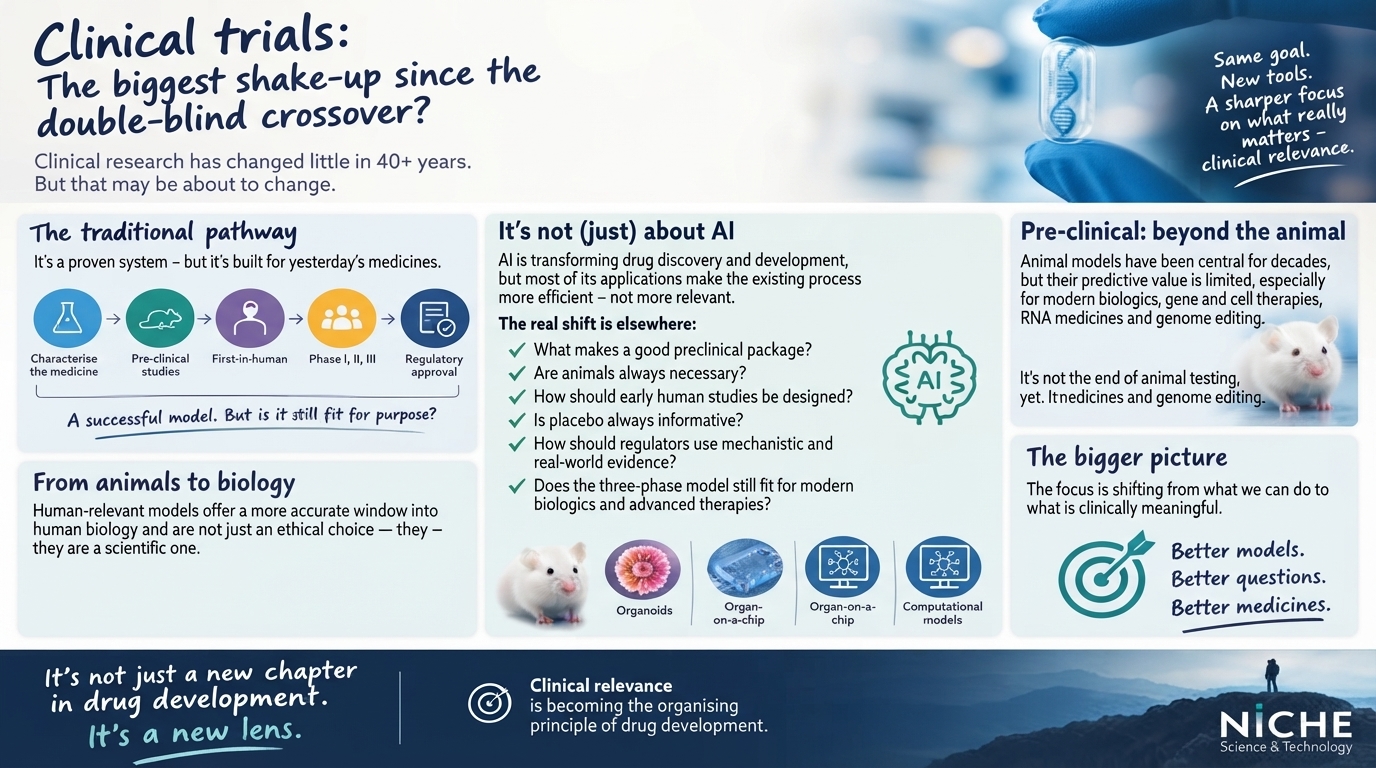
Clinical research is remarkably conservative. Despite extraordinary advances in molecular biology, genomics, imaging, computational science and therapeutic technology over the last 40+ years that I have been in the industry, the basic architecture of drug development has changed surprisingly little. A new medicine is characterised in the laboratory, subjected to a battery of pre-clinical studies, enters first-in-human testing, progresses through Phase I, II and III, and eventually reaches the regulator accompanied by a carefully assembled package of evidence. It is an enormously successful system. It is also, increasingly, a system designed around yesterday's medicines.
The question is whether clinical research is approaching its greatest methodological upheaval since the development of the randomised, controlled, double-blind trial and its sophisticated relatives, including the cross-over design. Those innovations fundamentally changed the question being asked of clinical evidence. Rather than simply asking whether patients appeared to improve, researchers could ask whether an observed effect was attributable to the intervention itself.
It currently feels like something similarly is happening in the field of medicines development and you may be surprised to hear that it does not involve artificial intelligence (AI). AI is certainly transforming drug discovery and development. It can interrogate enormous datasets, predict molecular interactions, assist with target identification, generate candidate molecules, automate aspects of documentation and identify patterns that are difficult for a human investigator to see. Yet most of these applications change how efficiently we perform the existing process. They do not represent a paradigm shift in the structure of the evidence required to demonstrate that a medicine is safe, pharmacologically active and clinically useful.
For me, the more consequential changes are occurring elsewhere. They concern what constitutes an appropriate preclinical package, whether animals remain necessary for every question, how first-in-human studies should be designed, whether placebo is always informative in early development, how regulatory agencies use mechanistic and real-world evidence, and whether the conventional three-phase model remains appropriate for medicines whose biology bears little resemblance to that of traditional small molecules.
The common theme is increasingly difficult to ignore. Clinical relevance is becoming the organising principle of drug development.
Pre-clinical
For decades, animal studies have occupied a central position in the transition between laboratory science and human experimentation. Their rationale is obvious: a drug is a complex biological intervention, and a collection of cells or isolated tissue preparation do not reproduce the integrated physiology of a living organism.
But the predictive limitations of animal models have become increasingly apparent. Drug development remains characterised by extraordinarily high attrition, with failures arising from inadequate efficacy, pharmacokinetics, toxicity and a variety of biological factors [1]. Studies have also demonstrated significant limitations in the ability of conventional animal models to predict human toxicities [2][3]. This does not mean that animal experiments are scientifically worthless. It means that their value is conditional upon the question being asked. That distinction becomes particularly important with modern biological medicines.
A monoclonal antibody may recognise a target that is absent from, or biologically different in, conventional laboratory species. It's necessary therefore to identify a surrogate species or construct a specialised model in which the target behaves sufficiently like its human counterpart [4][5]. The exercise can become scientifically awkward. The closer the therapeutic mechanism becomes to human-specific molecular biology, the less obvious it becomes that a conventional animal is necessarily the most informative model.
The same problem becomes even more striking with gene and cell therapies, RNA medicines and genome-editing technologies. The question is not simply whether an animal model can be used. It is whether it is an appropriate model for the biological question. That is a much more demanding question. And regulators are beginning to ask it themselves.
The US FDA has announced plans to reduce, refine and potentially replace animal testing, initially placing particular emphasis on monoclonal antibodies and other medicines. Its subsequent work on New Approach Methodologies has explicitly highlighted organoids, computational models and other human-relevant systems [6][7][8]. The European Medicines Agency has similarly promoted the development and regulatory use of approaches capable of reducing or replacing animal studies [9].
It's not the end of animal testing, yet. It may, however, be the beginning of the end.
From animals to biology
The attraction of organoids, organs-on-chip and other human-relevant models is not merely ethical. It is scientific. A human-derived liver model can uniquely answer questions about human hepatic toxicity. A cardiac model can interrogate electrophysiological effects. Kidney organoids and microphysiological systems can explore renal toxicity and transport. Tumour organoids can retain elements of patient-specific tumour biology [10][11].
None is a miniature human being. That obvious objection should not be underestimated. An organoid cannot reproduce the integrated physiology of an entire organism, including interactions between organs, immune responses, metabolism and complex pharmacokinetics. But perhaps that is not the right comparison. The future is unlikely to involve replacing an entire animal with a single organoid. Instead, the emerging model is likely to involve a portfolio of complementary systems: mechanistic human biology, organoids, organs-on-chip, computational modelling, pharmacokinetic modelling and carefully selected animal studies where animals genuinely provide information unavailable elsewhere. The change would therefore be subtle but profound.
The regulatory question could gradually move from:
"Have the required animal studies been performed?"
to:
"Has the relevant biological risk been adequately characterised?"
That is a very different philosophy.
The curious question of placebo
A similar challenge is emerging in the design of early clinical studies. Placebo-controlled trials are one of the great concepts of clinical science. But does every first-in-human study require a placebo group? The question is more complicated than it initially appears. In a small ascending-dose Phase I study, the principal objectives are generally safety, tolerability, pharmacokinetics and pharmacodynamics. Placebo subjects can be useful because adverse events occur in healthy volunteers irrespective of treatment, and expectations, study conditions and background physiological variation can complicate interpretation [12][13]. Yet the information gained from placebo may be limited when the study is extremely small and primarily concerned with dose escalation and pharmacology.
It has been argued that placebo and blinding in some underpowered Phase I dose-escalation studies are insufficiently justified and unlikely to provide useful information commensurate with their cost, complexity, and risk to healthy subjects [14]. The argument should not be interpreted as a call to abolish placebo. Rather, it challenges another assumption that has become embedded in development methodology: that a study design is scientifically superior simply because it has become customary. As medicines become increasingly mechanistically characterised, this question becomes more interesting.
If target engagement can be measured directly, if downstream signalling can be quantified, if a biomarker demonstrates the intended pharmacological effect and if exposure-response relationships can be modelled, a first-in-human study may increasingly resemble a carefully controlled human mechanistic experiment rather than a miniature efficacy trial. The distinction between pharmacological understanding and clinical efficacy becomes more important, not less.
Three phase blur
The conventional division between Phase I, Phase II and Phase III has always been more artificial than it appears. Adaptive designs can modify treatment allocation, dose selection, patient populations and other elements as evidence accumulates. Seamless designs can combine stages that would traditionally have been separated. Biomarker-driven development can identify potentially responsive patients before a conventional Phase II programme has established a broad efficacy signal [15].
This becomes particularly important in precision medicine. Suppose a treatment is intended for patients carrying a particular molecular alteration that occurs in only a small proportion of a disease population. Conducting a large conventional trial first and searching retrospectively for responders is increasingly difficult to justify. The biological hypothesis comes first. The relevant population is identified. Target engagement is demonstrated. Pharmacodynamic consequences are measured. Clinical benefit is then assessed in the population in which the mechanism is expected to operate. The clinical programme becomes an experiment built around mechanism, rather than an administrative sequence called Phase I, Phase II and Phase III.
The FDA's Real Tim Clinical Trials (RTCT) initiative accelerates this blurring. By enabling continuous regulatory visibility into accumulating data, RTCTs could support "seamless" trials that combine Phase I, II and III elements without discrete protocol transitions [16]. The agency has explicitly signalled that real-time oversight may eventually support continuous or seamless trials that blur conventional phase boundaries [4]. In oncology, the initial test bed for RTCTs, endpoints such as tumour response and cytokine release syndrome emerge rapidly and require dynamic dose management, making real-time regulatory feedback particularly valuable. AstraZeneca's Phase II TRAVERSE study in mantle cell lymphoma and Amgen's Phase Ib STREAM-SCLC study in small cell lung carcinoma are serving as proof-of-concept models [16].
Non-conformist medicines
The problem becomes even clearer when the new generation of therapeutic technologies is considered.
- Molecular glues and PROTACs introduce pharmacology based on induced molecular proximity and targeted protein degradation rather than conventional receptor occupancy [17][18].
- Bispecific antibodies can simultaneously engage two biological targets and produce effects dependent upon their interaction [19].
- Antibody-drug conjugates combine antibody specificity, tissue distribution, antigen biology, internalisation, linker chemistry and a highly potent payload [20].
- Radioligand therapies combine molecular targeting with radiation delivery, making patient selection and molecular imaging integral components of treatment [21].
- Personalised cancer vaccines can involve sequencing an individual tumour, identifying candidate neoantigens, manufacturing an individualised product and subsequently demonstrating an immune response [22].
- RNA medicines introduce another complication: delivery itself can be part of the therapeutic mechanism [23].
- Base editing and prime editing go further still. They seek to alter genetic information with potentially durable consequences, making questions of off-target editing, genomic integrity, delivery, durability and long-term safety integral to development [24][25].
These medicines do not merely provide new examples for the existing development system. They challenge some of its assumptions.
What precisely is Phase I for a personalised cancer vaccine that has to be manufactured individually? Where does Phase II begin for a molecularly defined treatment when the first patients already provide extensive mechanistic and pharmacodynamic information? What does a conventional Phase III trial mean for a rare genetic disorder in which the therapeutic mechanism is highly specific and the eligible population is tiny? And how should a gene-editing therapy be evaluated when the most important evidence may concern molecular changes that occur before a conventional clinical endpoint can possibly emerge?
The three-phase model can accommodate some of these situations. But it increasingly requires considerable ingenuity to do so.
Real-world evidence
Another important change is occurring after, and increasingly during, clinical development. Real-world evidence (RWE) is no longer regarded simply as something collected after the clinical trials have finished. Evidence submitted to the European Medicines Agency has demonstrated that real-world evidence is already contributing to marketing authorisation applications [26]. The FDA has similarly documented the increasing use of real-world data and evidence in regulatory decision-making [27].
This does not mean that randomised controlled trials are disappearing. They remain the strongest method for establishing causal treatment effects in many circumstances. But the boundary around the randomised trial is becoming less rigid. A clinical trial can establish efficacy under controlled conditions. Real-world evidence can subsequently examine whether that effect survives contact with ordinary clinical practice, where patients are older, less compliant, more heterogeneous and taking several other medicines.
Modern statistical methods make increasingly sophisticated use of these datasets, including causal inference, propensity methods, external controls, longitudinal modelling and Bayesian approaches. The question is consequently changing from:
"What happened in our trial?"
to:
"What does the totality of the evidence tell us about this treatment?"
That is a much broader scientific question.
The RTCT model extends this logic by integrating real-time clinical data into the regulatory review process itself. Rather than treating real-world evidence as a post-approval supplement, RTCTs create a continuous evidence stream that includes adverse-event rates, tumour-response metrics and dose-limiting toxicities transmitted directly to FDA reviewers through validated cloud infrastructure [16]. Paradigm Health's Study Conduct platform, which serves as the technical intermediary, captures information from electronic health records and algorithmically evaluates FDA-defined reporting criteria before transmitting signals simultaneously to sponsors and regulators [16]. This represents a further blurring of the boundary between trial conduct and regulatory review, and between controlled trial data and real-world data.
Is regulation becoming more permissive?
It would be tempting to interpret that changes in regulatory science is something of a race to the bottom. But that would be too simplistic. Regulatory agencies are undoubtedly adopting a more flexible approach to evidence generation. Accelerated pathways, surrogate endpoints, external controls, Real world evidence (RWE) and alternative nonclinical methods are increasingly incorporated into development strategies. But there is an important difference between lowering an evidential standard and changing the type of evidence considered most relevant. If an animal model provides poor information about a human-specific biological mechanism, replacing it with a validated human-relevant system is not necessarily lowering the regulatory bar. It is more like raising it.
Similarly, accepting an external control group for an exceptionally rare disease does not automatically mean accepting weaker evidence. It may mean relying on statistical methods that extract more information from the limited population available.
The RTCT initiative exemplifies this distinction. Allowing regulators to view safety signals in near real time does not lower the evidentiary bar; it changes when evidence is evaluated and how quickly regulatory feedback can inform trial conduct. The FDA has framed RTCTs as a mechanism to reduce the ‘white space’ between data generation and regulatory action—some estimates suggest that up to 45% of development time is consumed by administrative and procedural lag [3]. If successful, RTCTs could allow earlier dose optimisation, faster termination of ineffective arms and more efficient use of limited patient populations, particularly in oncology and rare diseases. The risk, as with all regulatory innovation, lies in execution: early clinical datasets are often incomplete and unadjudicated, and continuous exposure to evolving interim data could introduce statistical bias or influence regulatory judgment prematurely [16]. The challenge is to capture the efficiency gains without compromising the integrity of causal inference.
Regulatory competition between jurisdictions appears to be accelerating these developments. Sponsors can increasingly compare the scientific flexibility and development requirements of different agencies. Agencies capable of accommodating innovative science without compromising patient protection are becoming increasingly attractive. The danger is inconsistency. The opportunity is methodological innovation. Officials have explicitly linked the RTCT initiative to geopolitical competition, noting that China surpassed the United States in the number of Phase I clinical trials around 2021, with growth accelerating since then [3]. Faster development cycles increasingly carry strategic implications extending beyond commercial competitiveness into national biotechnology leadership.
The AI distraction
Against this background, AI can appear almost (oddly) secondary. That is not because AI is unimportant. It is because AI is primarily serving as a catalyst. It can make existing processes faster and potentially better. It can identify targets, design molecules, optimise protocols, interrogate scientific literature, analyse images, predict properties, automate documentation and assist statistical analysis.
And yet, AI does not remove the need to demonstrate human safety and clinical benefit. It does not make an ineffective drug effective. It does not resolve the fundamental question of whether a biological model predicts human biology. Nor does it tell us automatically what evidence a regulator should regard as sufficient. The deeper transformation therefore has little to do with whether a machine can design a drug. It concerns whether the methodology used to establish clinical relevance remains appropriate for the drug that has been designed.
The FDA's RTCT initiative illustrates this distinction precisely. AI-enabled analytics and cloud-native data pipelines are essential to the infrastructure, automating endpoint extraction from electronic health records, detecting safety signals and transmitting predefined regulatory metrics [16]. Yet the transformative element is not the AI itself but the regulatory willingness to receive and act on evidence continuously.
A new evidential architecture
The emerging picture is therefore not one in which Phase I, II and III suddenly disappear, animals are eliminated and placebo-controlled trials become obsolete. The change is likely to be much more complex and interesting.
If I was to predict a timescale I might suggest that over the next 12 months, further movement towards New Approach Methodologies, reduced use of nonhuman primates for selected medicines, greater incorporation of RWE and continued experimentation with adaptive and biomarker-driven designs seem likely.
Over the next 3 to 5 years, organoids, microphysiological systems, computational toxicology and mechanistic human data could become much more integrated into nonclinical packages. Some development programmes will combine conventional phases or use designs in which the boundaries between them are difficult to distinguish. Real-time clinical trial oversight could become more widely adopted beyond oncology. The FDA has indicated that future RTCT deployments will likely expand into neurology, immunology, cardiometabolic disease and rare disorders, particularly areas involving digital biomarkers, wearable monitoring and decentralised trial infrastructure [16]. Organoids, microphysiological systems, computational toxicology and mechanistic human data could become much more integrated into nonclinical packages, while RTCTs could provide the clinical counterpart, continuous, mechanism-aligned evidence generation that regulators can evaluate as it emerges.
Further ahead, perhaps over 5 to 10 years, the three-phase model will increasingly become one development architecture among several, something that I have discussed previously [28]. The conventional model will clearly survive because it remains extremely useful for many medicines. But it may cease to be regarded as the text-book description of clinical development. RTCTs could evolve into continuous evidence-generation models integrating remote patient monitoring, real-world data streams, digital therapeutics, genomic sequencing, AI-assisted imaging analysis and federated health data networks [16]. The conventional model will clearly survive because it remains extremely useful for many medicines. But it may cease to be regarded as the textbook description of clinical development. Instead, development architectures may be selected based on the biological question, the therapeutic modality and the evidence required, whether that involves conventional phases, seamless designs, RTCTs or hybrid approaches. That would represent a remarkable change.
The great methodological revolution of the twentieth century was to recognise that clinical evidence needed controlled comparison. The emerging revolution may be to recognise that controlled comparison is only useful when the underlying experimental model, population, endpoint and evidence architecture are appropriate to the biological question. The new medicines are forcing us to confront that question.
Molecular glues, degraders, bispecifics, ADCs, radioligands, RNA medicines, personalised vaccines, engineered proteins, novel delivery systems and genome editors are not merely adding variety to the pharmaceutical pipeline. They are exposing the assumptions embedded within the development methodology itself. And this may be the real nexus point. For decades, clinical development has essentially asked medicines to fit the methodology. Increasingly, the methodology may have to fit the medicine. That change has already begun. The question is when it will become impossible to ignore.
A reasonable prediction is that 2028–2030 will mark the period when the transformation becomes unmistakable. I feel that by then, it will no longer be unusual to see regulatory packages combining conventional clinical trials with organoid and microphysiological data, sophisticated mechanistic pharmacology, real-world evidence, adaptive designs, real-time regulatory oversight and highly integrated computational analyses. Phase I, II and III will probably still exist. Animal studies will probably still exist. Placebo-controlled trials will certainly still exist. But they will increasingly be selected because they answer a particular scientific question, rather than because the development system expects them to appear. That would be a much more profound transformation than another generation of AI-assisted drug discovery.
The FDA's RTCT initiative provides early evidence that this transformation has already begun. The agency's partnership with AstraZeneca and Amgen marks a notable inflection point: for the first time, the FDA is attempting to transition clinical oversight from episodic review toward continuous observation [16]. If successful, RTCTs could become the most significant modernisation of clinical development in decades. The question is no longer whether the methodology will adapt to new medicines, but how quickly and how broadly.
References
- Filipova D, et al. Need for NAMs: A systematic evidence synthesis revealing over half a century of drug development failure. NAM J. 2026;2:100119.
- Atkins JT, et al. Pre-clinical animal models are poor predictors of human toxicities in phase 1 oncology clinical trials. Br J Cancer. 2020;123(10):1496-1501.
- Van Norman GA. Limitations of Animal Studies for Predicting Toxicity in Clinical Trials: Is it Time to Rethink Our Current Approach? JACC Basic Transl Sci. 2020;5(4):387-396.
- Mould DR, Meibohm B. Drug Development of Therapeutic Monoclonal Antibodies. BioDrugs. 2016;30(4):275-293.
- Martin PL, Bugelski PJ. Concordance of preclinical and clinical pharmacology and toxicology of monoclonal antibodies and fusion proteins: soluble targets. Br J Pharmacol. 2012 Jun;166(3):806-22.
- Loewa A, Feng JJ, Hedtrich S. Human disease models in drug development. Nat Rev Bioeng. 2023;1:545-559.
- Huang W, et al. General Principles of Preclinical Study Design. Handb Exp Pharmacol. 2020;257:3-18.
- Zhou Y, et al. Organoids and organs-on-chips: Recent advances, applications in drug development, and regulatory challenges. Bioact Mater. 2025
- European Medicines Agency. EMA implements new measures to minimise animal testing during medicines development. 2021.
- Matsui T, Shinozawa T. Human Organoids for Predictive Toxicology Research and Drug Development. Front Genet. 2021;12:767621.
- Rosenzweig P, Brohier S, Zipfel A. The placebo effect in healthy volunteers: influence of experimental conditions on physiological parameters during phase I studies. Br J Clin Pharmacol. 1995;39(6):657-664.
- Rosenzweig P, Brohier S, Zipfel A. The placebo effect in healthy volunteers: influence of experimental conditions on the adverse events profile during phase I studies. Clin Pharmacol Ther. 1993;54(5):578-583.
- Parasrampuria DA, Benet LZ. Inclusion of placebos and blinding for ascending dose first-in-human studies and other underpowered phase 1 studies has not been justified and on balance is not useful. Basic Clin Pharmacol Toxicol. 2015;117(1):44-51.
- Zang Y, Lee JJ. Adaptive clinical trial designs in oncology. Chin Clin Oncol. 2014;3(4):49.
- Flynn R, et al. Marketing Authorization Applications Made to the European Medicines Agency in 2018-2019: What was the Contribution of Real-World Evidence? Clin Pharmacol Ther. 2022;1.
- Hardman TC. Inside the FDA's Real-Time Clinical Trial Experiment. Published May 21, 2026.
- Kong NR, Jones LH. Clinical Translation of Targeted Protein Degraders. Clin Pharmacol Ther. 2023;114(3):558-568.
- Dong G, Ding Y, He S, Sheng C. Molecular Glues for Targeted Protein Degradation: From Serendipity to Rational Discovery. J Med Chem. 2021;64(15):10606-10620.
- Labrijn AF, Janmaat ML, Reichert JM, Parren PWHI. Bispecific antibodies: a mechanistic review of the pipeline. Nat Rev Drug Discov. 2019;18:585-608.
- Colombo R, et al. The Journey of Antibody-Drug Conjugates: Lessons Learned from 40 Years of Development. Cancer Discov. 2024;14(11):2089-2108.
- Palihati M, et al. Emerging PET Imaging Agents and Targeted Radioligand Therapy: A Review of Clinical Applications and Trials. Tomography. 2025;11(8):83.
- Shemesh CS, et al. Personalized Cancer Vaccines: Clinical Landscape, Challenges, and Opportunities. Mol Ther. 2021;29(2):555-570.
- Saw PE, Song E. Advancements in clinical RNA therapeutics: Present developments and prospective outlooks. Cell Rep Med. 2024;5(5):101555.
- Testa LC, Musunuru K. Base Editing and Prime Editing: Potential Therapeutic Options for Rare and Common Diseases. BioDrugs. 2023;37(4):453-462.
- Murray JB, Harrison PT, Scholefield J. Prime editing: therapeutic advances and mechanistic insights. Hum Genet. 2025;144(2):83-92.
- Yuan L, Rahman M, Concato J. Comparison of two assessments of real-world data and real-world evidence for regulatory decision-making. Clin Transl Sci. 2024;17(1):e13702.
- Masarwy R, et al. Delivery of nucleic acid based genome editing platforms via lipid nanoparticles: Clinical applications. Adv Drug Deliv Rev. 2024;211:115359.
- Hardman TC, et al. The future of clinical trials and drug development: 2050. Drugs Context. 2023 Jun 8;12:2023-2-2.