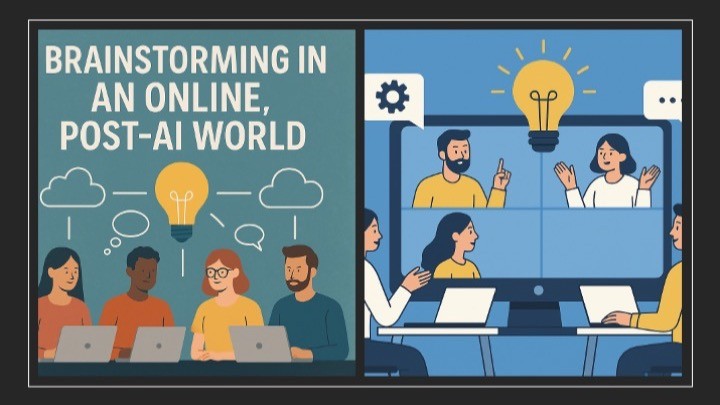
Brainstorming has long been regarded as an essential component of creative problem-solving, particularly in collaborative environments. Rooted in Osborn's principles of deferred judgment and the encouragement of free-flowing ideas, brainstorming in groups leverages cognitive diversity, social facilitation, and collective intelligence to generate novel solutions [1]. Effectively, diverse perspectives enhance idea generation [2].
Research confirms that interactive discussions stimulate neural mechanisms associated with learning and problem-solving [3]. When individuals from different backgrounds contribute unique insights, the collective output often exceeds what individuals could achieve independently. Moreover, associative thinking, where ideas build upon one another, promotes lateral thinking, a key component of creativity [4]. Furthermore, brainstorming sessions encourage psychological safety, allowing individuals to voice unconventional ideas without fear of criticism [5]. This openness fosters team cohesion and a collaborative environment where risk-taking and innovation can thrive. By engaging in shared ideation, teams develop a sense of ownership over ideas, increasing commitment to implementation [6]. In addition, the collective nature of brainstorming mitigates cognitive biases, such as confirmation bias, by exposing participants to a broader range of viewpoints [7].
Cognitive psychology suggests that group brainstorming relies on key mechanisms such as associative thinking, cognitive diversity, and social facilitation [8]. These elements contribute to richer discussions and novel ideation. However, while groups theoretically benefit from cognitive stimulation (exposure to others' ideas triggering new connections), research also highlights potential inefficiencies in group brainstorming, including production blocking (when individuals must wait their turn to speak), social loafing (when participants contribute less effort in group settings), and evaluation apprehension (fear of judgment) [2].
As you can see, there is a substantial body of science to support our continued use of group brainstorming. However, meta-analyses suggest nominal groups (individuals working alone) frequently outperform interactive groups in idea quantity, though not always in quality or originality. Yet, brainstorming is still considered a valued tool for creativity and innovation and its practice persists in the business setting, possibly due to its secondary benefits: team cohesion, shared ownership of solutions, and the democratisation of participation. If that is not reason enough, it could be that your boss is out of ideas and wants to pick your brains. The Matthew Effect describes how managers, academics, and senior colleagues will often appropriate innovative suggestions from subordinates without acknowledgment [9].
Shifting to Online Brainstorming
The rapid digitisation of collaboration, accelerated by remote work trends since the COVID-19 pandemic, has fundamentally transformed brainstorming practices across industry and academia. Platforms like Zoom, Microsoft Teams, and virtual whiteboards such as Miro and MURAL have normalised online meetings, displacing face-to-face interactions and reshaping creative workflows. While these tools enable geographically dispersed teams to share ideas in real time, research highlights significant trade-offs in engagement, creativity, and communication efficacy.
Studies underscore that digital environments, though efficient, often erode the social and cognitive dynamics vital for effective brainstorming. Researchers observed that virtual platforms hinder engagement by stripping away non-verbal cues, such as gestures, facial expressions, and tone, that foster mutual understanding and spontaneity [10]. These cues are critical for building psychological safety, a precursor to uninhibited idea generation. In their absence, participants report feeling less connected, leading to guarded contributions and reduced cognitive stimulation. A study showed online brainstorming generates 15-20% fewer unconventional ideas compared to in-person sessions [11]. The authors attribute this gap to production blocking stifling the fluid exchange of ideas. Moreover, the loss of spontaneity and emotional resonance further compounds these challenges.
In-person brainstorming thrives on unstructured moments, such as side conversations, laughter, or a colleague's offhand remark, which often spark novel connections. Virtual sessions, constrained by rigid agendas and technical limitations (e.g., muted microphones, screen-sharing focus), truncate these organic interactions. A 2021 study noted that teams collaborating online exhibited lower levels of divergent thinking, a hallmark of creativity, due to reduced cognitive synchronicity [12].
The risk of miscommunication also escalates in digital settings. Without contextual nuance, such as a raised eyebrow signalling scepticism or a pause indicating contemplation, participants misinterpret ideas, leading to conflicts or premature dismissal of concepts. Research revealed that virtual teams spend 30% more time clarifying intent than co-located groups, diverting energy from innovation to damage control [13].
Despite these drawbacks, academia and industry continue to adopt digital tools for their scalability and accessibility. Let’s face it, it’s cheaper and less trouble than shipping everyone to one venue. Hybrid models, combining asynchronous idea submission via platforms like Slack with synchronised refinement sessions, aim to mitigate engagement gaps. However, critics argue that such structures prioritise efficiency over creativity, sidelining the serendipitous interactions that drive breakthroughs. The erosion of informal, spontaneous dialogue, known as the ‘water cooler effect’, is a significant loss; these casual encounters have been shown to foster the cross-pollination of ideas and strengthen interpersonal bonds that underpin effective collaboration [10].
AI Taking Control
With the advent of AI and large language models such as ChatGPT and Claude, the process of idea generation has been significantly altered. AI systems can now produce extensive, well-structured arguments within seconds, leading to questions about whether human-led brainstorming remains valuable. Unlike humans, AI has access to unimaginable amounts of information and it lacks cognitive biases (e.g., anchoring, confirmation bias) and fatigue, enabling it to explore a host of unconventional combinations (e.g., “What if Uber partnered with libraries?”). Companies are already deploying AI to simulate brainstorming sessions, producing SWOT analyses, risk assessments, and even ethical critiques with granular detail. Industries that have traditionally relied heavily on brainstorming, such as marketing, product development, and academia, are already seeing shifts in workflow due to AI integration.
While AI brainstorming is efficient, there are also concerns about the depth and authenticity of the ideas produced. Homogenised outputs can only serve to reduce the diversity of truly novel perspectives [14]. It seems that our future is beige and absent of any groundbreaking innovation. Despite its access to vast knowledge, AI will often prioritise coherence over ambiguity, discouraging the exploratory tangents essential for breakthroughs. AI also remains tainted by concerns over its potential to hallucinate and incorporate societal biases based on the data it has been trained on.
While comprehensive AI-generated responses may lack the emotional intelligence, depth of personal anecdotes, spontaneity of real-time interaction, and ethical considerations that human teams naturally incorporate into their decision-making processes [15]. Moreover, the serendipitous "Aha!" moments that emerge from human discussion often stem from shared understanding, something AI cannot replicate authentically. Empathy, humour, emotional intelligence, and an ability to connect disparate ideas through lived experience are irreplaceable human components of effective ideation [16]. A significant gap exists in AI's capacity for ethical reasoning; it cannot replicate the nuanced moral sensitivity that emerges from human empathy and social awareness [5].
Conclusion
Traditionally, group brainstorming has been considered a vital process for problem-solving and creative thinking. Brainstorming is not merely transactional; it builds trust and aligns teams around shared goals. The laughter, eye contact, and empathetic pauses in a live session foster psychological safety, a prerequisite for innovation. However, if you have surrendered your brainstorming exercises to online meetings, it is likely that you have already lost whatever benefits might emerge from your sessions.
The rise of artificial intelligence (AI) and large language models (LLMs) has transformed how individuals and organisations generate and refine ideas. While AI democratises access to information and accelerates ideation, human-led face-to-face brainstorming currently remains irreplaceable in cultivating empathy, ethical judgment, and breakthrough innovation. For now, the challenge lies not in choosing between humans and machines but in designing systems that amplify their complementary strengths, possibly where AI generates initial ideas that can be refined through human discussion, providing the opportunity for team bonding and the serendipitous insights that arise from in-person discussions.
As LLMs grow more sophisticated, preserving the "human spark", the irrational, emotional, and socially embedded roots of creativity, will define the next era of problem-solving. This has implications for workplace culture, decision-making, and even employee satisfaction, as people derive intrinsic value from collaborative problem-solving [6]. Does this sound the death knell for brainstorming? You tell me.
References

Get our latest news and publications
Sign up to our news letterResources
Social


Contact us
Address
Niche Science & Technology
Unit 26 Falstaff House
Bardolph Road
Richmond TW9 2LH
United Kingdom