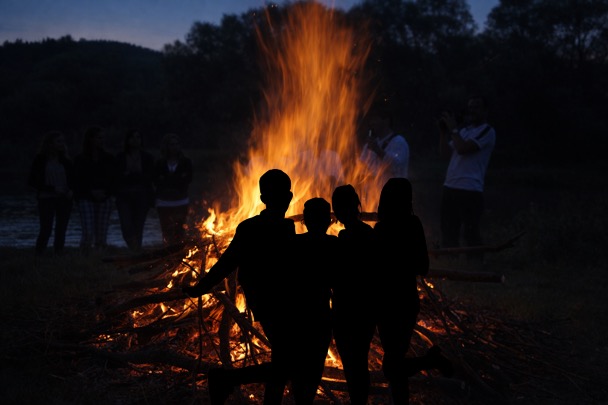
For me, Bonfire Night has never been about the rockets or the smoke. It is about the fire itself. That is where we burn the guy, thaw frozen fingers, and, if we are lucky (and you stick around long enough), bake potatoes or toast marshmallows (a habit I blame on American influence) in the embers. Beneath the tradition lies something beautiful: a bonfire is biology, chemistry, and physics all meeting together. I have been building fires since I was probably too young to hold a match. The secret? Listen to what the log has to say.
Look at a piece of firewood. To most, it is just fuel. To a biologist, it is a tower of complex sugars. The main ingredients are long organic chains called cellulose, hemicellulose, and lignin [1]. Trees evolved these polymers to grow tall and haul water metres into the air. When we burn them, we liberate ancient sunlight. But wood is not pure carbon and hydrogen. Hidden inside are trace metals, especially calcium and potassium, that will later paint the flames with colour [2].
When I think of logs you are releasing energy from decades to a few hundred years. In contrast, the formation of coal is an incredibly slow process, taking place over millions of years. The most significant and high-quality coal deposits began forming around 360 to 290 million years ago during the Carboniferous period. This vast timeline means the coal we use today is the result of geological processes that occurred long before the age of dinosaurs.
Strike a match, and you supply the activation energy. That is the little push needed to start breaking chemical bonds. A 2011 paper showed that woody biomass lights more readily than coal precisely because its activation energy is lower [3].
Heat the wood to somewhere between 280 and 420 °C, and those large molecules begin to fragment [4]. In a perfect world, combustion would produce nothing but carbon dioxide and water. But because lignin has those stubborn ring-shaped structures, the reality is messier. The fire spits out soot, carbon monoxide, and a range of organic fragments. Studies of pyrolysis reveal that these volatile compounds are exactly what give wood smoke its distinctive, mouth-watering aroma, the same one that flavours smoked food [5]. The calcium and potassium? They refuse to burn. They simply remain behind as the pale grey ash that coats your shoes [6].
You have a spark. The chemistry is running. So why do the flames shine yellow? That is physics at work. Inside the fire, carbon atoms get incredibly hot. Their electrons absorb that thermal energy and leap to a higher energy level, what scientists call an excited state. When those electrons fall back down, they must shed the extra energy. They do so by releasing photons of yellow light [7].
Watch the base of the fire carefully. You may catch a hint of lilac or orange. That is the classic flame test from school chemistry. Potassium gives that pale purple tinge, while calcium produces a brick-orange colour [8].
Now that we understand the science, let us put it into practice. Do not simply throw logs together and hope for the best.
From the breakdown of lignin polymers to the dance of excited electrons, every bonfire tells a story of science. Enjoy the show.
References

Get our latest news and publications
Sign up to our news letterResources
Social


Contact us
Address
Niche Science & Technology
Unit 26 Falstaff House
Bardolph Road
Richmond TW9 2LH
United Kingdom