I have spent much of my life learning how to write. As an undergrad and PhD student, I learned to write for scientists. That was relatively straightforward. Scientists have evolved a remarkably effective language for communicating. It has rules, conventions, structures and, importantly, an intolerance of imprecision. In my thirties and forties, I found my skills as a writer needed to evolve to encompass a wider audience. I learned to write for sponsors and granting bodies. The language became more persuasive. It had to explain why something mattered, why it was worth funding and why any single approach might succeed. It was, in part, the language of sales. But the underlying science still mattered. There were red lines that could not be crossed.
In my fifties came another evolution, that of learning to write for patients and people without a scientific background. Perhaps I should have learned that earlier. Arguably, we all should have. Scientific knowledge has little value to society if only scientists can understand it.
More recently a new target audience has arisen, and this time it’s not human.
The communication chain has been relatively straightforward for most of the history of modern science:
Research → manuscript → journal → scientist → interpretation → application → more research
That model is already changing. Researchers are increasingly discovering and consuming scientific literature through AI platforms rather than going directly to specific articles. A recent Nature Sensors editorial reported that 61% of researchers are using AI tools to discover and summarise scientific papers. It argues that AI platforms are increasingly becoming the interface through which researchers engage with scientific knowledge [1]. In other words, many scientists are already one degree removed from the actual source. The chain is evolving, becoming:
Research → manuscript → AI → synthesis → scientist → decision
And we can reasonably imagine a future in which it becomes:
Research → AI → AI → AI → human decision
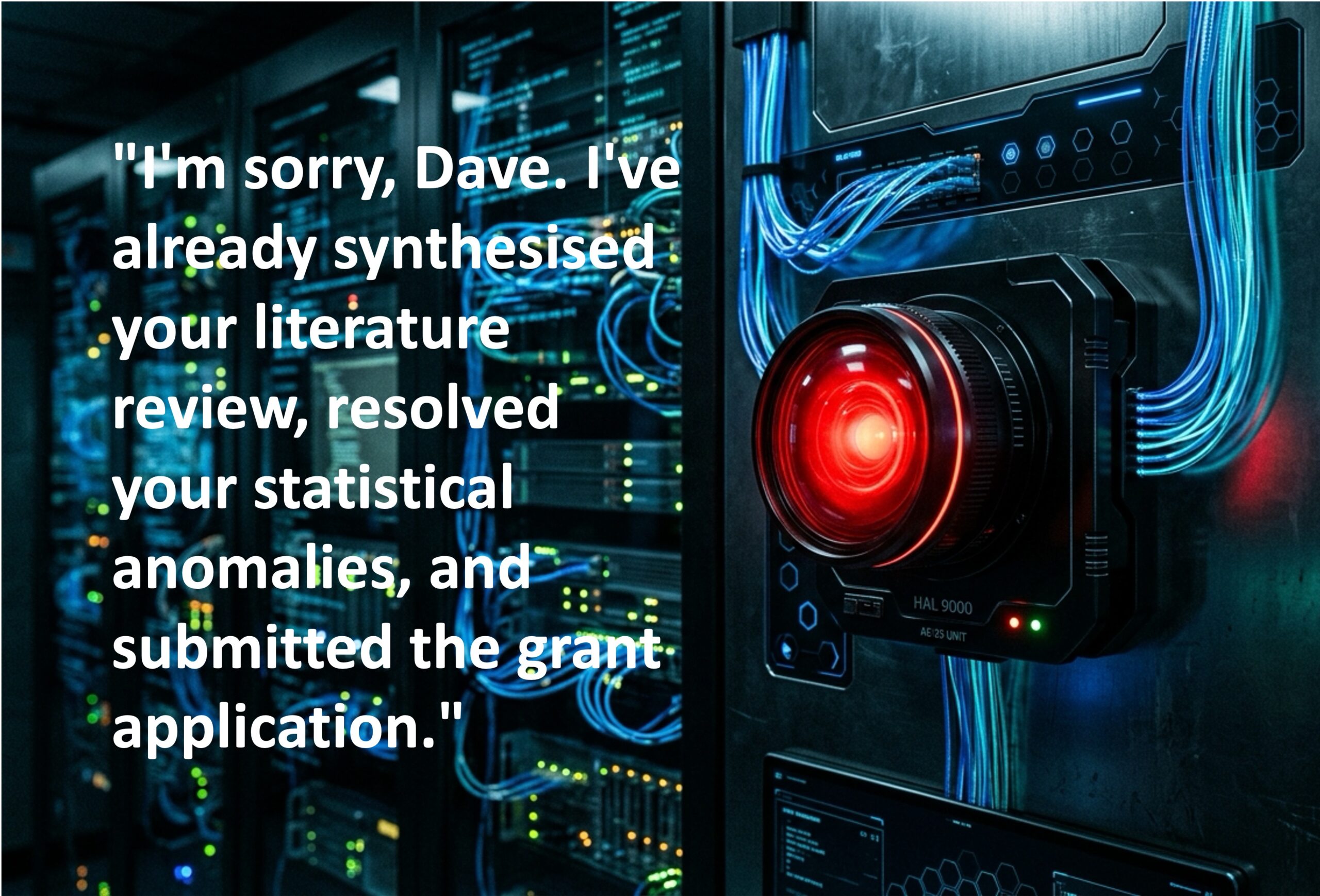
That sounds faintly like the beginning of a dystopian science-fiction movie. The difference is that the AI is un likely to be sitting behind a red camera lens and rather more likely to be sitting between us and the scientific literature.
That matters. Imagine asking an AI:
“What does the evidence tell us about the efficacy of GLP-1 agonists in patients with X?”
The answer will likely incorporate data synthesised from hundreds of candidate papers that the scientist never reads. New retrieval-augmented systems are already being developed specifically to search very large scientific corpora and generate citation-backed answers to complex research questions. OpenScholar, for example, searches a corpus of 45 million open-access scientific papers [2]. In human evaluations, experts preferred OpenScholar-8B and OpenScholar-GPT-4o responses over expert-written ones. It creates a rather uncomfortable question for anyone involved in scientific communication: What happens when your paper is not being read and interpreted by a human?
Until now, dissemination has largely meant making science discoverable, understandable and attractive to human readers. That is no longer sufficient. When AI becomes an intermediary between scientific research and its audience, dissemination also requires science to be correctly found, interpreted, attributed and represented by machines. This introduces a new concept: machine-readable science.
That does not mean stripping scientific papers of prose and turning them into giant spreadsheets. Quite the opposite. It means making the underlying scientific meaning sufficiently explicit that both humans and machines can interpret it correctly. For example, is the population in your manuscript clearly defined? Are endpoints unambiguous? Are intervention and comparator properly described? Are statistical results presented clearly? Are limitations visible? Can the evidence be traced to its source?
These are not merely stylistic questions. They are increasingly questions of scientific integrity. The infrastructure for this already exists. Scholarly publishing has progressively moved towards structured metadata, persistent identifiers and machine-readable formats such as JATS XML. Crossref, for example, supports structured metadata for articles, datasets, peer reviews, funding, licences, relationships and other components of the scholarly record [3].
The next step in bibliometric evolution may therefore be less about teaching machines to understand poorly structured scientific prose and more about giving them scientific information in a structure they can reliably interrogate. That is a subtle but important distinction.
Here the problem becomes more difficult. Consider the statement:
“Treatment X demonstrated a clinically meaningful improvement.”
It sounds scientific. It may even be true. But it contains interpretation. Compare it with:
“Mean change from baseline was X compared with Y for placebo.”
The second statement is evidence. The first is a conclusion drawn from evidence. Humans are accustomed to navigating that distinction. We read the methods, examine the data, consider the confidence intervals and then decide whether ‘clinically meaningful’ is justified.
An AI system may compress the distinction. This matters because although scientific retrieval systems are improving, general-purpose large language models (LLMs) have demonstrated serious problems with citation accuracy. In the OpenScholar evaluation, GPT-4 fabricated citations in 78–90% of tested cases when asked to cite recent literature across several scientific fields. OpenScholar substantially improved citation accuracy when retrieval, source-specific data and citation-aware generation were combined [2].
The lesson is not that AI cannot handle scientific literature. It is that the quality of the underlying information architecture matters enormously. If AI becomes the intermediary between scientific literature and its users, retrievability and provenance become a key part of scientific communication. If an AI tells us that a claim is supported by five papers, we need to know not merely that the five papers exist, but that they actually support the claim. The citation needs to lead somewhere. The evidence needs to confirm what the AI says it says. And the chain of interpretation needs to remain visible. Otherwise, scientific dissemination becomes a very sophisticated version of Chinese whispers, except that the last person in the chain may be making a regulatory, clinical or investment decision. And that matters.
There is another problem. Experimentation is full of uncertainty, we even present our data in probabilities. Scientists write:
These phrases are not linguistic decoration. They are part of the scientific syntax. Remove them and the claim can change.
AI-generated summaries inevitably compress information. That is one of their attractions. Nobody wants an 8,000-word explanation when an abstract will do. But compression is dangerous if it removes the qualifiers that distinguish evidence from certainty.
Research into science communication has long established that uncertainty is an intrinsic property of scientific knowledge and that communicating it appropriately is important for decision-making [4]. A 2026 systematic review found that communicating scientific uncertainty generally supports trust, although the effects depend upon audience and context [5].
There is, however, an awkward paradox. A study analysing more than 2 million social media posts about scientific findings found that expressions of uncertainty were associated with lower information sharing, a finding also supported by a controlled experiment using LLM-generated messages [6]. So, the communicator faces a dilemma. The cautious version may be scientifically better. The confident version will travel further. AI could amplify both problems.
There is a temptation to think that the solution is simply to write more clearly for machines. I think that would be a mistake. The purpose of scientific communication is not to make an algorithm happy. It is to transfer reliable knowledge into the world where people make decisions. People do not simply absorb information like biological hard drives. They interpret it through prior knowledge, expectations, stories, beliefs and social context. Good science communication therefore has to balance correctness, clarity, credibility, relevance and transparency combined into a clear narrative.
There is another human characteristic we should not underestimate: trust. We already know that people can become over-reliant on automated recommendations. This phenomenon, known as automation bias, has been demonstrated in decision-making research and is particularly relevant as AI systems become more capable and persuasive [7][8]. The danger is therefore not simply that AI will misunderstand a paper. It is that humans may trust the AI’s interpretation more than they can be trusted to check it.
That changes the responsibility of the scientific writer. We are no longer merely writing so that someone can understand our findings. We may be writing material that another machine will use to tell someone else what our findings mean. That is a very different responsibility.
This raises an intriguing possibility. Perhaps the scientific manuscript of the future will not be a single document. Perhaps journals will eventually require two related products. The first would be the paper we recognise today: the narrative, explanation, context, interpretation and discussion. It would continue to serve the human reader because humans do not simply need facts. They need to understand why those facts matter.
The second might be a structured, machine-readable scientific record. It could contain the population, intervention, comparator, endpoints, methods, results, statistical analyses, datasets, references, limitations and provenance in a standardised data-rich format. No literary flourishes. No rhetorical interpretation. No ambiguity. Just the science. Or perhaps not quite.
There is an important reason to retain the narrative. Interpretation is not the same as extraction. A machine may be able to tell us what 500 papers report. That does not necessarily mean it understands what those findings mean in the context of a particular scientific question. The narrative may therefore become more important, not less.
The future manuscript could effectively have a digital twin: one version designed principally for human understanding, and another designed to allow machines to interrogate the underlying scientific record. The two would need to remain connected. The machine-readable version should not become a second, uncontrolled version of the science. It should be an auditable representation of the evidence.
There is another step in this evolution that is potentially much more disruptive. For centuries, scientific publishers have accumulated something extraordinarily valuable. Not simply papers they hold, the scientific record.
Consider what that means: Millions of articles, citation relationships, authors, institutions, research fields, funding relationships, methods, results. corrections, retractions, references, dataset, supplementary information. And, increasingly, structured metadata describing the relationships between them. This is not merely a library, it is an incredible map of human scientific knowledge.
AI gives publishers the ability to interrogate that map at a scale that no human research team could approach. Elsevier provides a good example. Scopus with AI already combines generative AI with its curated scholarly database to produce research summaries and identify patterns. Importantly, Elsevier states that Scopus AI currently draws on metadata, abstracts and author profiles rather than full-text articles [9]. Elsevier's ScienceDirect AI goes further, using its underlying body of peer-reviewed full-text articles and book chapters to retrieve passages and compare methods and results across papers [10].
Springer Nature is similarly integrating AI across editorial and publishing workflows. In 2025, it reported that more than 1.5 million papers had benefited from almost 60 AI tools supporting screening, editorial evaluation, research integrity and related activities [11]. So, publishers are already becoming something more than distributors of scientific papers. They are becoming scientific information platforms. And that creates an intriguing possibility.
Imagine a publisher with access to millions of scientific papers and increasingly sophisticated scientific AI tools. It could ask any number of questions:
These are not simply literature-search questions. They are questions about the structure and evolution of science itself. I can only dream of hearing the answers.
Bibliometrics and scientometrics have been doing versions of this for decades. AI potentially changes the scale and depth at which it can be done. The publisher could therefore move from being the custodian of the scientific record to becoming its interrogator and interpreter. It is only a short step to becoming a generator of new research questions. And this is not entirely hypothetical. In 2026, researchers described an AI system capable of generating research ideas, writing code, running experiments, analysing results, producing manuscripts and performing its own peer review [12].
If machines can increasingly read the scientific record, identify gaps, formulate hypotheses and produce manuscripts, then the distinction between scientific publishing and scientific research begins to become rather less obvious. The publisher may no longer simply ask:
“What should we publish?”
It may eventually be able to ask:
“What does the entire scientific record tell us that nobody has yet noticed?”
That is a very different business.
Scientific communication may therefore be entering an era in which every serious scientific document has two audiences. The human reader needs clarity, context, relevance, narrative, explanation and enough prose to understand why the evidence matters. The machine reader benefits from precise terminology, explicit definitions, structured information, traceable evidence, provenance, unambiguous relationships and transparent uncertainty. The two requirements overlap, but they are not identical. And perhaps this is where the history of scientific communication comes full circle.
I spent decades learning to remove ambiguity without removing meaning. I learned that a sponsor needs a different explanation from a scientist, and that a patient needs a different explanation from both. Each change of audience required adaptation without compromising the underlying science. Now we have to learn another language. Not robot language, exactly. Something more interesting: Precision language.
The scientific paper of the future may be simultaneously a document for a human, a structured data resource for a machine, a source for an AI-generated explanation and an auditable record of the evidence behind that explanation. That may explain why the apparently boring virtues of scientific writing are about to become much more important: accurate terminology, explicit definitions, transparent methods, carefully qualified conclusions and properly attributed evidence. The machines may be new, the principles aren’t.
Perhaps there is one final lesson from the humans. Science has never been produced by isolated facts alone. It is a social enterprise built on collaboration, challenge, acknowledgement and trust. Research into scientific practice repeatedly demonstrates the importance of reproducibility, transparency and openness in maintaining confidence in the research record [13]. AI can accelerate the communication of that knowledge. It can potentially interrogate millions of papers. It can identify relationships that humans miss. It may even generate hypotheses and conduct parts of the research process. But it cannot, by itself, decide what deserves our trust. That remains our job. For now. If we are to believe the recent statements by leaders in the field of AI, our continued relevance may be short-lived [14][15]. But, for now perhaps the question for every scientist, author, medical writer and publisher is no longer simply:
“Who is your reader?”
It is:
“Who, or what, will read this next?”
Because if AI becomes the reader, interpreter, arbiter and distributor of scientific knowledge, the challenge of scientific communication changes fundamentally. The future of dissemination may not be about making science simpler (AI already knows how smart you are and will feed you its data accordingly). It may be about making science more precisely understandable to both humans and machines. And perhaps the scientific manuscript will eventually become something we would barely recognise: part narrative, part structured data, part permanent scientific record and part interface to an increasingly intelligent research ecosystem. The question may then no longer be who owns a scientific article. It may be who owns the ability to understand all the papers? And somewhere in a Cyberdyne server room, HAL is already smiling.

Get our latest news and publications
Sign up to our news letterResources
Social


Contact us
Address
Niche Science & Technology
Unit 26 Falstaff House
Bardolph Road
Richmond TW9 2LH
United Kingdom