We learned the story of Nero as kids. The emperor who, according to legend, ‘fiddled’ while Rome burned. The image persists because it captures something timeless: a leader detached from reality. Drunk with power that he had no skill to wield; Nero was unable to recognise the catastrophe unfolding before him. He didn’t actually fiddle as the instrument hadn’t been invented, but we get the idea. The story endures because it is too perfect a metaphor for power divorced from competence. The disturbing question today is what happens when behaviour that looks like Nero's ceases to be ancient history and becomes public policy.
Just a few days ago, Donald Trump signed an executive order directing that the combined measles, mumps and rubella (MMR) vaccine be administered as three separate (single-disease) shots [1]. Almost laughably, the individual vaccines don’t exist in the US. They haven’t been available since 2008 [1][2]. According to Merck, one of the two manufacturers licensed to produce MMR vaccines, it could take up to 10 years to develop, license and commercialise them [1]. Let’s hope they drag their feet. This policy is not merely impractical. It is a solution in search of a problem that there is no evidence to support. And while the policy makers fiddle with executive orders, the fire spreads.
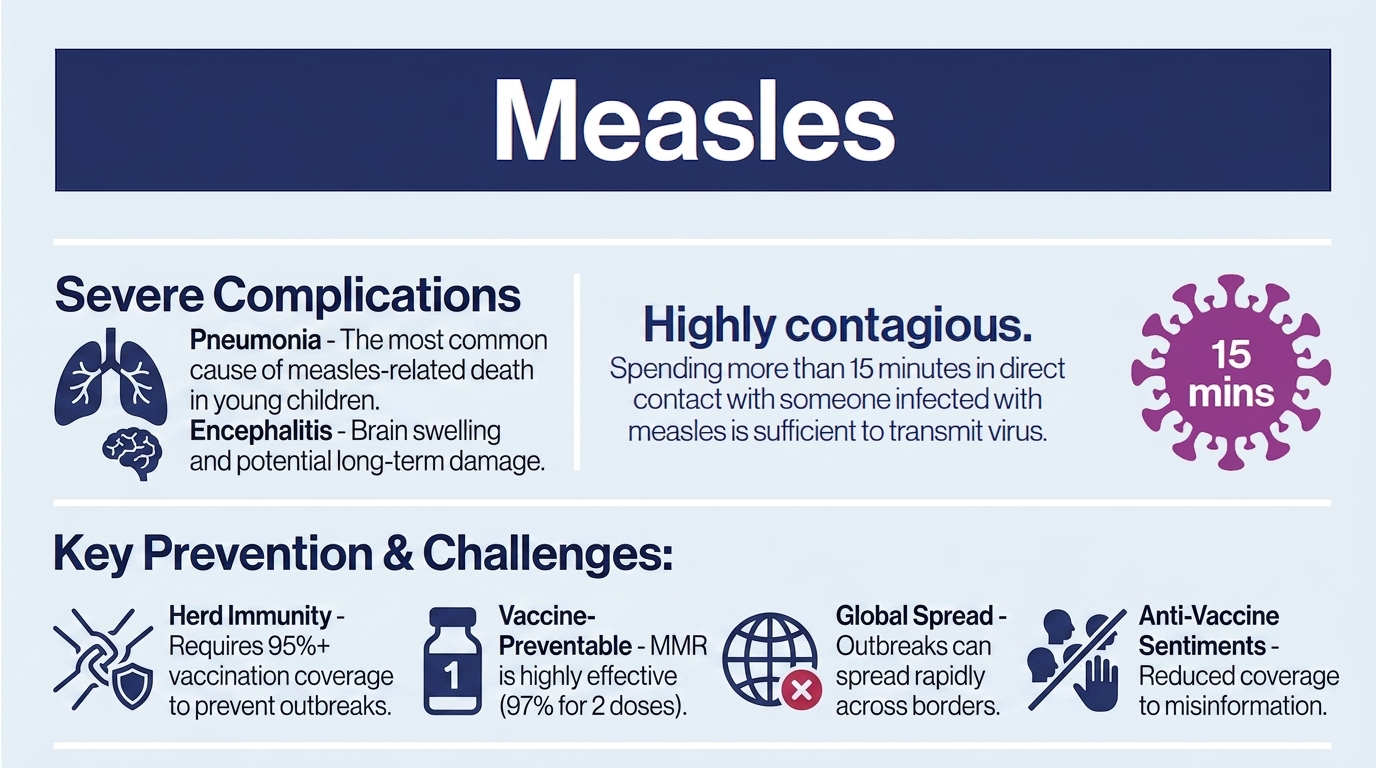
Face it, measles, mumps and rubella are not historical curiosities. Measles is among the most contagious human infections; health officials estimate that herd immunity for measles requires at least 94% of the population to be immune [3]. Complications include pneumonia (4% of cases), encephalitis (1%), and subacute sclerosing panencephalitis, a fatal degenerative neurological condition [4]. Mumps causes aseptic meningitis and orchitis, which can result in sterility in adult males. A recent outbreak in India saw an attack rate of 147 per 100,000 among children aged 5–9 years, reported complications that included pancreatitis and aseptic meningitis [5].
Rubella (German measles) during pregnancy, particularly in the first trimester, can cause miscarriage, stillbirth, or congenital rubella syndrome; characterised by deafness, blindness, cataracts, cardiac abnormalities and intellectual disability [6]. During early pregnancy it gives you an up to a 90% chance of giving birth to a baby with congenital rubella syndrome (CRS), and 33% of infants born with CRS die before their first birthday [6][7]. It is estimated that 32,000 children globally were born with CRS in 2019 [6][7]. These are not theoretical risks, they aren’t even facts, they are preventable tragedies. And the most vulnerable are the ones who bear the brunt.
The combined MMR vaccine is among the most extensively studied interventions in medical history. A 2021 Cochrane review included 138 studies involving over 23 million participants [8]. The evidence is conclusive: MMR vaccination markedly reduces measles, mumps and rubella. The review found no evidence of an increased risk of autism spectrum disorder or inflammatory bowel disease [8]. Only a deranged ex-drug addict demonstrating extreme withdrawal psychosis would think otherwise. A 2026 study of more than 2.5 million US children reinforced these findings, showing no association between MMR vaccination before age 2 and an autism [9]. The European Medicines Agency has similarly reaffirmed that rigorous studies consistently find no causal link, noting that the false belief in a link originates from a 1998 study that contained falsified data and was subsequently retracted [10]. Imagine the resources that have been expended collecting the evidence to contradict what is little more than a fantasy.
The original Wakefield paper, published in The Lancet in 1998, involved only 12 children [11]. It failed to establish that MMR caused autism, but it triggered an enormous international research effort. The paper was eventually fully retracted in 2010, and Wakefield was struck off the UK medical register. WHO describes the study as wrong and fraudulent. Since then, researchers have examined the hypothesis using multiple epidemiological approaches:
| Evidence | Approximate scale | |
| Early WHO review, 2002 [12] | 11 epidemiological studies + 3 laboratory studies | |
| Meta-analysis of vaccine/autism studies | >1.2 million children | |
| Danish MMR study, 2002 [13] | 537,303 children | |
| Danish MMR study, 2019 [14] | 657,461 children | |
| WHO 2010–2025 evidence review [15] | 31 studies examined | |
| WHO review finding no association [16] | 20 studies found no association; 11 suggesting one had major methodological limitations | |
WHO's original 2002 review already concluded that the available evidence did not support an association between MMR and autism. It also specifically rejected the idea that children should routinely receive separate measles, mumps and rubella vaccines instead of MMR [12].
The 2019 Danish study is particularly powerful as it followed 657,461 children, generating data amounting to more than 5 million person-years of follow-up. It found no increased autism risk following MMR vaccination, including among children considered to have elevated autism risk because of family history [14]. And this isn't simply one enormous study producing one reassuring result. The evidence has been replicated across countries, populations, study designs and decades (see above).
There are those that witter on about mercury; one vaccination containing thiomersal (a mercury containing preservative) equates to eating a can of tuna. A meta-analysis identified ten relevant studies involving more than 1.2 million children and found no evidence that MMR, thimerosal (a mercury-containing preservative) or mercury exposure increased autism risk. Again, let’s be clear, the CDC explicitly states that the MMR vaccine never contained thiomersal [16]. The latest WHO review is even more revealing. Its 2025 assessment examined research published between 2010 and 2025. Of 31 studies reviewed, 20 found no association; the 11 that suggested an association were judged to have significant methodological problems and high risk of bias. WHO consequently reaffirmed that vaccines do not cause autism [17].
There isn't a reliable accounting system that might tell us "$X billion has been spent investigating the MMR-autism hypothesis". Much of the research was incorporated into broader vaccine-safety programmes, university epidemiology, national health registries and routine pharmacovigilance. Assigning a precise cost would therefore be speculative. But we can confidently assume that the opportunity cost is substantial. For more than 25 years, researchers, epidemiologists, statisticians, clinicians, regulators and public-health agencies have repeatedly had to revisit a hypothesis that should have died with its original evidence.
Nero, at least, could claim ignorance, he did not have 23 million study participants or five decades of epidemiological research at his disposal. Modern policy makers have no such excuse (see below).
| Scientific/public-health question | Evidence-based position | Proposed policy direction |
| Does combining MMR vaccines create an established safety problem? | No convincing evidence from >23 million participants [8] | Treats separation as preferable |
| Does MMR cause autism? | No credible causal evidence; multiple large studies refute link [9][10] | Continues to fuel the controversy |
| Does separating vaccines improve protection? | No demonstrated advantage; increases number of injections [16] | Creates additional vaccination visits |
| What happens if vaccination is delayed? | Children remain vulnerable longer [18] | Greater opportunity for infection |
| What happens to herd immunity? | High uptake protects communities; threshold is 94-95% [8] | Fragmentation may reduce uptake |
| What about rubella and pregnancy? | Prevention protects future pregnancies; CRS can cause severe birth defects [6][7] | Delayed protection creates avoidable risk |
Trump’s proposal is not merely a scheduling change. Not only are individual measles, mumps and rubella vaccines not licensed in the US, they are not used routinely in most other countries [19]. Implementation would require manufacturers to develop new products, establish new manufacturing processes (make three times as many vials) and obtain FDA approval. The costs would be substantial, and the process would take years. The American Academy of Pediatrics has noted that there is no indication manufacturers have any interest in pursuing this [20].
The consequences are predictable: more healthcare appointments, more opportunities for missed vaccinations, greater administrative complexity, and potential delays in protection. Public health experts have long recommended the combined vaccine precisely because it reduces the number of injections and lowers the risk that children will miss protection against one of the three diseases. The proposal solves no clearly defined clinical problem while creating problems that public-health science already understands. This is not complexity born of necessity; it is complexity born of ideology. And complexity, in public health, is measured in missed appointments, unprotected children, and outbreaks that should never have happened.
Nero's folly was not merely that he played music while Rome burned. It was that he could not see the fire at all, or more likely didn’t care. The policy appears to be driven not by science but by political pressure from vaccine-sceptical constituencies, ideological opposition to perceived government overreach, and the enduring influence of the vaccine-autism narrative despite overwhelming evidence against it [21]. During the Oval Office signing, Trump made unsupported statements linking vaccines to autism, saying: "There are some groups that have virtually no problem with autism... They're groups that aren't big into the world of vaccines, so there is something wrong".
The frustration is visceral (it should be). We know the outcomes of this policy are predictable and harmful. We know the evidence. We know the history. We know the science. The fire is not metaphorical. In 2025, western Texas experienced the largest measles outbreak in decades, with 762 confirmed cases, intensive care admissions and fatalities [21]. The US is currently experiencing its worst measles outbreak in 35 years, with over 2,400 cases reported [7]. Among affected communities, kindergarten vaccination coverage had fallen below the 95% threshold required for herd immunity [21]. The overwhelming majority of cases (93%) occurred in unvaccinated individuals [21].
The danger is not simply that one vaccine might be divided into three injections. It is that scientific evidence becomes optional when it conflicts with political ideology. The 2006 movie Idiocracy was supposed to be a warning disguised as comedy. Nero was supposed to be a cautionary tale about what happens when power is divorced from competence. If public-health policy begins ignoring decades of evidence, the joke stops being funny. Children do not get a second chance at herd immunity. The US is currently conducting an uncontrolled experiment on public health, and the subjects are children. We learned nothing from Rome. We learned nothing from satire. We are watching the fire spread, and the only thing burning is their collective future.
References

Get our latest news and publications
Sign up to our news letterResources
Social


Contact us
Address
Niche Science & Technology
Unit 26 Falstaff House
Bardolph Road
Richmond TW9 2LH
United Kingdom