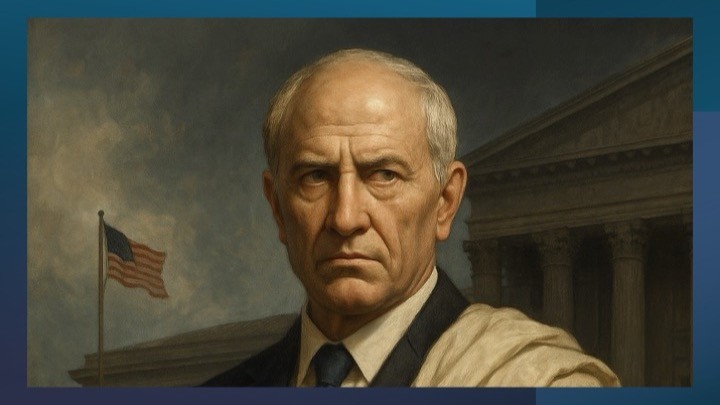
It is generally acknowledged that one should not discuss politics on professional social media. History, however, is apparently fair game. And there is a useful distinction: politics tells us what people want us to believe today; history (occasionally) tells us what actually happened.
Cicero himself would probably have approved of the distinction.
Marcus Tullius Cicero (106 BC to 43 BC) was a Roman statesman, lawyer, philosopher and, above all, an exceptionally gifted orator. He lived through the increasingly violent final decades of the Roman Republic and watched, with growing alarm, as political competition became personal, institutions became negotiable and ambitious men discovered the considerable electoral value of promising people what they wanted to hear. His surviving speeches, philosophical works and almost 950 letters provide an unusually detailed window into the political culture of the late Republic [1][2].
He also understood the importance of history. In Orator, written in 46 BC, he observed:
“To be ignorant of what occurred before you were born is to remain always a child” [3].
It is an excellent quotation, particularly for social media, where the temptation to announce that something has "never happened before" is apparently irresistible.
Cicero's point was more sophisticated than simply saying that history is interesting. He argued that understanding the past gives political and intellectual judgement depth. Without historical memory, every crisis looks unprecedented, every ambitious politician looks revolutionary and every bad idea arrives dressed as a new one [3].
That makes Cicero an interesting companion for anyone watching current politics.
But there is a problem.
Cicero is frequently presented as an uncomplicated champion of democracy, constitutional integrity and the rule of law. He was certainly a powerful advocate of republican government and the common good. Yet he was also an aristocratic Roman politician defending a political system that was neither democratic nor remotely egalitarian. The Roman Republic contained substantial popular participation, but political power was structured through assemblies, magistrates, tribunes, patronage and a highly influential Senate. Democracy by comparative historical standards, although restricted to ‘citizens’ and operated very differently from modern representative systems [4].
In other words, Cicero was defending a republic, not modern liberal democracy.
That distinction matters.
In De re publica, he described the res publica as a commonwealth held together by agreement concerning law and a shared conception of common interest [5]. His political philosophy therefore rested on an idea that remains remarkably contemporary: institutions are not enough. A functioning political system depends upon citizens and leaders accepting that some things are more important than their immediate personal advantage.
In De officiis, written shortly before his death, Cicero returned repeatedly to the relationship between private advantage and public duty. He argued that what appears advantageous to an individual cannot genuinely be advantageous if it damages the community. Justice, in his formulation, requires that we do no harm and preserve the common interests [6]. This is where Cicero starts to sound rather modern.
The difficulty is that he was not simply a philosopher sitting safely above the political fray. He was in it up to his neck in it. As consul in 63 BC, Cicero confronted the conspiracy of Lucius Sergius Catiline. He portrayed Catiline as an existential threat to the Republic and succeeded in suppressing the conspiracy. But several conspirators were executed without trial, a decision that later contributed to Cicero's exile and became one of the most damaging controversies of his political career [7]. This is the uncomfortable part of Cicero's story, and it deserves to remain uncomfortable.
The great defender of constitutional government was prepared, under circumstances he regarded as exceptional, to stretch constitutional safeguards to protect the Republic. That is an old political problem. It is also a remarkably modern one.
When a politician argues that extraordinary circumstances require extraordinary powers, the question is not simply whether the threat is real. It is whether the exceptional measure itself damages the institutional system that is supposed to survive the crisis.
Cicero was not alone in confronting this dilemma. The late Roman Republic had already experienced political violence, assassinations, military coups and constitutional improvisation. Sulla had marched on Rome with an army. Caesar subsequently did the same. The problem was therefore not one rogue politician suddenly appearing from nowhere. The Republic had developed a political culture in which institutional rules could increasingly be treated as obstacles to be circumvented when the stakes became sufficiently high [4][5].
And that may be one of Cicero's most useful lessons.
Democracies rarely collapse because somebody wakes up one morning and announces, "Today I shall destroy democracy." They usually become weaker by increments. A rule is bent because the circumstances are exceptional. A convention is ignored because the other side started it. An opponent becomes an enemy. An enemy becomes a traitor. A political disagreement becomes a moral struggle. Compromise becomes surrender. Institutions become obstacles rather than safeguards (sound familiar?).
Eventually, behaviour that would once have been regarded as extraordinary becomes normal.
Modern political science gives this process a less entertaining name: democratic backsliding. Recent research suggests that polarisation and democratic erosion can reinforce one another, with attacks on democratic institutions themselves capable of increasing political polarisation [8][9].
Cicero would have recognised the mechanism.
He was also fascinated by constitutional balance. Drawing on the Roman political tradition and earlier Greek political thought, he regarded the Republic as a system in which different sources of power could constrain one another. The consuls, Senate and popular assemblies represented different constitutional elements, creating a form of mixed government intended to prevent power becoming excessively concentrated [5][10]. This was not democracy as we understand it today. It was closer to the political equivalent of putting several people in charge of the nuclear launch codes and hoping none of them has a particularly bad afternoon.
Yet the underlying principle remains important: power needs counterweights.
Cicero's fear was not simply that a bad person might gain power. His deeper concern was that institutions might become incapable of constraining a powerful person.
That distinction is crucial.
A democracy cannot rely upon finding exceptionally virtuous politicians (as we can plainly see). That would be a rather poor constitutional strategy. It has to be designed on the assumption that politicians will sometimes be ambitious, self-interested, vain, frightened or simply wrong.
In this respect, Cicero's thinking remains remarkably relevant. His De re publica placed considerable emphasis not only on constitutional arrangements but also on the character of political leaders. Modern scholarship similarly stresses the interaction between institutions, political norms and the behaviour of political elites [5][8][9].
There is another lesson here, perhaps an even more important one.
We should be careful about using the word ‘populism’ as though it describes everything Cicero disliked.
The Roman populares were not simply ancient versions of modern populist parties. The political vocabulary, institutions and social structures were entirely different. Nevertheless, there is an interesting modern parallel in the use of popular grievances to challenge established institutions and in the tendency of political leaders to claim a uniquely authentic relationship with ‘the people’.
Modern research on populism emphasises precisely this tension. Populist politics can challenge unresponsive elites and draw attention to genuine grievances, but it can also become hostile to pluralism when one political movement begins to claim that it alone represents the authentic people. That is where populism can become dangerous to the institutions that make political disagreement possible in the first place.
And there is a delicious irony here. Cicero himself was an expert in political rhetoric.
He knew better than most that words do not merely describe political reality. They help create it.
His letters reveal a politician attempting to persuade, negotiate, manipulate, reassure and occasionally panic his way through a collapsing political order. They are not the writings of an impartial observer. They are the correspondence of a participant desperately trying to work out what on earth everyone else is doing [1][2].
That makes them rather more interesting. It also makes Cicero rather more human.
He was brilliant, vain, courageous, inconsistent, politically ambitious and occasionally spectacularly wrong. He defended republican government while benefiting from an aristocratic political system. He championed law while taking extraordinary action against perceived enemies. He believed deeply in civic virtue while operating in a political world in which virtue and political survival were not always comfortable bedfellows.
In other words, he was a politician. Perhaps that is why his story continues to resonate.
Cicero's final years were dominated by the struggle following the assassination of Julius Caesar. He attacked Mark Antony in the Philippics, attempting to mobilise political and military resistance to Antony and preserve what remained of the Republic. His letters from this period show him trying to influence military leaders despite lacking the direct authority to command them [2]. He failed.
The Second Triumvirate of Octavian, Antony and Lepidus eventually turned against their political enemies. Cicero was proscribed and murdered in December 43 BC. His head and hands were displayed on the Rostra in Rome, the very place from which he had delivered some of his most famous speeches. It is difficult to imagine a more brutally appropriate ending for a professional orator.
They did not merely kill Cicero. They displayed the equipment he used to ‘send a message’ to others.
But the Republic did not simply become an empire overnight, nor did Rome subsequently experience 500 years of straightforward imperial tyranny. The transition was a prolonged series of civil wars and constitutional transformations, culminating in Octavian's victory and the establishment of the Augustan principate. The western Roman Empire later collapsed, but the eastern Roman state survived for another millennium [4].
Cicero therefore did not lose because one demagogue suddenly defeated democracy. He lost because a political system that had survived for centuries had become increasingly unable to contain the incentives, ambitions and conflicts of its most powerful participants.
And that brings us rather uncomfortably back to the present.
Modern democracies face different circumstances, different technologies and vastly broader electorates. We have mass media, social media, instantaneous communication, professional political campaigns and an almost industrial capacity to manufacture outrage before breakfast. It would be foolish to pretend that Rome and the twenty first century are the same.
But the human beings remain remarkably familiar.
Political polarisation can make opponents appear illegitimate rather than merely wrong. Institutional safeguards can be portrayed as obstacles to popular will. Leaders can exploit genuine grievances while simultaneously weakening the mechanisms designed to constrain them. Research on contemporary democratic backsliding suggests that this interaction between elite behaviour, polarisation and institutional erosion is neither imaginary nor trivial [8][9].
Cicero's most valuable lesson may therefore not be that we need another Cicero.
It may be that we should stop waiting for one.
A democracy that requires a uniquely virtuous, brilliantly eloquent and morally courageous individual to save it is already in trouble. The more durable defence lies in institutions, political norms, civic participation, an informed electorate and a willingness to accept that losing an argument, an election or a political battle is not the same thing as losing the country.
Cicero's own preferred formulation was wonderfully concise:
Salus populi suprema lex esto.
Let the welfare of the people be the highest law [11]. That seems a considerably better political motto than "win at all costs". And perhaps that is the final lesson from Cicero.
History does not repeat itself neatly. It rarely has the courtesy. But human beings repeatedly encounter the same temptations: power, fear, greed, tribalism, certainty and the intoxicating belief that our side is sufficiently important to justify breaking the rules.
Cicero knew all about them. He also knew that once constitutional restraints become optional, they are not particularly good restraints. Two thousand years later, that seems worth remembering. Especially here.
References

Get our latest news and publications
Sign up to our news letterResources
Social


Contact us
Address
Niche Science & Technology
Unit 26 Falstaff House
Bardolph Road
Richmond TW9 2LH
United Kingdom