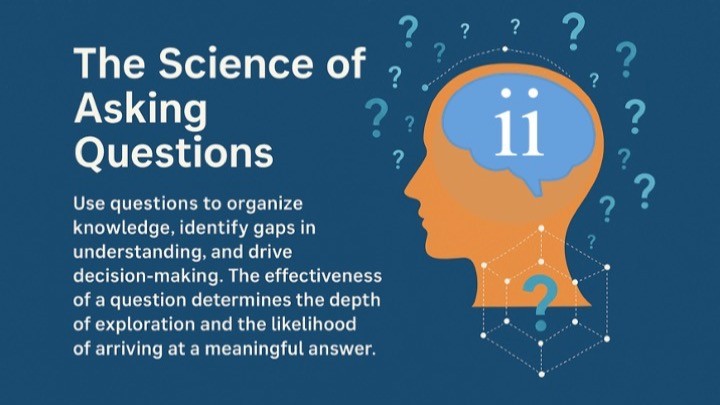
We use questions to organise knowledge, identify gaps in understanding and drive decision-making. The effectiveness of a question determines the depth of exploration and the likelihood of arriving at a meaningful answer [1]. Research in cognitive psychology shows that well-structured questions stimulate deeper processing and retention of information [2]. Socratic questioning promotes critical thinking by challenging assumptions and examining implications [3]. A well-posed question illuminates the path to discovery, whereas a poorly framed one can create confusion or lead to wasted effort.
The way a question is framed can significantly influence the direction and outcome of scientific inquiry. Bloom’s Taxonomy classifies questions into levels of increasing complexity, and a well-framed question is clear, specific and aligned with the problem being addressed [4]. It avoids ambiguity and keeps attention on the core issue. Einstein’s thought experiments were guided by fundamental questions about space, time and relativity [5]. Ambiguous or leading questions, by contrast, introduce bias and limit the scope of inquiry. The right question is a compass rather than a destination.
Research in cognitive psychology supports the idea that question framing affects problem-solving. Open-ended questions encourage exploration and creativity and often lead to more innovative solutions than closed-ended questions, which restrict responses to predefined options [6]. In scientific contexts, open-ended questions stimulate curiosity and can lead to unexpected discoveries. For example, asking how quantum mechanics might support new computing technologies has driven decades of research in quantum computing.
Identifying the problem
Every aspect of science is framed in questions.
A common pitfall in scientific inquiry is failing to ask the right question. This often occurs when we focus on symptoms rather than underlying causes or when preconceived notions shape our assumptions. Reflective questioning helps avoid this by encouraging critical examination of initial beliefs. Techniques such as the Five Whys, originally developed by Toyota, can be adapted for scientific inquiry [7]. By repeatedly asking why, researchers can drill down to root causes.
If a biologist observes a decline in a species, they might ask why the population is falling. If the answer is habitat loss, the next question becomes why habitat loss is occurring. This continues until the underlying cause, such as urbanisation or climate change, is identified. By focusing on the real problem, researchers can design more effective interventions and avoid superficial solutions.
Encouraging exploration and creativity
Einstein noted that curiosity has its own reason for existing. Effective questioning clarifies problems and fosters exploration and creativity. Questions that challenge existing paradigms or encourage interdisciplinary thinking often lead to breakthroughs. Asking whether gravity might be a curvature of spacetime transformed physics and led to general relativity. In contemporary science, questions that bridge disciplines yield some of the most innovative results. Bioinformatics emerged from asking how computational tools could analyse biological data, transforming genomics, proteomics and other areas of life sciences.
In philosophy, leadership and innovation, the value of a question lies not only in its answerability but in its power to illuminate, unsettle and inspire. Effective questioning requires clarity, relevance, depth and open-endedness.
Navigating uncertainty and ambiguity
The depth of a question reflects the depth of thought. Shallow questions lead to shallow insights. In many scientific endeavours, definitive answers are rare due to the complexity of the problems being studied. In such cases, the process of asking questions becomes even more important. Questions that embrace uncertainty and encourage iterative exploration can lead to incremental progress and the accumulation of knowledge. In climate science, asking how global warming will affect regional weather patterns does not yield a single answer, but it guides research that improves predictive models and informs policy.
Karl Popper emphasised the importance of falsifiability in scientific inquiry, arguing that good questions are those that can be tested and potentially disproven [8]. Asking what evidence would falsify a hypothesis promotes critical thinking and ensures that inquiry remains grounded in empirical evidence.
Ensuring actionable outcomes
Questions can be more transformative than answers. A well-formulated question should guide the search for answers and lead to actionable outcomes. This is particularly important in applied sciences, where the goal is to solve practical problems. Questions that are too abstract or theoretical fail to produce tangible results. To ensure actionable outcomes, feasibility and scalability should be considered when framing questions.
Define the core problem: What appears to be the question may be a symptom of a deeper issue [9]. Use open-ended and exploratory questions: Ask what factors influence a phenomenon rather than whether it is true [10]. Encourage multiple perspectives: Ask about trade-offs rather than best solutions [11]. Iteratively refine the question: As Einstein suggested, understanding the problem is often more important than finding the solution [5].
Question asking in the age of AI
Crafting the right question remains central to philosophical inquiry, visionary thinking and the pursuit of deeper understanding. The widespread availability of large language models (LLMs) is reshaping scientific enquiry by transforming how questions are asked, explored and answered. Traditionally, formulating a research question required deep engagement with literature, theoretical frameworks and collaboration. LLMs now provide immediate access to summaries, explanations and hypotheses, enabling rapid iteration and refinement [12]. This accelerates early-stage thinking, lowers barriers for non-experts and enhances interdisciplinary exploration.
However, the ease of generating plausible-sounding answers introduces risks. Fluent responses can encourage superficial enquiry, discourage deep literature review and create a surface-level understanding of complex topics [13]. LLMs may produce confident but inaccurate or misleading answers due to training on non-peer-reviewed or outdated content [14] and can reflect societal and academic biases [15]. Without critical oversight, scientific rigour may erode. Evidence suggests that convenience can discourage independent critical thinking by promoting passive consumption of information [14].
On the positive side, LLMs support hypothesis generation, experimental design brainstorming and even code or data analysis, helping scientists focus on high-level synthesis. They also democratise access to scientific discourse, supporting students and researchers in under-resourced settings [16]. Their impact depends on awareness of limitations and responsible integration. When used critically as thinking partners rather than authorities, they can enhance scientific enquiry.
Missing consideration: epistemic humility and source evaluation
By 2025, a crucial addition to the practice of asking questions is epistemic humility. The rise of AI-generated content requires researchers to ask not only what the answer is but how reliable the source might be. Studies in cognitive psychology and science communication emphasise the importance of evaluating evidence quality, recognising uncertainty and acknowledging the limits of one’s knowledge [17]. Good questions now include meta-questions: What assumptions underpin this answer? What evidence supports it? How might the source be biased? These questions strengthen scientific reasoning and protect against misplaced confidence.
Conclusion
Science is a quest for answers, and asking the right question is often the most critical step in solving a problem. Socrates argued that awareness of ignorance is the beginning of wisdom. Recognising our lack of knowledge and embracing a continuous quest for understanding through questioning is fundamental to scientific discovery and critical thinking. By framing questions well, we enhance problem-solving, foster creativity and navigate uncertainty.
Effective questioning also plays a crucial role in scientific communication. Anticipating the questions that research might raise and addressing them proactively helps highlight significance and relevance and supports dialogue and collaboration. As challenges grow more complex, the ability to ask the right questions will remain essential for progress.
The best thinkers are not those who merely find answers but those who explore the most illuminating questions. As scientific enquiry evolves with new technologies, a multi-threaded approach that uses AI tools responsibly can refine ideas and strengthen conclusions. Concerns remain that reliance on such systems may erode curiosity and critical thinking, but used correctly, AI can expand intellectual horizons.
By examining strategies for crafting focused, open-ended and actionable questions, this article highlights the importance of questioning as a tool for problem-solving and discovery. The art of asking questions remains essential for navigating uncertainty and achieving meaningful results.
References (validated, pre‑2025 sources)

Get our latest news and publications
Sign up to our news letterResources
Social


Contact us
Address
Niche Science & Technology
Unit 26 Falstaff House
Bardolph Road
Richmond TW9 2LH
United Kingdom