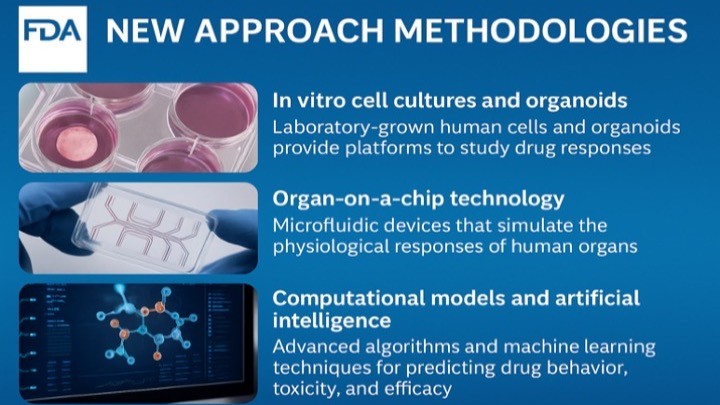
In a landmark shift, the US Food and Drug Administration (FDA) has announced plans to reduce its reliance on traditional animal testing requirements in drug development [1]. Rather than representing an outright ban on animal studies, the initiative encourages the use of scientifically justified alternatives where these can provide equivalent or superior evidence of safety and efficacy. This decision reflects a growing consensus that alternative methods, collectively termed new approach methodologies (NAMs), can offer more ethical, efficient, and, in many cases, more human relevant means of evaluating new medicines [2][3]. These methodologies encompass a diverse range of innovative experimental and computational approaches that are rapidly transforming preclinical drug development.
Traditional animal testing has long been the cornerstone of preclinical drug evaluation. However, concerns have steadily grown regarding its ethical implications, cost, time requirements and, importantly, its ability to predict human responses accurately. Numerous studies have demonstrated that many animal models have limited translational value, contributing to the high attrition rates observed during clinical development when promising compounds fail because of unexpected toxicity or lack of efficacy in humans [4][5].
The financial burden of animal studies has also increased substantially. Rising ethical standards, more stringent welfare requirements, supply chain constraints and the global shortage of laboratory non-human primates have all contributed to escalating costs. For example, the price of a single cynomolgus monkey, commonly used in regulatory toxicology studies, increased from approximately US$5,000 in 2019 to well over US$30,000 by 2024 because of restricted supply and increased international demand [6]. When the costs of specialist housing, veterinary care, regulatory compliance and complex toxicology studies are included, the expense of preclinical safety programmes can become a significant barrier, particularly for smaller biotechnology companies. These pressures have accelerated investment in alternative technologies capable of generating more human relevant data while reducing development costs [2][7].
The move towards NAMs is also consistent with the long established 3Rs principles of Replacement, Reduction and Refinement, first proposed by Russell and Burch over sixty years ago [8]. Advances in cell biology, tissue engineering, computational modelling and artificial intelligence now offer realistic opportunities to implement these principles without compromising scientific rigour.
The FDA signals a change in direction
Recognising these scientific and practical challenges, the FDA has initiated an important change in regulatory thinking. In April 2025, the agency announced plans to encourage the use of validated NAMs, particularly during the development of monoclonal antibodies and other biological therapies where conventional animal models often provide limited predictive value [1].
Importantly, the FDA has not eliminated animal testing requirements altogether. Instead, it is adopting a more flexible, evidence-based approach in which developers may submit robust non-animal data when supported by appropriate scientific justification. The agency also intends to encourage early dialogue between sponsors and regulators to determine when alternative approaches are suitable and has indicated that high quality non-animal evidence may facilitate more efficient regulatory review.
This policy reflects an increasing recognition that no single experimental model is likely to replace animal testing completely. Rather, future regulatory submissions are expected to rely on integrated evidence generated from complementary methodologies, combining in vitro systems, computational modelling, existing human data and, where necessary, targeted animal studies to provide a comprehensive assessment of safety [2][9].
The FDA's initiative also aligns with broader international efforts to modernise preclinical testing. Regulatory authorities, including the European Medicines Agency (EMA), the UK Medicines and Healthcare products Regulatory Agency (MHRA), and the Organisation for Economic Co-operation and Development (OECD), have all increased their support for the development, validation and regulatory acceptance of alternative methodologies. Although regulatory implementation continues to vary between jurisdictions, international harmonisation will be essential if NAMs are to realise their full potential in global drug development [2][10].
New approach methodologies
New approach methodologies encompass a suite of advanced technologies designed to assess drug safety and efficacy without relying exclusively on animal data. Rather than representing a single technology, NAMs integrate complementary experimental and computational approaches that collectively provide increasingly sophisticated models of human biology.
Among the most promising technologies are:
Together, these complementary technologies are beginning to reshape preclinical development by generating more human relevant evidence while reducing dependence on traditional animal models. Although further validation and regulatory acceptance remain necessary, their continued evolution is likely to play an increasingly important role in future drug development.
AI-based computational models
One of the most promising developments within NAMs is the application of artificial intelligence (AI) to improve the prediction of drug safety and efficacy. Machine learning algorithms are increasingly capable of analysing large volumes of chemical, biological and clinical data to identify patterns that would be difficult for conventional statistical approaches to detect. These tools are already being used to support compound prioritisation, predict off-target effects, identify potential toxicities and optimise drug design before laboratory studies begin [13][14].
Among the FDA's most notable initiatives is AnimalGAN, developed by the agency's National Center for Toxicological Research. AnimalGAN is a generative adversarial network trained using historical toxicology datasets to generate synthetic animal study results. Rather than replacing experimental studies outright, the model is intended to complement existing evidence by predicting clinical pathology outcomes for previously untested compounds. Validation studies have demonstrated that AnimalGAN can reproduce many conventional toxicological endpoints with encouraging accuracy, suggesting that AI-generated synthetic datasets may become valuable components of future regulatory submissions [15].
The broader application of AI extends well beyond synthetic toxicology. Modern computational approaches increasingly integrate quantitative systems pharmacology, physiologically based pharmacokinetic (PBPK) modelling and network biology to simulate drug disposition and biological responses in virtual patient populations [14][16]. These techniques have the potential to identify safety concerns earlier, optimise dose selection and reduce late-stage development failures.
Despite this promise, regulatory confidence in AI remains dependent upon transparency, reproducibility and data quality. Machine learning models are only as reliable as the datasets on which they are trained, and regulators continue to emphasise the need for rigorous validation, independent verification and clearly documented model performance before AI-generated evidence can support regulatory decision making [2][13].
Organs-on-a-chip and organoids
Organ-on-a-chip and organoid technologies have emerged as some of the most physiologically relevant alternatives to conventional animal models. These systems recreate key aspects of human tissue architecture and function by combining living human cells with engineered microenvironments that replicate mechanical forces, fluid flow and cell-to-cell interactions [12].
Unlike traditional two-dimensional cell cultures, organoids preserve many of the structural and functional characteristics of native tissues. They have already demonstrated considerable value in modelling human disease, investigating mechanisms of drug action and identifying potential toxicities across a wide range of therapeutic areas [11].
Similarly, organ-on-a-chip platforms can reproduce interactions between multiple tissue types, allowing investigators to evaluate complex physiological processes under controlled laboratory conditions. Liver-on-a-chip systems, for example, have shown particular promise in predicting drug-induced liver injury, one of the leading causes of compound attrition during development and post-marketing withdrawal [12][17].
Researchers are now developing interconnected multi-organ platforms capable of linking liver, kidney, heart, lung and intestinal tissues within a single microphysiological system. Although these technologies remain under active development, they offer the prospect of modelling whole-body pharmacology more accurately than isolated experimental systems [17].
Regulatory and legislative support
The FDA's changing position has been facilitated by evolving legislation and regulatory policy. The FDA Modernization Act 2.0, enacted in December 2022, removed the longstanding expectation that animal studies would always be required before first-in-human clinical trials. Instead, the legislation explicitly recognises appropriately validated alternatives, including cell-based assays, organoids, organs-on-a-chip, computational models and other scientifically justified approaches for evaluating drug safety [18].
The 2025 FDA announcement builds upon this legislative foundation by signalling a greater willingness to accept well-validated non-animal evidence within regulatory submissions. Rather than prescribing a single testing strategy, the agency is moving towards a science-led framework in which the most appropriate methods are selected according to the characteristics of each investigational product [1].
This evolution reflects a broader international trend. Organisations including the European Medicines Agency (EMA), the International Council for Harmonisation (ICH) and the OECD continue to develop guidance supporting the qualification, validation and regulatory acceptance of innovative testing methodologies. While regional differences remain, increasing international collaboration should help establish common standards for evaluating the reliability and applicability of NAMs across global drug development programmes [2][10].
Challenges and future directions
Despite the considerable progress made in recent years, significant challenges remain before NAMs can be adopted routinely across all areas of pharmaceutical development.
The foremost requirement is scientific validation. New methodologies must consistently demonstrate reliability, reproducibility and relevance to human biology before they can achieve widespread regulatory acceptance. Standardised protocols, inter-laboratory comparisons and formal qualification programmes remain essential for building regulatory confidence [2][9].
Another challenge is the complexity of human physiology itself. While individual organoids and microphysiological systems can accurately model specific tissues, reproducing the integrated interactions between multiple organs, immune responses, endocrine signalling and chronic disease processes remains difficult. Consequently, certain therapeutic areas, particularly immunology, oncology, regenerative medicine and gene therapies, may continue to require carefully selected animal studies until alternative approaches mature further [5][17].
Data quality also represents an important consideration for computational methodologies. AI models require diverse, high quality datasets that accurately represent human biology. Incomplete or biased training data can reduce predictive performance and limit regulatory confidence, reinforcing the need for transparent model development and independent validation [13].
Finally, regulatory harmonisation remains a global priority. Drug developers routinely submit applications across multiple jurisdictions, making consistent regulatory expectations increasingly important. Continued collaboration between regulatory authorities, academic researchers and industry will be essential to establish internationally accepted standards for the qualification and use of NAMs [2][10].
Although these challenges are substantial, the pace of scientific progress suggests that future preclinical development will increasingly rely on integrated evidence generated from complementary experimental and computational approaches rather than any single technology. The transition is therefore likely to be evolutionary rather than revolutionary, with validated NAMs progressively replacing animal studies where they provide equal or superior scientific evidence.
Conclusion
The FDA's decision to encourage the use of new approach methodologies marks one of the most significant changes in preclinical drug development for decades. Rather than representing the end of animal testing, it signals the beginning of a more scientifically flexible and evidence-based regulatory framework in which the most appropriate methods are selected according to the question being asked. As alternative technologies continue to mature, developers will increasingly be able to combine complementary sources of evidence to provide more predictive assessments of drug safety and efficacy [2][9].
This shift is particularly timely given the rapid expansion of advanced therapies, including gene therapies, cell therapies and precision biologics. The FDA continues to anticipate substantial growth in investigational new drug (IND) applications for regenerative medicines, reflecting the increasing pace of innovation within the sector [19]. Many of these products present challenges for conventional animal models because of species-specific biology, immune responses and complex mechanisms of action. In such cases, carefully validated human-based models may ultimately provide more clinically relevant information than traditional animal studies alone [20].
The transition to NAMs also has important economic implications. More predictive preclinical models have the potential to reduce late-stage clinical failures, shorten development timelines and lower research costs while simultaneously improving patient safety. Although significant investment will still be required to validate emerging technologies and establish internationally harmonised regulatory standards, the long-term benefits could be substantial for regulators, pharmaceutical companies and, most importantly, patients awaiting innovative new treatments [2][3].
Perhaps the greatest significance of the FDA's announcement is that it recognises advances in science rather than simply changes in policy. Artificial intelligence, organoids, organs-on-a-chip, computational modelling and other human-centred technologies are no longer viewed solely as experimental research tools. Increasingly, they are becoming integral components of regulatory science. While animal studies will continue to play an important role for some applications in the foreseeable future, the future of preclinical drug development is likely to rely on integrated evidence generated from multiple complementary methodologies, providing a more ethical, efficient and human relevant pathway for bringing new medicines to patients.
References

Get our latest news and publications
Sign up to our news letterResources
Social


Contact us
Address
Niche Science & Technology
Unit 26 Falstaff House
Bardolph Road
Richmond TW9 2LH
United Kingdom