Over the past two decades, academic consortia have become an increasingly important model for conducting biomedical research. Advances in genomics, translational medicine, epidemiology, rare diseases, and precision medicine have created scientific questions that are often too large and complex for individual investigators or institutions to address alone. As a result, collaborative networks involving multiple research centres, diverse scientific disciplines, and international partnerships have become commonplace. Niche itself has been involved in several self-started, government funded multimillion pound research programmes such as MID-Frail, Frailomics and RASP-UK.
While these collaborations have dramatically expanded research capabilities, they have also introduced new challenges. Large consortia often generate multiple datasets, support numerous parallel analyses, and involve a wide range of stakeholders, including investigators, funding agencies, patient groups, and policymakers. In such environments, scientific discovery alone is not sufficient. The ultimate value of research depends on how effectively findings are communicated to the wider scientific community and translated into knowledge that influences future research, clinical practice, and public policy.
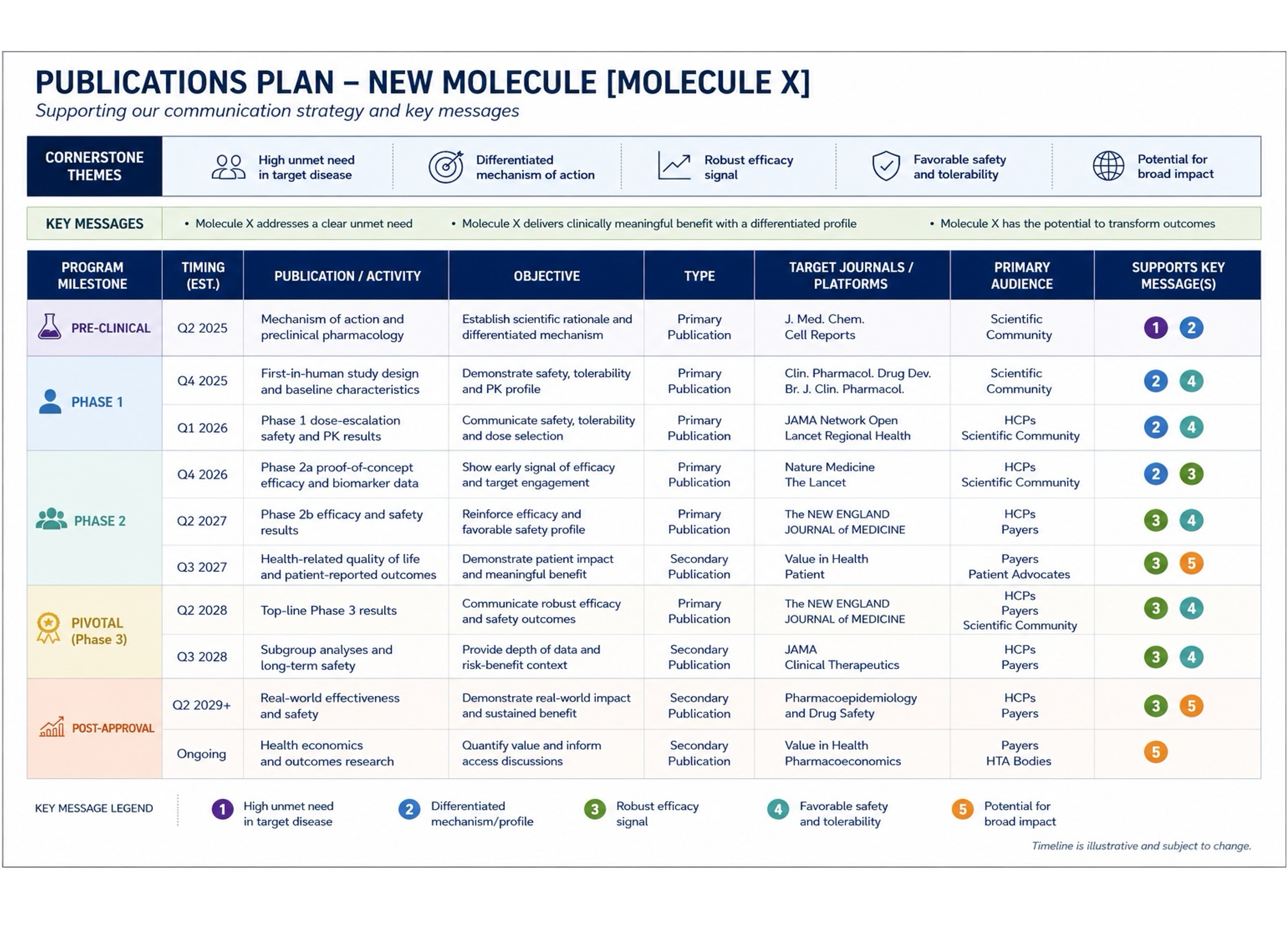
Publication planning has emerged as an important mechanism for achieving this objective. Although the discipline originated largely within the pharmaceutical industry, its principles are increasingly relevant to academic research programmes. At its simplest, publication planning is the systematic process of organising, prioritising, developing, and disseminating scientific outputs arising from a research programme. More fundamentally, it represents the bridge between data generation and scientific impact [1][2]. However, when looked at as the art of dissemination, publication plan is the synthesis of research, data and strategy to exploit your data to change behaviour for the better.
From Research Programme to Publication Strategy
A common misconception is that publication planning begins once data become available. In reality, effective publication planning starts much earlier and should be integrated into the overall scientific strategy of a consortium. Publications are not merely end products of research; they are one of the principal mechanisms through which research achieves its intended purpose [3].
The first step is understanding the consortium’s scientific landscape. This typically involves an information audit that examines completed studies, ongoing projects, anticipated analyses, available datasets, stakeholder expectations, and future research priorities. Such an exercise helps identify publication opportunities, potential overlaps between research groups, and gaps that may require additional investigation.
The information gathered through this process forms the basis of a strategic publication plan. Rather than approaching manuscripts as isolated activities, the consortium develops a coordinated programme of scientific communications. Primary manuscripts communicate the key findings of major studies, while secondary publications may explore subgroup analyses, methodological innovations, mechanistic insights, or broader implications of the research. Review articles, consensus statements, and conference presentations can further extend the visibility and impact of consortium-generated knowledge [4].
The goal is to ensure that individual publications contribute to a coherent scientific narrative. When viewed collectively, the publication portfolio should reflect the overall objectives of the consortium and provide a structured progression of evidence that advances understanding within the field.
Governance, Collaboration, and Scientific Integrity
As academic collaborations become larger and more complex, governance becomes increasingly important. Many successful consortia establish Publication Working Groups or Publication Steering Committees to oversee publication activities. These groups help coordinate manuscript development, prioritise publication opportunities, monitor timelines, and ensure consistency across scientific outputs [5].
Perhaps no aspect of publication planning receives more attention than authorship. Large collaborative projects may involve dozens or even hundreds of contributors, making authorship decisions particularly challenging. Disputes over author eligibility, author order, and recognition can undermine collaboration and delay dissemination of important findings.
For this reason, publication planning should include clear authorship policies from the outset. The recommendations of the International Committee of Medical Journal Editors (ICMJE) provide a widely accepted framework for defining authorship and accountability [6]. Establishing expectations early in the research programme promotes transparency, reduces conflict, and reinforces trust among collaborators.
Publication planning also contributes to broader goals of scientific integrity. Increasing attention has been directed toward publication bias and selective reporting, particularly the tendency for positive findings to be published more frequently than negative or inconclusive results. Such practices can distort the scientific literature and lead to inaccurate assessments of evidence [7].
A prospective publication strategy helps mitigate these concerns by documenting intended outputs and establishing a commitment to comprehensive dissemination. For publicly funded research programmes in particular, publication planning supports accountability to funders, participants, and the wider scientific community.
The same principles apply to reporting quality. Over the past decade, reporting guidelines such as CONSORT, STROBE, and PRISMA have become central to efforts aimed at improving transparency and reproducibility in biomedical research [8][9][10]. Incorporating these standards into publication planning processes ensures that manuscripts are developed in accordance with recognised best practices and facilitates successful peer review.
Maximising Scientific Impact
The ultimate purpose of publication planning is not simply to produce manuscripts but to maximise the scientific impact of research. Achieving this objective requires thoughtful consideration of publication timing, audience, and dissemination strategy utilising all channels available – termed an omnichannel approach, making the most of any means of communication.
Journal selection, for example, should be driven by scientific relevance rather than solely by journal prestige. Factors such as readership, scope, publication timelines, and accessibility all influence the reach and influence of published research. Similarly, conference presentations should be strategically aligned with key milestones in the research programme, allowing important findings to be shared rapidly while preserving opportunities for subsequent peer-reviewed publication.
Successful publication programmes also recognise the practical realities of manuscript development. Scientific writing, statistical support, editorial review, project management, and submission activities all require specialised expertise and dedicated resources. Consortia that underestimate these requirements frequently experience delays in dissemination and reduced publication productivity.
Increasingly, technology is helping address these challenges. Publication management platforms provide investigators with real-time visibility of manuscript progress, facilitate collaboration across institutions, and create transparent audit trails for publication decisions. As research networks continue to expand, such systems are likely to become an increasingly important component of publication governance.
Looking forward, the need for structured publication planning is likely to grow. Scientific collaborations continue to become larger, datasets more complex, and expectations regarding transparency more demanding. Funding agencies, journals, regulators, and patient organisations are all placing greater emphasis on responsible dissemination of research findings, data sharing, and research accountability [11].
In this evolving environment, publication planning should be viewed not as an administrative necessity but as a scientific discipline in its own right. By integrating strategic thinking, governance, transparency, and operational excellence, academic consortia can ensure that their discoveries achieve maximum visibility and influence.
Conclusion
The success of a research consortium is ultimately measured not only by the quality of the data it generates but also by the extent to which those data contribute to scientific progress. Publication planning provides the framework through which research findings are transformed into scientific knowledge and societal benefit.
For academic consortia operating in an increasingly collaborative and data-rich environment, publication planning offers a structured approach to managing complexity, promoting transparency, and maximising impact. As research programmes continue to grow in scale and ambition, effective publication planning is likely to become an essential component of successful scientific leadership rather than a downstream administrative activity.
References

Get our latest news and publications
Sign up to our news letterResources
Social


Contact us
Address
Niche Science & Technology
Unit 26 Falstaff House
Bardolph Road
Richmond TW9 2LH
United Kingdom