Going to 'big school' aged 11, many of the teachers said, "Ah yes, Chris Hardman's brother, you are going to be a runner." I didn't know Chris, then Headboy, and he wasn't my brother, but it certainly set me on a path. What began as a simple activity gradually became one of the most influential forces in my life. Running was not merely exercise; it became a source of friendship, discipline, learning, identity, health, and happiness. There was no financial reward, no leaderboard beyond the immediate competition, and no carefully engineered behavioural system designed to keep me engaged. At first, I ran because I enjoyed it, it gave me purpose. The activity itself was the reward.
This experience reflects something fundamental about human nature. For much of human history, play has been recognised as an intrinsically rewarding activity that supports learning, creativity, social development, and psychological wellbeing [1][2]. All young mammals play, even when play appears energetically costly and offers no immediate survival advantage. Evolutionary psychologists and developmental scientists have long argued that play functions as a biological training ground, allowing individuals to experiment with skills, social relationships, and problem-solving in relatively low-risk environments [1][3].
Unlike work (something we learn about later in life), play is usually voluntary. It is pursued for its own sake rather than for an external outcome. This distinction has profound psychological importance. Self-Determination Theory, one of the most influential frameworks in motivational psychology, suggests that intrinsic motivation emerges when activities satisfy fundamental needs for autonomy, competence, and relatedness [4]. Put simply, we enjoy activities when we choose them freely, feel capable while performing them, and experience meaningful connections through them.
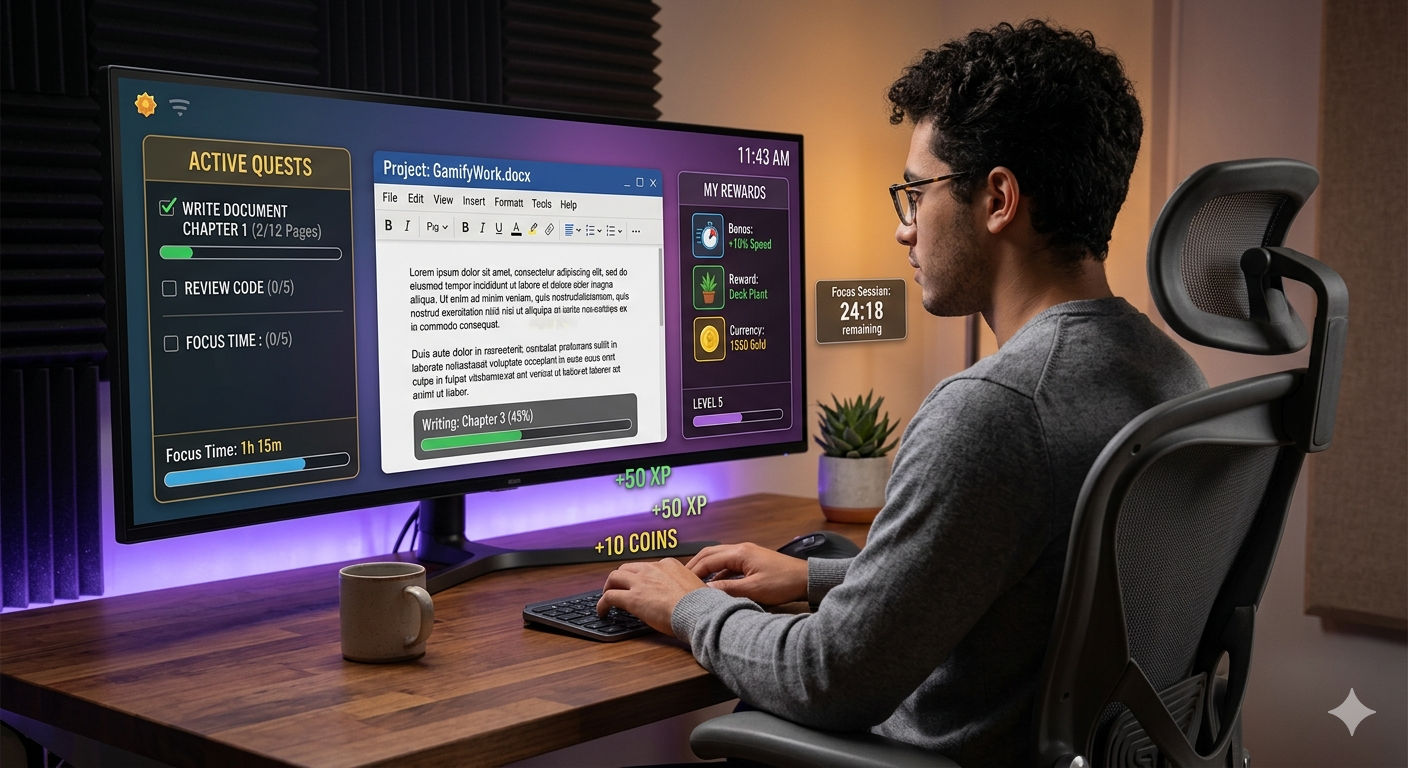
The modern world, however, has increasingly sought to exploit these motivational mechanisms. During the past two decades, organisations have embraced the concept of gamification, the application of game-like elements such as points, badges, rewards, progress bars, and leaderboards to activities that are not inherently games [5]. Educational platforms award achievement badges. Fitness applications create competitive rankings. Workplace software tracks employee performance using points and rewards. The underlying assumption is straightforward: if people enjoy games, perhaps work can be transformed into a game, thereby increasing engagement and productivity.
The appeal is obvious. Many empirical studies demonstrate that gamification can increase participation, engagement, and short-term motivation under certain conditions [5][6]. Leaderboards can increase time spent on tasks. Reward systems can encourage behavioural compliance. Competitive structures can create excitement around otherwise repetitive activities [6]. For employers and designers, gamification appears to offer a relatively inexpensive method for increasing productivity without fundamentally changing the work itself. However, designing effective systems that don't make employees feel patronising takes time and effort and is not effective in all cases, employees need to feel recognised.
Yet beneath this promise lies an important paradox. Play derives much of its value precisely because it is freely chosen. Once play becomes a tool for achieving external objectives, it risks losing the qualities that made it enjoyable in the first place.
Psychologists have investigated this problem for decades. Classic research on the 'over-justification effect' demonstrated that external rewards can sometimes reduce intrinsic interest in activities that individuals already enjoy [7]. When rewards become the primary focus, attention shifts away from the activity itself. Instead of drawing because drawing is enjoyable, children begin drawing for stickers. Instead of running because running feels rewarding, athletes may become preoccupied with rankings, times, sponsorships, and external validation.
The result is often a subtle transformation in motivation. Activities once associated with curiosity and enjoyment become associated with performance pressure and obligation.
I experienced this transformation personally. Athletics initially provided an endless source of enjoyment. The training was demanding, but improvement felt rewarding. Yet after more than a decade of competitive training and competition, something changed. Progress became increasingly difficult. Improvements were measured in fractions of seconds. Tiny gains required enormous effort. Instead of viewing marginal improvements as achievements, I increasingly viewed them as evidence of failure because they fell short of larger ambitions.
The activity that once felt liberating gradually became restrictive. Endless training sessions, relentless performance monitoring, and the constant pursuit of incremental gains began to erode the original pleasure of participation. By the age of 22, I retired from competitive athletics, disillusioned by a system that increasingly demanded sacrifice while offering diminishing emotional returns. I started to experience similar feelings and researching and writing about new topics when it became critical to my work.
This experience is far from unique. Athlete (and researcher) burnout has become a recognised phenomenon within sports psychology. Burnout is characterised by emotional and physical exhaustion, reduced accomplishment, and sport devaluation [8]. Research suggests that excessive training loads, external pressures, perfectionism, and narrow performance-focused identities all contribute to the development of burnout [8][9]. Ironically, systems designed to maximise performance may eventually undermine the very motivation required to sustain performance.
The same principle may apply to gamification more broadly. While gamified systems can initially increase engagement, prolonged exposure often leads to habituation. Novelty fades. Rewards become expected rather than exciting. Competition becomes stressful rather than motivating. The psychological machinery required to maintain engagement becomes increasingly complex, forcing those designing the games to continuously introduce new incentives, achievements, and challenges. In this sense, gamification resembles an arms race against human adaptation. What initially motivates eventually becomes normal. Sustaining engagement requires escalating interventions, creating an ever-expanding cycle of behavioural engineering. This raises an intriguing question. If maintaining motivation requires such extensive effort, is gamification truly an efficient solution?
The emergence of artificial intelligence introduces a radically different perspective. Historically, gamification has focused on increasing human productivity. The goal has been to motivate people to perform tasks more effectively. AI changes the equation because it increasingly performs the task itself. This distinction is crucial. Gamification attempts to optimise human effort. AI increasingly reduces the need for human effort altogether.
The challenge of gamification is therefore fundamentally psychological. Designers must continuously discover ways to sustain engagement, maintain motivation, and prevent boredom. This is a difficult and resource-intensive undertaking. Game developers spend enormous effort balancing challenge, reward schedules, progression systems, and social dynamics to maintain player interest. Organisations adopting gamification face similar challenges.
AI presents a contrasting strategy. Rather than motivating a human to perform repetitive cognitive work, AI systems increasingly automate the work itself, finding the most efficient means for delivery. Recent research suggests that AI is transforming not only productivity but also the psychological meaning of work, altering how individuals understand their professional identities and roles within organisations [10]. Tasks involving information processing, content generation, analysis, and decision support are becoming increasingly automated.
The central question therefore shifts. Instead of asking how humans can be motivated to work harder, we may increasingly ask which activities should remain human at all. This transition could be described as a movement from gamification to 'AI-ification.' Productivity gains would arise not from exploiting the human desire to play but from delegating tasks to intelligent systems. Many forms of routine cognitive labour may eventually become as automated as arithmetic became after the invention of electronic calculators.
Such a possibility creates understandable anxiety. For centuries, work has provided more than income. It has offered structure, purpose, social identity, and meaning. As AI assumes a larger share of productive activity, societies may need to reconsider the relationship between work and human fulfilment [10][11].
Yet there may also be an unexpected opportunity hidden within this transition. If AI reduces the necessity of certain forms of labour, humans may increasingly return to activities motivated by intrinsic rather than extrinsic rewards. Activities once pursued for productivity may once again be pursued for enjoyment. Sport, art, music, learning, exploration, conversation, and community participation may become valuable not because they maximise economic output but because they enrich human experience.
In many ways, I have already experienced a version of this transition. Decades after leaving competitive athletics, I returned to running in my sixties. The difference is profound. I no longer train for rankings, medals, or records. I run because I enjoy running. The activity has regained the qualities that first attracted me as a child. The pleasure lies not in optimisation but in participation. Similarly, I have found a renewed interest in writing. Now I write for me.
Perhaps this points toward a broader future. The long history of play suggests that humans are not naturally driven solely by productivity. We are creatures who explore, create, compete, cooperate, and learn because these activities are inherently satisfying. Gamification attempted to harness these instincts in service of productivity. AI may eventually make such efforts less necessary (I hope).
The ultimate irony may be that as machines become increasingly efficient, humans become increasingly free to rediscover inefficiency. We may learn that not everything valuable needs to be optimised. Not every activity requires measurable outcomes. Some experiences are worthwhile precisely because they serve no purpose beyond enjoyment itself.
The future contest may therefore not be between humans and AI, but between two competing visions of human value. One vision treats play as a mechanism for extracting greater productivity. The other (which I prefer) recognises play as an end in itself. As AI assumes more responsibility for productive labour, society may finally have the opportunity to rediscover a lesson that children instinctively understand: some of the most important things we do are worth doing simply because we enjoy them.
References

Get our latest news and publications
Sign up to our news letterResources
Social


Contact us
Address
Niche Science & Technology
Unit 26 Falstaff House
Bardolph Road
Richmond TW9 2LH
United Kingdom