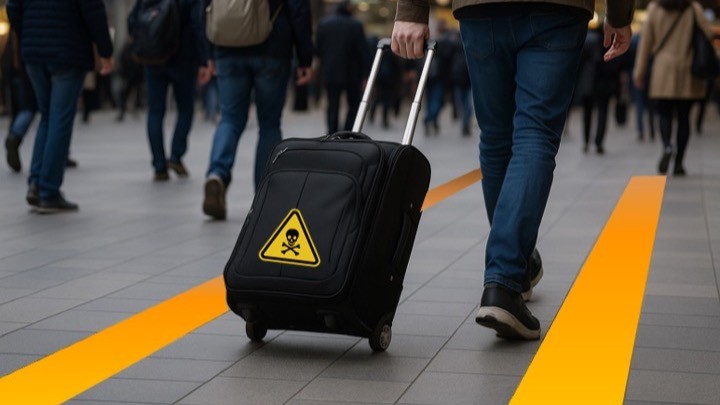
Modern travel is designed to be efficient, convenient, and accessible. Airports, train stations, and city sidewalks brim with people flowing to and from destinations with remarkable speed. And, in the midst of this ceaseless movement, one seemingly innocuous travel accessory has earned a solid reputation for causing frustration, irritation and harm: the 'wheely' suitcase. Once a marvel of ergonomic design and innovation, the ubiquitous wheely case has come to play a divisive role in public spaces. It is a source of practical convenience for its user, but frequently an irritant and hazard for their unsuspecting victims.
The wheeled suitcase was first patented in the 1970s [1], and despite a slow start, the Rollaboard suitcase eventually transformed air travel in particular [2]. Initially designed to ease the physical burden of carrying heavy luggage through sprawling airports, various iterations of the wheely case rapidly became de rigueur for all, from the Boarding Class Warrior to the mile-high narcissist, democratising a once high-end convenience. As the global appetite for travel exploded in the decades that followed, so too did the bag's popularity.
Today, wheeled luggage is no longer reserved for large, heavy bags. Tiny carry-ons, laptop cases, and even personal handbags now feature retractable handles and spinner wheels. While the intent is noble, reducing physical strain, the result has been a proliferation of awkward, inconsiderately managed luggage trailing behind otherwise distracted travellers.
The fundamental issue with wheeled suitcases lies not in their design, but in human nature. In the same way that guns don't kill people... wheely cases cannot be blamed in themselves for their anti-socialness. The act of dragging an object behind oneself creates a kind of personal blind spot. Users rarely acknowledge or even care how much space the case occupies or how its unpredictable path can disrupt the flow of foot traffic. A sudden stop, an abrupt directional shift, or a trailing bag left blocking a narrow passage will instantly cause frustration, and worse, accidents. The wheely case ‘dragoons’ drag their unacknowledged appendages sideways into ankles, over feet and through crowds without a flicker of awareness.
Studies in crowd dynamics show that congested public spaces function best when participants move predictably and attentively [3]. Research has quantified the disturbance caused by luggage-laden passengers, demonstrating that the abnormal motion of wheeled cases, such as ‘2ing,’ can trigger unavoidable local disturbances and turbulence in surrounding pedestrian flows, increasing congestion risk [4]. Wheeled suitcases disrupt the balance by extending a traveller's effective footprint without increasing their awareness. When multiple travellers with cases converge in confined areas, aircraft aisles, train doors, ticket queues, the incidence of collisions and bottlenecks rises significantly.
Compounding the issue is the general decline in spatial etiquette during stressful travel. Fatigue, time pressure, and digital distractions (like smartphones) reduce vigilance. As travellers navigate unfamiliar environments, their focus narrows to immediate personal goals, usually at the expense of communal consideration and good manners.
Travel environments are emotionally charged spaces. Delays, security checks, missed connections, and physical discomfort fray tempers. In such settings, minor irritations are magnified. A wheeled case clipping your heel or blocking your path may feel disproportionately aggravating because it compounds existing stress. Woe betide anyone pointing out that cases do not have the same rights as other commuters, the wheeled case is never wrong.
Psychologists have long understood that travel induces cognitive overload [5]. The constant need to process schedules, signage, security requirements, and social cues leaves an attenuated mental bandwidth for managing frustration diplomatically. As a result, interactions over minor issues like inconsiderate bag handling can escalate quickly. This explains why social media is littered with rants and memes about travellers and their obliviously wielded wheely cases. I have often tail-gated a Samsonite four-wheeler wishing I had a handy axe. It is not the object itself, but the timing and circumstances of the encounter that inflame emotions (including mine).
Wouldn't a light backpack do instead for a two-night stay? An often-overlooked issue with the wheeled suitcase is its role in enabling overpacking. The logic is simple: there is a hard outer shell which allows you to squeeze in the contents of a small Ikea wardrobe. Clearly, you will pack more 'just-in-case' if you do not have to physically carry the weight of your belongings. Unlike a shoulder bag or rucksack, which communicates the burden of its contents to the body, a rolling suitcase masks the physical effort of lugging more than you need.
It does not take a genius to understand that this has tangible environmental consequences. Heavier luggage means greater energy consumption during transport. The International Air Transport Association estimated that reducing average passenger luggage weight by even 1 kg could save tens of thousands of tons of CO₂ annually [6]. Every extra kilogram on board increases fuel burn and emissions, with analysis suggesting that additional cabin baggage can add more than 1.5 tonnes of weight to a single short-haul flight [7]. Moreover, excess luggage strains urban public transport systems, especially in tourist-heavy cities like London, Paris, and Tokyo. Crowded metros and buses become even more congested when travellers with oversized rolling cases occupy multiple standing spaces. Equally, the extendable handle encourages the traveller to strap a handbag or laptop case to their wheeled juggernaut. Someone please tell me when ‘one bag only’ stopped meaning only ONE bag. Small is beautiful, less is more!
One of the enduring mysteries of wheeled luggage culture is the number of perfectly healthy travellers who default to wheeled cases for light loads. A small bag, that could easily be carried, is instead dragged. This behaviour hints at deeper cultural and psychological factors. The prevalence of wheeled bags may be less about necessity and more about habit, status signalling, or perceived entitlement to convenience. In busy airports and train stations, the wheely case has become both a personal shield and a symbol of travel sophistication, irrespective of actual need. Imagine what will happen when the 'ride-on' wheely case becomes popular—and it will—pedestrians beware.
We seem to have adopted a culture of overaccommodation for rolling luggage, where infrastructure and social norms increasingly prioritise the convenience of bag owners over the collective comfort and safety of shared spaces.
Several years ago, I had the great pleasure of working with the absolutely fantastic Professor Helen Muir OBE, an acknowledged world leader in air passenger safety. She was an expert in human factors and hugely respected throughout the world of aviation [8]. She often expressed concerns about the wheely bag’s potential contribution to coming disasters, but in her renowned pragmatic nature realised that there was no putting the genie back in the bottle. Solving the frustrations of wheeled suitcase use is not about banning the bags, but about encouraging better etiquette and smarter infrastructure. Things might be better if travellers could just:
Little of this will be of any use unless airports and stations commit to designing wider walkways and designated luggage lanes, install (free and secure) luggage storage zones near seating and dining areas, and provide visual and audio reminders about considerate bag use. I am waiting to see the first airport that advises passengers to keep their bags under control. A charge for wheeled-case use might lower airport and onboarding (and offboarding) angst for everyone.
At its heart, the wheeled suitcase dilemma is a case study in the unintended consequences of our convenience culture. What began as an ergonomic innovation now contributes to overpacking, crowding, social friction, and environmental strain. By promoting mindful travel habits, packing only what is necessary, remaining spatially aware, and prioritising communal comfort over personal ease, we can restore balance in busy public spaces. It requires only a small shift in behaviour from individual travellers but would dramatically improve the collective travel experience. There is also the benefit of reduced risk of injury. Your spine is designed to support your body during everyday movements, but adding the weight of a large suitcase, especially while twisting or reaching overhead, is a regular cause of acute back injuries [10]. The American Academy of Orthopaedic Surgeons notes that more than 85,000 people were treated in emergency rooms for luggage-related injuries in 2017 alone, with improper handling of heavy luggage causing neck, back, and shoulder strain [11].
The frustrations surrounding wheeled luggage are certainly not petty complaints, but meaningful indicators of how individual behaviours intersect with public environments. In an era where travel is both a privilege and a necessity, we owe it to ourselves and each other to be better stewards of shared spaces.
As transport hubs evolve, perhaps integrating AI-assisted crowd management and smarter luggage solutions, the hope is that the wheeled case will regain its place as a tool of convenience rather than a source of contention. Until then, a little awareness and empathy would go a long way in smoothing the journey for all. Oh, and one last point, if you are loading your wheelie case (containing that core of a neutron star you could not possibly live without) into an overhead locker, please put it in wheels first. The delays caused by diminutive passengers struggling to find a handhold on their poorly stored luggage must cost us all millions of hours in frustrated queuing as we desperately wait to exit the aircraft.
References

Get our latest news and publications
Sign up to our news letterResources
Social


Contact us
Address
Niche Science & Technology
Unit 26 Falstaff House
Bardolph Road
Richmond TW9 2LH
United Kingdom