I was watching an interview with Sam Altman, co-founder of OpenAI, talking rather smugly about how the company had scraped the internet for every last bit of data (for free) and now wanted to sell it back to us labelled as ‘intelligence’ as a service – just like water companies do with water (something I also don’t think should be commoditised). It got me thinking…
We have spent two centuries building cathedrals of progress. Industrial agriculture, global supply chains, digital connectivity, and modern medicine have lifted billions from poverty and extended human lives beyond what any previous generation could have imagined. Yet the very systems that delivered this progress, scientific, industrial, economic, and political, were never designed for the world they have created. Today, humanity is moving toward a critical nexus point, where the stability of the geopolitical and socioeconomic order is visibly fracturing under converging stresses.
Consider the evidence accumulating around us. Plastic waste is now found in deep ocean trenches, Arctic ice, and human placentas. Climate change, driven by fossil fuel dependence, is intensifying storms, fires, and heatwaves simultaneously across hemispheres [1]. Natural resources, from phosphorus for fertiliser to lithium for batteries, are being depleted faster than geological timescales can replenish them. Biodiversity is collapsing at rates that threaten the pollination, pest control, and soil fertility upon which our food systems depend [2]. Extreme concentration of wealth has reached levels not seen since the Gilded Age, and this concentration increasingly shapes which scientific questions receive funding, which evidence reaches policy desks, and which narratives dominate public discourse [3]. Misinformation, amplified by algorithmically optimised platforms, reinforces these inequalities by fragmenting the shared factual basis for democratic deliberation. Energy demand continues to rise even as fossil fuel extraction becomes more expensive and environmentally destructive. Food insecurity now coexists absurdly with systematic overproduction and waste, while freshwater scarcity affects more than two billion people.
These are not isolated problems. They are interconnected stressors acting upon a single, finite global system. And here is the paradox that should keep every policymaker awake: science already offers viable pathways to address every single one of these challenges. From circular economy models to agroecological redesign, from renewable energy storage to desalination powered by solar, the technical solutions exist. Clearly, science should not dictate policy or personal choice unilaterally, values must always guide decisions. But science remains the most reliable framework for understanding the consequences and trade-offs of those decisions [4][5]. The failure, therefore, is not one of scientific capability. It is the catastrophic bottleneck of how scientific knowledge is communicated, interpreted, and acted upon.
Adaptive Resilience Depletion: A More Sophisticated Warning
To understand why this bottleneck has become so dangerous, we need a more sophisticated framework than the familiar ‘boiling frog’ analogy. That old parable, that a frog placed in slowly heated water will fail to perceive the danger until it is too late, focuses on a failure of perception. Our situation is different and, in some ways, more insidious. Modern societies do not fail to perceive change. They adapt continuously to stressors, and this adaptation creates an illusion of resilience and normality. Yet each successful adaptation consumes underlying reserves of systemic buffering capacity, a process we might call adaptive resilience depletion.
The theoretical lenses that describe this process are well established across multiple disciplines. Resilience theory shows that systems can maintain their core functions while progressively losing adaptive capacity, a distinction often invisible to casual observation [6]. The adaptive cycle model, growth, conservation, rigidity, collapse, renewal, reminds us that prolonged conservation phases inevitably lead to rigidity, where the very efficiencies that delivered stability become sources of brittleness [7]. The Jevons paradox, observed in energy economics, demonstrates that efficiency gains often increase rather than decrease total consumption, as savings are reinvested in expanded activity [8]. From physiology, the concept of allostatic load describes how sustained adaptation to stress exacts a cumulative cost that eventually manifests as system failure [9]. And the "shifting the burden" archetype from systems thinking reveals how short-term fixes, building another dam, subsidising more corn, mining deeper, undermine the long-term resilience that only fundamental restructuring can provide.
Consider the analogies close at hand. A healthcare system that keeps patients alive through repeated emergency interventions while never addressing underlying diet, housing, or social isolation is not resilient; it is accumulating allostatic load. A financial system that responds to every crisis with liquidity injections while never restructuring debt or inequality is not stable; it is transferring risk into hidden corners. A coastal city that builds higher seawalls while allowing continued groundwater extraction and wetland destruction is not adapting; it is depleting its buffering capacity against the next, larger storm. In each case, successful adaptation masks accumulating fragility.
The Communication Bottleneck
This is precisely where science communication becomes the critical limiting factor in societal survival. We have two dominant paradigms, and neither, in its current form, is adequate [10].
The first is the dissemination model: top-down, focused on informing, correcting information deficits, and persuading audiences to accept scientific conclusions. This model assumes that if people simply understood the facts, they would act rationally. But in a world of politicised science, where trust in scientists has become polarised along party lines in many nations, dissemination alone fails [11]. During COVID-19, massive social media campaigns aimed at increasing vaccination shifted opinions by only about 1% on average [12]. Climate change messages that work for non-sceptics often backfire or simply slide off those with lower trust [13]. The dissemination model also struggles with scientific uncertainty, which can be exploited to undermine consensus [14]. Moreover, it often positions science as value-neutral, a position that becomes untenable when evidence inevitably collides with competing societal values [15].
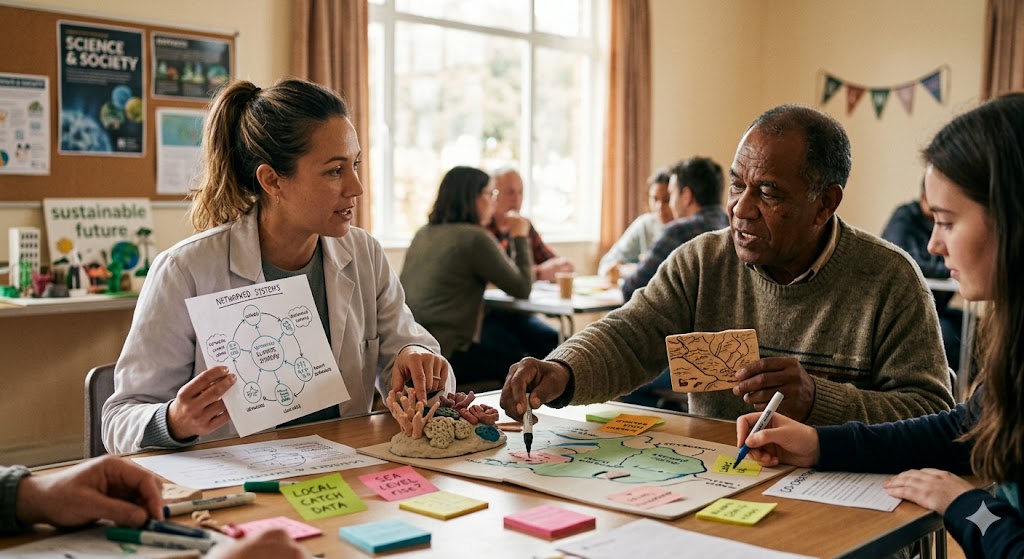
The second is the participatory model: dialogic, bottom-up, focused on mutual understanding and engagement rather than persuasion. This model better addresses value conflicts, distrust in institutions, and the inconvenient truth that science is never value-neutral, what gets studied, which populations are included, and how findings are framed all embed ethical choices. Participatory approaches build trust through transparency and intellectual humility, creating relationships that can survive the communication of uncertainty or negative findings [16]. However, they are resource-intensive, often reach only those already motivated to engage, and risk becoming transactional rather than truly transformative [17]. Furthermore, participatory methods struggle to incorporate the disengaged, those who have been alienated from science or never invited into the conversation.
The failure of the dissemination model is not that it has no value; it is that it cannot solve problems born of politicisation, mistrust, and value pluralism. The limitation of the participatory model is not that it is wrong; it is that it remains under-resourced, under-studied, and unevenly applied—often for political reasons.
Co-creation and Shared Ownership: A New Agenda
What we urgently need is not a choice between these paradigms but a synthesis that moves beyond both: a new agenda for science communication built on co-creation and co-production of knowledge [10]. This means shifting from transactional communication, scientists producing knowledge, then communicating it to a passive public, toward shared ownership of understanding. It means building infrastructure that supports ongoing dialogue rather than reactive crisis messaging: dedicated funders, consensus best practices, sustained cross-disciplinary collaborations that exist before the next pandemic or climate tipping point arrives.
This agenda must deliberately engage the less motivated and the disengaged, those who have been historically underserved or actively mistreated by scientific institutions. It requires investing in education systems that foster critical thinking, epistemic humility, and scientific literacy early in life, not as a transfer of facts but as a practice of questioning, evaluating evidence, and understanding uncertainty. Without such investment, entire populations remain vulnerable to entrenched belief systems driven not by genuine scepticism but by manufactured misinformation, and with them, entire democracies become vulnerable to decisions based on fantasy rather than reality. We have seen this with catastrophic clarity: the Brexit referendum, fought on claims that have since dissolved into legal and economic chaos; the election of leaders who dismiss established evidence on climate, vaccines, and economics, with consequences measured in preventable deaths and avoidable crises.
A co-production agenda also requires that scientists and science communicators abandon the comforting fiction of value-neutrality. As the President of the US National Academy of Sciences, Engineering, and Medicine recently noted, science can affirm that climate change is happening and caused by human activity, but it cannot decide for society how to balance economic, environmental, and equity goals [15]. Those are value choices. Science communication must therefore create spaces where values can be articulated, debated, and reconciled with evidence, not hidden behind a false wall of objectivity.
Who Controls the Narrative?
This brings us to the deepest question: who controls the narrative? The future trajectory of society depends increasingly on the answer. We are witnessing an emerging tension between the many and the few. Concentrated wealth does not merely buy political influence; it buys the information ecosystems that shape what billions believe to be true [3]. Algorithmic amplification, targeted disinformation, and the erosion of local journalism all serve to reinforce inequality of voice and of epistemic access. The proprietary nature of social media data means that large segments of the research infrastructure sit outside the control of the scientific community, accessible only to select scholars who partner with corporations [10].
In this environment, science communication cannot afford to remain naive about power. If it remains within the dissemination paradigm, it risks becoming just another channel for elite persuasion, telling people what to think, but now dressed in the language of evidence. A truly transformed science communication agenda, however, can function as a democratising force. It does not tell people what to think. It equips them with the tools to think critically, together, about the trade-offs that science illuminates. It shifts from correcting deficits to building collective capacity. It recognises that broad and equitable access to science should be a normative priority, not an afterthought [10].
A Forward-Looking Caution
The solutions to our converging global crises already exist within scientific knowledge. The risk is not that we do not know what to do. The risk is that we fail to communicate, interpret, and act on that knowledge effectively. Without a transformation in how science engages with society, how it listens, how it builds trust, how it shares not just findings but the very process of inquiry, we will continue to ‘adapt’ ourselves into fragility. We will mistake short-term stability for long-term security, allostatic load for health, rigidity for resilience. And we will make, again-and-again, very bad decisions based on poor quality data and fragmented narratives.
The future will not be determined by what we know. It will be determined by how well we collectively understand and use what is clear to see. That is no longer a matter of scientific curiosity. It is becoming a matter of survival.
References
- IPCC. (2023). Climate Change 2023: Synthesis Report. Contribution of Working Groups I, II and III to the Sixth Assessment Report of the Intergovernmental Panel on Climate Change.
- IPBES. (2019). Global Assessment Report on Biodiversity and Ecosystem Services. Bonn: Intergovernmental Science-Policy Platform on Biodiversity and Ecosystem Services.
- Oreskes, N, Conway, EM. (2010). Merchants of Doubt: How a Handful of Scientists Obscured the Truth on Issues from Tobacco Smoke to Global Warming. Bloomsbury Press.
- Funtowicz, SQ, Ravetz, JR. (1993). Science for the post-normal age. Futures, 25(7), 739–755.
- Scheufele, DA. (2013). Communicating science in social settings. Proceedings of the National Academy of Sciences, 110(Supplement 3), 14040–14047.
- Holling, CS. (1973). Resilience and stability of ecological systems. Annual Review of Ecology and Systematics, 4, 1–23.
- Gunderson, LH, Holling, CS. (Eds.). (2002). Panarchy: Understanding Transformations in Human and Natural Systems. Island Press.
- Jevons, WS. (1865). The Coal Question: An Inquiry Concerning the Progress of the Nation, and the Probable Exhaustion of Our Coal-mines. Macmillan and Co.
- McEwen, BS, Stellar, E. (1993). Stress and the individual: Mechanisms leading to disease. Archives of Internal Medicine, 153(18), 2093–2101.
- Druckman, JN., et al. (2025). An agenda for science communication research and practice. Proceedings of the National Academy of Sciences, 122(27), e2400932122.
- Cologna, V, et al. (2025). Trust in scientists and their role in society across 68 countries. Nature Human Behaviour, 9, 713–730.
- Athey, S, et al. (2023). Digital public health interventions at scale: The impact of social media advertising on beliefs and outcomes related to COVID vaccines. Proceedings of the National Academy of Sciences, 120(22), e2208110120.
- Vlasceanu, M, et al. (2024). Addressing climate change with behavioral science: A global intervention to humanize science. Science Advances, 10(25), eadj5778.
- Bolsen, T, Druckman, JN. (2018). Do partisanship and politicization undermine the impact of a scientific consensus message about climate change? Group Processes & Intergroup Relations, 21(3), 389–402.
- McNutt, M. (2024). Science is neither red nor blue. Science, 386(6722), 707.
- Petersen, MB, et al. (2021). Transparent communication about negative features of COVID-19 vaccines decreases acceptance but increases trust. Proceedings of the National Academy of Sciences, 118(29), e2024597118.
- Lewenstein, B. V. (2022). Is citizen science a remedy for inequality? The Annals of the American Academy of Political and Social Science, 700(1), 183–194.